Autumn Plein Air Painting: How to Capture Foliage and Changing Light in the UK
A practical UK guide to autumn plein air painting: palette and oil techniques for cold damp conditions, handling short light, permissions, safety and top regions to paint from September to November.

Key takeaways
- • Autumn in the UK runs in three phases: September is early and mild, October is peak colour for many areas, and November is low light with muted tones.
- • Autumn light is low and directional; the strongest effect is warm foliage against cool sky. Choose one lighting condition and commit to it.
- • Use a limited warm-cool palette and neutralise mixes. Reserve high saturation for a single focal point to avoid a garish result.
- • Work fast in stages: thumbnail value sketch, warm toned ground, block in large masses, establish temperature across the whole painting, then refine two or three focal areas.
- • Prepare for cold and damp: prefer panels, use alkyd or water-mixable oils, bring warm gear, plan around short daylight hours, and get permissions when required.
There is a particular quality to UK autumn light that stops you mid-stride: warm orange beeches burning against a blue-violet sky, or raking sunlight catching the edge of a hedgerow whilst everything behind it sinks into cool shadow. Autumn plein air painting offers some of the most extraordinary colour contrasts of the year. It also comes with short sessions, cold hands, slow-drying paint, and light that shifts faster than you expect. This guide gives you the practical tools to handle all of it: palette choices, oil painting techniques, managing cool damp conditions, access and permissions, and where to go across the UK from September through November.
What Makes UK Autumn Different for Plein Air Painters
Painting outdoors in autumn is genuinely different from summer work, and not just because you'll need an extra layer. The light angle, the colour relationships, the drying behaviour of your paint, and the length of your working window all change significantly. Understanding the season properly helps you make better decisions before you even pick up a brush.
A season in three phases
UK autumn isn't a single event. It's a progression that behaves quite differently across its three months, and across different parts of the country.
September still feels relatively forgiving. Greens are beginning to shift, with the first yellows appearing in birch and ash. Light is warm and lower than summer but sessions are still comfortable. You'll often get a couple of hours of usable morning or afternoon light without rushing.
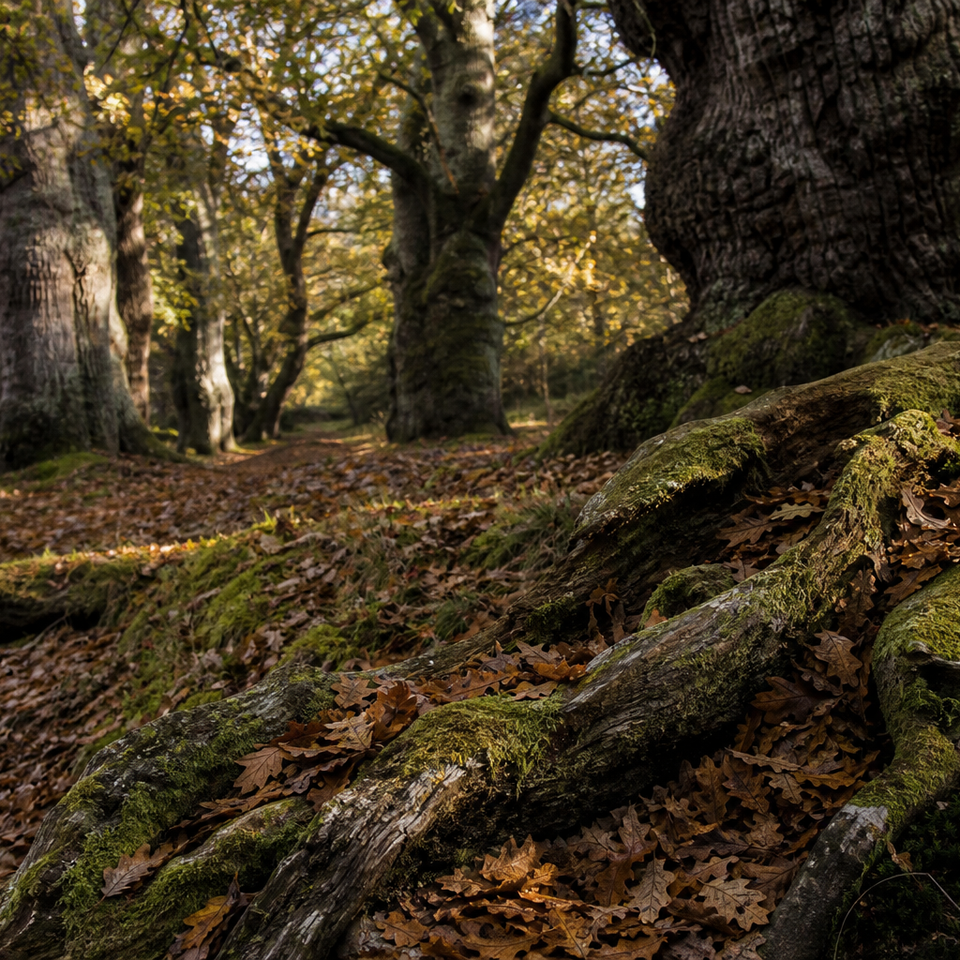
October is peak colour for most of broadleaf England and Wales: beech, oak, and sweet chestnut at full orange and russet. Days are noticeably shorter, and the warm-cool contrast between lit foliage and grey or blue sky becomes dramatic. This is the month most painters are thinking of when they picture autumn work, and it rewards early planning.
November shifts the mood entirely. Much of the canopy is bare or going. Colour becomes muted: dark russets, pale greys, cold browns, the last stubborn ochre on an oak. Low light and long shadows dominate. It's harder work, but the stripped-back compositions and subtle, complex colour offer something summer and October never can.
Regional timing matters too. Scotland and the northern uplands often reach peak colour a full two to three weeks ahead of southern England. Perthshire birch and Cairngorms larch can be extraordinary in late September when London parks are barely turning. Coastal areas sometimes hold colour longer than inland woodland, partly due to milder temperatures and different species mixes. If you're planning a dedicated autumn trip, look up typical peak dates for your specific region rather than assuming a single national timeline.
The light you'll actually get
Low sun angles are the defining feature of autumn light in the UK. From October onwards, even midday sun sits relatively low, creating raking light across fields and along woodland edges that throws texture and shadow into sharp relief. Morning and late afternoon are especially dramatic, with long cast shadows and strong directional warmth.
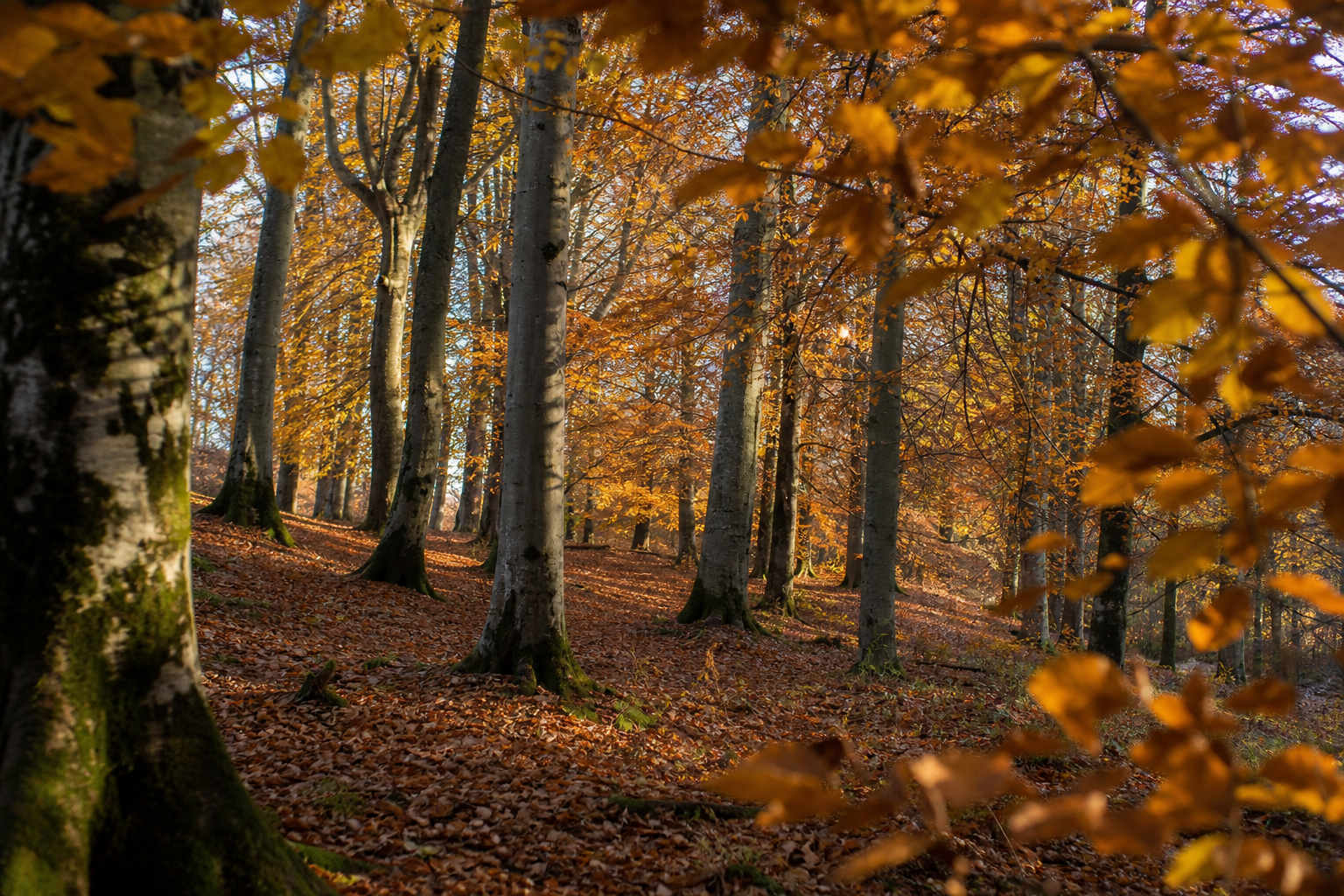
The most distinctive colour relationship in UK autumn is warm foliage against cool sky. A lit beech canopy in orange-gold sitting against a grey-blue or blue-violet sky is a genuine complementary contrast, and it's visually powerful. The temptation is to lean into that and paint everything as saturated as possible. Resist it. That contrast reads best when most of the scene is neutralised and the warm colour is reserved for the key focal area.
Overcast days are underrated. Flat cloud creates soft, even light with no harsh shadows, and the colour in the scene becomes subtler and more complex: muted greens and ochres, cool greys, gentle warm-neutrals in the distance. These are excellent conditions for quiet, careful colour studies, and the light doesn't change on you mid-session the way raking sunlight can.
Make the most of short days
In October and November, golden light arrives earlier and disappears faster than you expect. Aim to be set up and ready to paint before 9am, or plan a late afternoon session finishing no later than 3pm. Midday on overcast days is genuinely useful for subtle colour studies and misty woodland.
Choosing Your Palette for Autumn Landscape Painting
You don't need a separate autumn palette. What you need is a thoughtful adjustment to your usual setup, leaning into warm earth tones whilst keeping your cooler colours close for sky, shadow, and distance.
A limited warm-cool palette that works
A practical starting point for autumn landscape painting in oils might look like this:
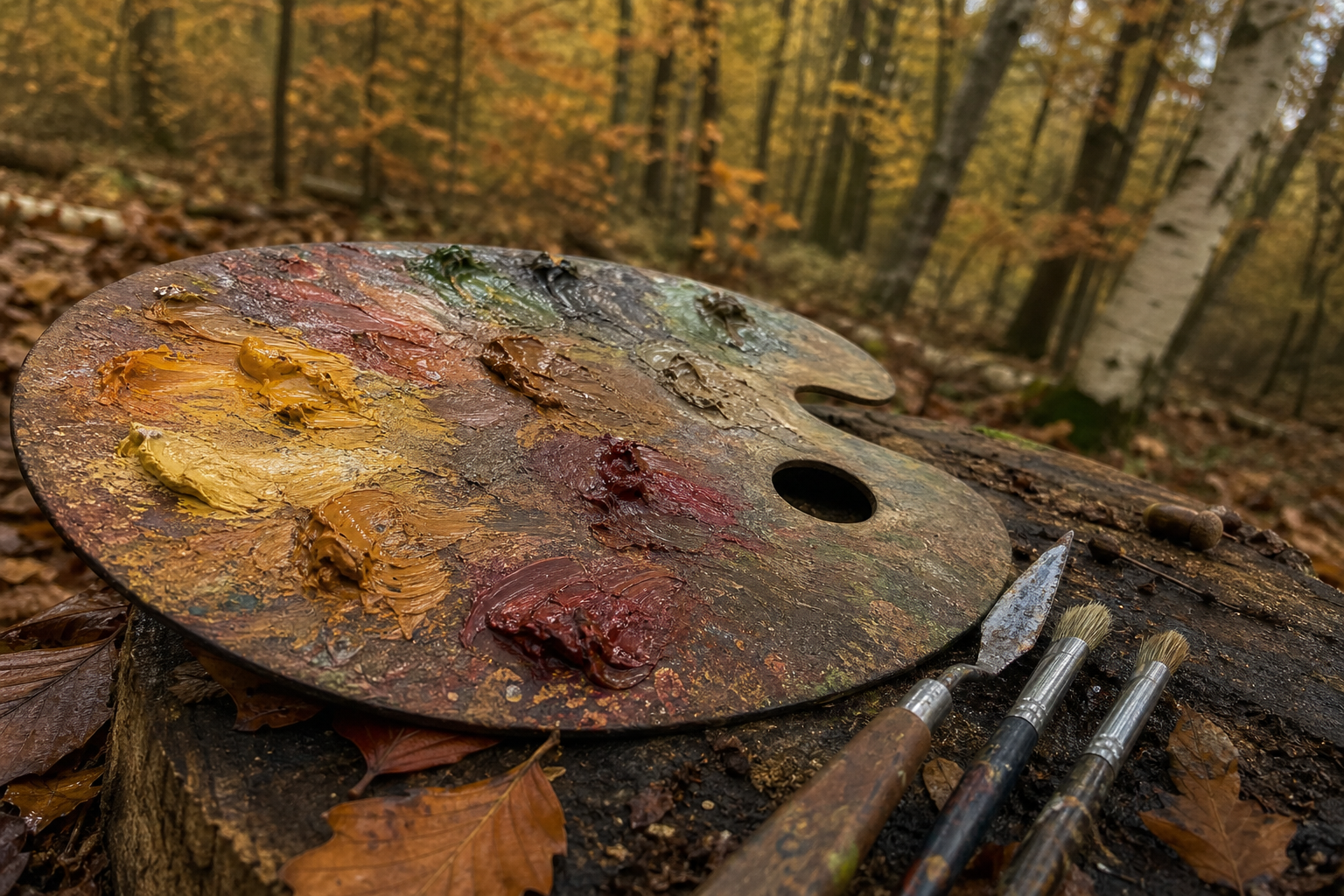
Warm tones: yellow ochre, cadmium yellow (or a cadmium-free alternative such as Winsor yellow), transparent orange or cadmium orange, burnt sienna.
Reds: alizarin crimson or permanent crimson for deep foliage, shadow, and mixing rich darks.
Blues: ultramarine for skies, shadows, and neutralising greens; cobalt or phthalo blue if you want a cleaner, cooler sky tone.
White: titanium white.
This is a starting point, not a rule. Many experienced painters work with even less. The point is to have enough range to mix warm foliage, cool shadow, neutral distance, and muted mid-tones without reaching for a colour that will oversaturate the painting.
| Target tone | Mix | Notes |
|---|---|---|
| Muted golden foliage | Yellow ochre + cadmium yellow + touch of ultramarine | Knock back the green; don't let it go summery |
| Deep orange-brown | Burnt sienna + cadmium orange | Useful for beech and oak at peak |
| Neutral grey-green | Viridian or sap green + burnt sienna + white | Late season grass and hedgerows |
| Cool violet shadow | Ultramarine + permanent crimson + white | Shadows under trees and along woodland paths |
| Muted russet | Burnt sienna + alizarin crimson + ochre | Late October hedgerows and bracken |
The one rule that matters: don't chase saturation
This is the single most important point in autumn colour work. The most common mistake beginners make is painting everything at full intensity: blazing orange trees, vivid red undergrowth, brilliant yellow grass. The result looks garish rather than believable, because the eye reads the scene as a collection of saturated colours rather than a coherent, atmospheric whole.
The fix is to neutralise most of the painting using complements. A touch of ultramarine into an orange foliage mix knocks it back towards a believable mid-tone. A small amount of burnt sienna into a green pulls it away from summery brightness towards the duller, darker greens of autumn. These mixed, greyed tones become the majority of the painting.
Then, and only then, you reserve your most saturated, warm colour for a single focal point: one lit tree crown, one bright section of hedge, one patch of bracken catching raking light. That concentration of intensity is what makes the eye travel and the painting sing. Spread it everywhere and it loses all its force.
Cool blue-violet mixtures in distant tree masses push them convincingly back in space and add the sense of aerial perspective that makes a landscape feel deep rather than flat.
Oil Painting Techniques for Changing Autumn Light
Autumn light in the UK can change dramatically in a single session, especially in October when cloud moves quickly across the sky. The practical response isn't to chase every shift in conditions. It's to make a decision before you start and paint that, regardless of what happens after.
Decide on your light and lock it in
Before you put paint on the surface, decide what you're painting. Is it morning sidelight with long shadows? Soft overcast with muted colour? Late afternoon raking sun? Choose one and commit. When the cloud moves across, or the sun dips, or the shadows shift, keep painting the scene you decided on. This takes discipline early on but it produces far more coherent paintings than trying to update the scene every twenty minutes.
A quick thumbnail sketch before you start is genuinely worth the five minutes it takes. A small pencil or charcoal value study (three tones: light, mid, dark) helps you fix the essential structure in your mind before colour decisions cloud it.
Block in fast, refine selectively
Toning the surface first makes everything easier. A diluted wash of burnt sienna thinned almost to transparency, applied with a large brush and left to settle for a few minutes, gives you a warm mid-tone ground to judge against and unifies the palette from the start. Judging colour against white ground in autumn is particularly difficult because white makes every mixed tone look darker and duller than it is.
Then work quickly through the first twenty to thirty minutes establishing large value masses: sky, ground plane, main tree masses, primary shadow shapes. Thin paint, soft edges, no detail. The goal is to get the value structure across the whole surface before you start developing colour or form.
Autumn painting process
Thumbnail and tone
Quick value sketch to lock composition. Apply a diluted warm ground and let it settle while you plan.
Block in large masses
Sky, ground, tree masses, shadow shapes. Thin paint, soft edges. Get the value structure right before colour.
Build colour temperature
Work across the whole surface establishing warm-cool relationships. Don't detail any one area yet.
Select and sharpen
Choose two or three focal points to bring forward. Leave the rest loose. Stop earlier than feels comfortable.
Once value relationships are established, develop colour temperature across the whole surface: warm the lit areas, cool the shadows, push the distances back with blue-violet neutrals. Only then, in the last twenty minutes or so, should you start sharpening edges and adding any suggestion of specific form. Choose two or three areas at most: a lit trunk against dark shadow, the silhouette of a branch against sky, the edge of a path. Leave everything else soft and suggested.
Stopping earlier than feels comfortable is one of the most useful habits in plein air work. Overworked passages are harder to recover outdoors than in the studio.
Simplifying foliage
Never try to paint individual leaves across a whole tree. Group foliage into large soft-edged masses, varying the colour temperature within each mass (slightly warmer in the light, cooler and darker underneath) but keeping the edges soft and the form simple.
Then, selectively, at the edge of a mass where it reads against sky or open shadow, indicate a few individual leaf shapes or fine twig lines. These small, specific marks carry the impression of detail without filling the canvas with competing information. The eye fills in the rest.
Managing the Conditions: Cold, Damp, and Short Days
What cool, damp air does to oil paint
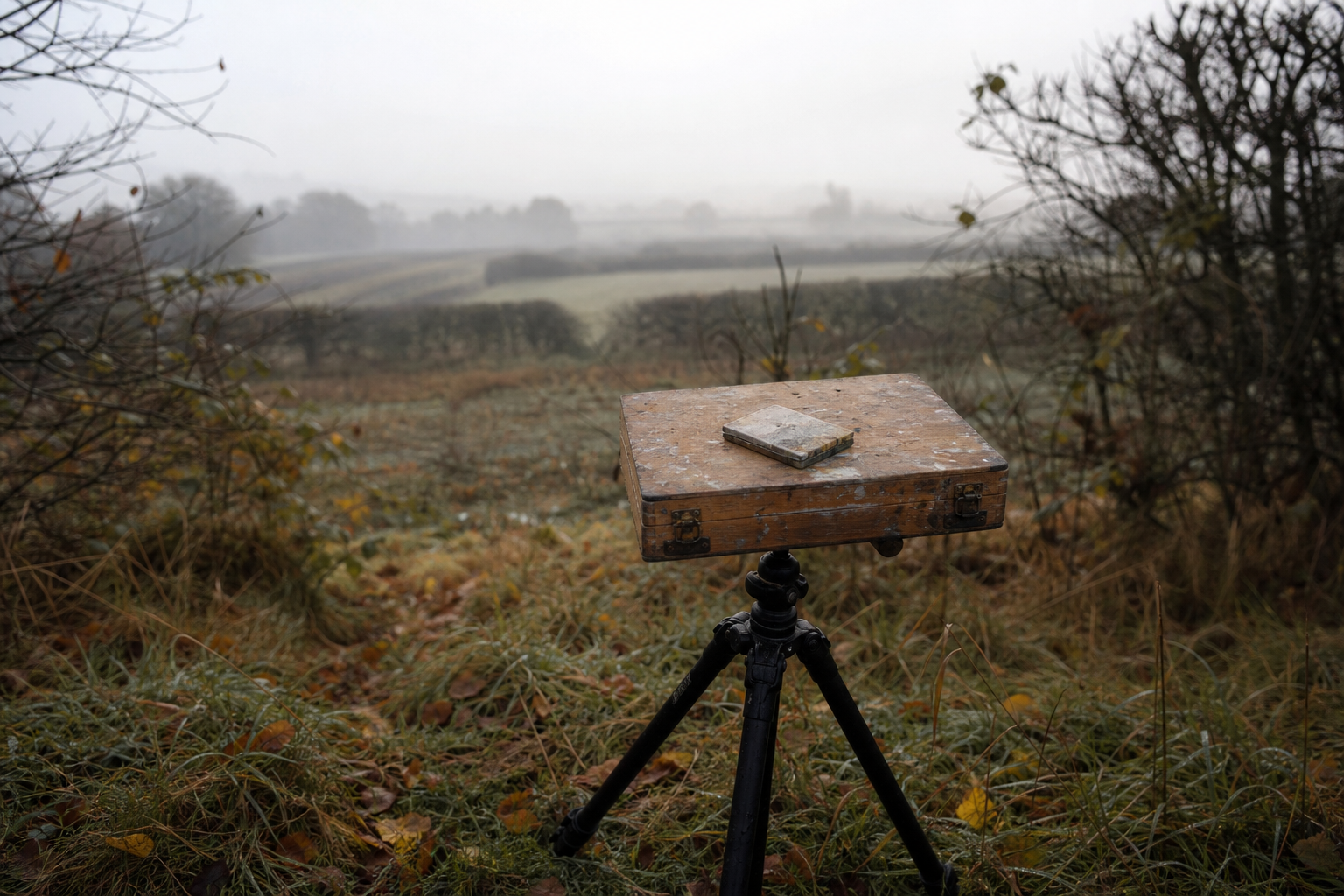
This is a practical reality that most general painting guides skip over. Oil paint dries significantly slower in cool, humid conditions. A painting done on a damp October afternoon may still be tacky several days later, which matters when you're transporting work and stacking panels.
The most practical solution is to use an alkyd medium. Products like Liquin (Winsor & Newton) or Gamblin Galkyd accelerate drying significantly, often allowing a painting to be touch-dry overnight even in autumn conditions. Both are widely available from UK suppliers including Jackson's Art and Ken Bromley. Use them sparingly in the early lean stages and be aware that they do affect handling slightly, making paint flow a little more freely.
Keep paint lean in the early blocking-in stages outdoors, avoiding oil-rich mediums that will slow drying further in cool air.
Panels are generally preferable to canvas for autumn outdoor work. They're stiffer in wind, easier to carry in a wet-panel carrier without risk of smearing, and less susceptible to surface condensation in damp air. A simple wooden or aluminium wet-panel carrier is a modest investment that solves a genuine autumn problem.
If you're painting on public land or in busy parks, water-mixable oils are worth considering. Winsor & Newton Artisan and Royal Talens Cobra are the main UK-available ranges. Handling characteristics differ slightly from conventional oils (they're a little stiffer out of the tube and dry a touch faster), but they remove the need for solvent entirely, which matters when other people are nearby.
Staying warm enough to paint
Cold hands are the most common complaint in autumn plein air sessions, and they affect more than comfort. When your fingers are numb, your brushwork suffers and your colour judgement deteriorates. It's worth taking this seriously.
Fingerless gloves or fold-back mittens (which open to expose the fingertips when needed) give enough warmth between marks without sacrificing dexterity. A hand-warmer in your coat pocket costs almost nothing and makes a real difference during pauses. Layer your clothing properly: a thermal base layer, a fleece or insulating mid-layer, and a windproof and waterproof outer shell. Standing still in a field in October is significantly colder than walking through one.
Cold hands and decision-making
When your hands are really cold, your brushwork suffers and your colour judgement goes with it. If you're shivering, stop. Warm up before you continue. A ten-minute break is better than twenty minutes of decisions you'll regret.
Access, Permissions, and Leaving No Trace
This is an area most plein air guides ignore, but it's one that matters practically and for the reputation of outdoor painters generally.
Urban parks and public commons (including places like Hampstead Heath, Victoria Park, and most municipal parks) are generally fine for a compact easel setup as part of a normal visit. Keep your footprint small, don't block paths, gates, or sight lines, and pack up tidily. In practice, a single painter with a pochade box attracts little attention.
National Trust and similar managed estates are generally welcoming to individual painters visiting as normal members or paying guests. In practice, most sites raise no objection to a small easel. However, some busier or more ecologically sensitive properties do have restrictions on tripods, large setups, or organised group activity. If you're bringing a group, or setting up anything larger than a compact pochade box, it's worth contacting the property in advance. Policies vary between sites and the Trust is generally helpful when asked directly.
SSSIs (Sites of Special Scientific Interest), nature reserves, and sensitive habitats require extra care. Work from hard surfaces, paths, or established viewpoints where possible. Never cut, trample, or move vegetation to improve a view. Access conditions on these sites vary and may require permissions for anything beyond a standard public footpath visit.
Leave no trace is not optional. Take all paint scraps, solvent, and waste materials home with you. Never pour solvent or rinse water containing paint residue onto soil or into waterways. This matters legally and practically, but it also matters for how outdoor painters are perceived by landowners, park managers, and conservation bodies. One careless session can affect access for everyone.
If you're running organised workshops or events on private or managed land, formal permission is likely required. Check before you book, not after.
Safety and Planning as Days Shorten
By late October, usable painting light can be gone by half past three in the afternoon. This catches people out more often than you'd expect, particularly when you're absorbed in a session and not watching the clock.
Plan sessions around the light, not against it. Aim to be set up and painting by nine in the morning for a morning session, or start your afternoon session no later than one o'clock if you want two hours of decent light. Have a clear end time in mind before you begin.
If you're working alone in quiet countryside, tell someone your location and expected return time. This is simple and takes thirty seconds. Carry a charged phone, and consider downloading an OS map offline before you leave (apps like OS Maps work without mobile signal once downloaded). A small headtorch is worth carrying from October onwards; it's easy to misjudge how quickly dusk closes in when you're focused on a painting.
Have a backup option in mind if conditions deteriorate quickly: a sheltered corner, a viewpoint from the car, or simply the decision to pack up and call it a productive half-session. Knowing your exit plan reduces the pressure to push on in deteriorating conditions.
Where to Paint in the UK This Autumn
This is a broad overview rather than a detailed location guide, but it should give you a sense of the range available.
Broadleaf woodland in southern England and the Welsh borders offers some of the richest autumn colour in the UK: oak, beech, and sweet chestnut at peak in mid to late October. The New Forest, the Chilterns, and the Forest of Dean all provide accessible woodland with dramatic canopy colour and a mix of open rides and enclosed paths to work from.
The Yorkshire Dales and North York Moors turn from late September onwards, with bracken going rust and gold across open moorland and dry-stone walls and field barns providing strong linear structure to work against. The combination of warm bracken tones against cool limestone and grey sky is particularly distinctive.
Scottish Highlands and Perthshire are worth a trip for early autumn: birch and larch colour can peak in late September, sometimes earlier in a dry year, and the low-angle light and cloud-wrapped hills produce conditions you won't find further south. Perthshire in particular has a well-established reputation for autumn colour that attracts painters and photographers from across the UK.
Urban parks in London, Edinburgh, Manchester, and other major cities offer genuine autumn colour with the added convenience of nearby cafes, shelter options, and straightforward access without long drives. They're underrated as painting locations and particularly useful for a shorter session or when you can't get far afield.
For location knowledge specific to your area, local plein air groups are genuinely invaluable. Many run organised autumn painting days and can point you towards spots that don't appear in any guide. Seasonal workshops and events run through October and into November in most UK cities; searching current listings rather than relying on fixed dates is the most reliable way to find what's running near you.
Autumn is a genuinely rewarding time to be outside with a paintbox in the UK. The light is extraordinary when it arrives, the colour relationships are unlike any other season, and the shorter, more focused sessions have a discipline to them that can sharpen your decision-making in ways that long summer afternoons sometimes don't. Go prepared, make your decisions early, and don't try to paint every leaf.
FAQ
Frequently Asked Questions
When is peak autumn colour in the UK for plein air painting?
It varies by region. September can be peak in Scotland and northern uplands, October is usually best for much of England and Wales, and November shows the last muted tones. Check local peak dates before planning a trip.
What palette should I use for autumn plein air painting?
Use a limited warm-cool palette: yellow ochre, a warm yellow, transparent orange or cadmium orange, burnt sienna, a crimson, ultramarine plus a cooler blue, and titanium white. Neutralise mixes and reserve saturated warm colour for one focal area.
How do I handle rapidly changing autumn light outdoors?
Decide the light you will paint before you start and stick to it. Do a quick thumbnail value study, tone the surface, block in large masses fast, then develop temperature across the whole surface and refine only two or three focal areas.
How do I keep oil paintings from staying tacky in cool, damp conditions?
Use an alkyd medium sparingly to speed drying, paint lean in early stages, prefer panels to canvas, and store work in a wet-panel carrier. Water-mixable oils are a solvent-free alternative that dry a little faster.
Do I need permission to paint in parks, managed estates, or nature reserves?
For a small pochade setup most urban parks and National Trust sites are fine but check if you plan a large group or tripod. Sensitive sites like SSSIs may require permissions. Always follow leave no trace principles.
Author

PleinAirPainting Editorial Team
PleinAirPainting.co.uk helps artists paint outdoors with confidence through UK-focused guides, equipment advice, resources and plein air inspiration.