Plein Air Painting in Scotland: A Guide to the Best Highland Locations
A practical guide to plein air painting Scotland covering when to go, Highland light, top locations, access rules, midges, wind, and what to pack for successful outdoor painting trips.

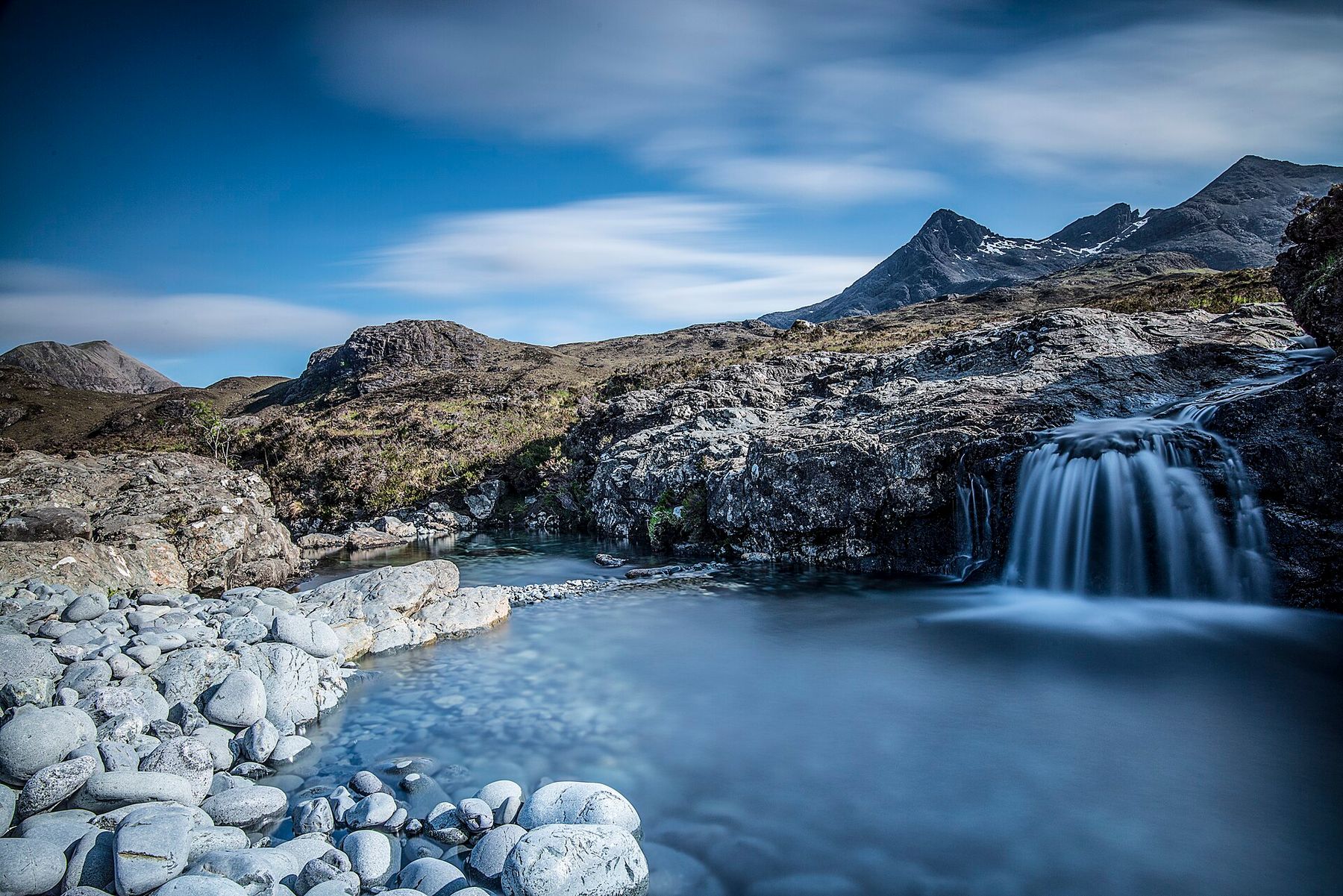
Glen Sligachan, Isle of Skye — CC0.
Credit: CC0 via Wikimedia Commons
Key takeaways
- • Highland light and scale demand fast tonal decisions and focused compositions rather than trying to paint everything.
- • The Land Reform Act grants responsible access to most land, but respect privacy, land management and ticketed sites.
- • Best seasons are spring and autumn; summer offers long light but midges, winter is for advanced trips.
- • Top locations: Glencoe and Glen Etive, Rannoch Moor, Cairngorms, Skye, Torridon and Assynt, plus Inverness and the Moray Firth coast.
- • Pack light, favour stable low supports, heavy paper or panels, weather layers, navigation aids, and a Plan B for bad weather.
Plein air painting Scotland trips take real planning, but artists who have made the journey tend to come back changed by it. The quality of Highland light, the sheer scale of the landscape, and the speed at which weather moves through a glen combine to create painting conditions that are genuinely unlike anything you will find in southern England. This guide covers the practical side: where to go, when to go, what the access law actually says, and how to handle the midges, the wind, and the horizontal rain when they arrive.
Why the Scottish Highlands Are Worth the Journey
The Scottish Highlands offer something compositionally challenging that most of lowland Britain does not: a landscape so large that your first instinct (to paint all of it) is almost always wrong. Learning to find a foreground, to anchor a composition in a particular rock or patch of heather or bend of river, is one of the most useful lessons the Highlands can teach you.
The light is the other thing. Low sun angles for much of the year mean long shadows across moorland and deep tonal contrasts between lit peaks and dark valleys. Cloud shadows move across hillsides fast enough that the painting you start in grey, flat light can find strong sunlight within twenty minutes. That is both the frustration and the reward. Working quickly, committing to a tonal reading before the scene shifts, is a discipline the Highlands will push you towards whether you want it or not.
Logistics here take more planning than a day trip to the South Downs or the Cotswolds. Petrol stations are sparse in remote areas, single-track roads add time to every journey, and mobile signal disappears in many glens. None of that should put you off. It does mean a trip benefits from a little forethought: locations scouted the day before, a Plan B location identified for each day, and a rough sense of the drive times involved.
Access and Permissions: What You Need to Know Before You Go
This is where Scotland differs meaningfully from England and Wales, and it matters for painters.
The Scottish Outdoor Access Code in Plain English
The Land Reform (Scotland) Act 2003 gives everyone the legal right of responsible access to most land and inland water in Scotland for recreational purposes. Sketching and painting outdoors falls clearly within that. In practical terms, this means you can set up your easel on open hillside, moorland, riverbank, or loch shore without needing to ask anyone's permission. This is not a loophole or a grey area; it is the law.
The Scottish Outdoor Access Code sets out the responsibilities that come with that right. The core principle is to behave considerately: do not obstruct access routes, respect the privacy of homes, avoid interfering with land management operations, and take your litter with you.
When You Might Need Permission
The right of access does not extend everywhere. You should stay clear of private gardens and the ground immediately surrounding houses (known as the curtilage). Working farmland and active harbours require care and common sense; do not set up in a way that blocks a working gate or a slipway.
Deer stalking is worth knowing about, particularly for upland routes between roughly July and February for stags, with hinds running to around March. During the stalking season, some estate tracks and hillsides may be temporarily restricted. A quick call to the local estate or a check with the Hillphones service (a recorded information line covering many Highland estates) before heading to a remote upland spot is worthwhile in summer and autumn.
Managed heritage sites such as those run by Historic Environment Scotland operate as ticketed attractions with their own rules. If you want to paint inside the grounds of a managed castle or monument, check on arrival. The right of access does not override ticketing arrangements at these sites.
Commercial workshops involving a group are in a different position from a sole painter and may need separate arrangement with estates for regular use. If you are attending a painting retreat, the organiser should have handled this. If you are running one, look into it separately.
When to Go: Seasons and Conditions for Plein Air Painting in Scotland
| Season | Light & landscape | Midges | Weather risk | Verdict |
|---|---|---|---|---|
| Spring (Apr–early Jun) | Fresh colour, snow on peaks, long days building | Low–moderate | Changeable but improving | Best first trip |
| Summer (mid-Jun–Aug) | Very long days, deep greens, golden evenings | High | Mixed, can be dreich | Great light, plan for midges |
| Autumn (Sept–Oct) | Golden light, heather, low sun angles | Low | Storms more likely, shorter days | Favourite for many painters |
| Winter (Nov–Mar) | Dramatic snow and low light | None | High risk, short days | Specialist only |
One practical note overrides all seasonal generalisations: short-range forecasts matter far more than averages. The west coast of the Highlands, which takes Atlantic weather first, is significantly wetter and more changeable than the east. The Cairngorms, Speyside, and the Inverness area sit in a relative rain shadow and tend to offer more settled conditions than Torridon or Skye. Factor that in when choosing where to base yourself, particularly on a first trip.
Summer days in the northern Highlands are extraordinarily long: genuinely usable daylight runs past ten in the evening in June. This gives you the option to revisit a subject at different times of day, which you simply cannot do in winter. The trade-off is midges, and the trade-off is real.
Autumn from September into mid-October is the season most experienced Highland painters nominate as their favourite. The bracken turns russet, the heather finishes its flowering season in a last flush of purple, low sun angles create long modelling shadows across hillsides, and the midges are largely gone. Days shorten quickly from mid-September, so morning sessions have to start earlier to catch the best light.
Six of the Best Highland Locations for Plein Air Painting
Glencoe and Glen Etive
Glencoe is the obvious starting point, and there are reasons it has been painted for generations. The Three Sisters ridgeline above the valley floor is one of the most compositionally striking views in Scotland: three deep-cut ravines dividing a high, dark ridge, with the valley floor in front offering bog, river, and foreground texture. Roadside laybys on the A82 give access to several classic viewpoints without requiring any walking.
A few practical cautions. Some of the A82 laybys are very narrow, and the road carries fast-moving traffic. Before setting up, look honestly at the distance between the layby edge and the carriageway. If it does not feel safe, drive on to the next one. The valley is also exposed to wind channelling from both directions; a low-profile setup with your easel legs spread wide works better than a tall French easel here.
Glen Etive, which leaves the A82 south at Altnafeadh, is a much quieter alternative. The single-track road follows a river through birch and pine, giving intimate foreground interest that Glencoe itself sometimes lacks. This is better for smaller-format, more detailed work.
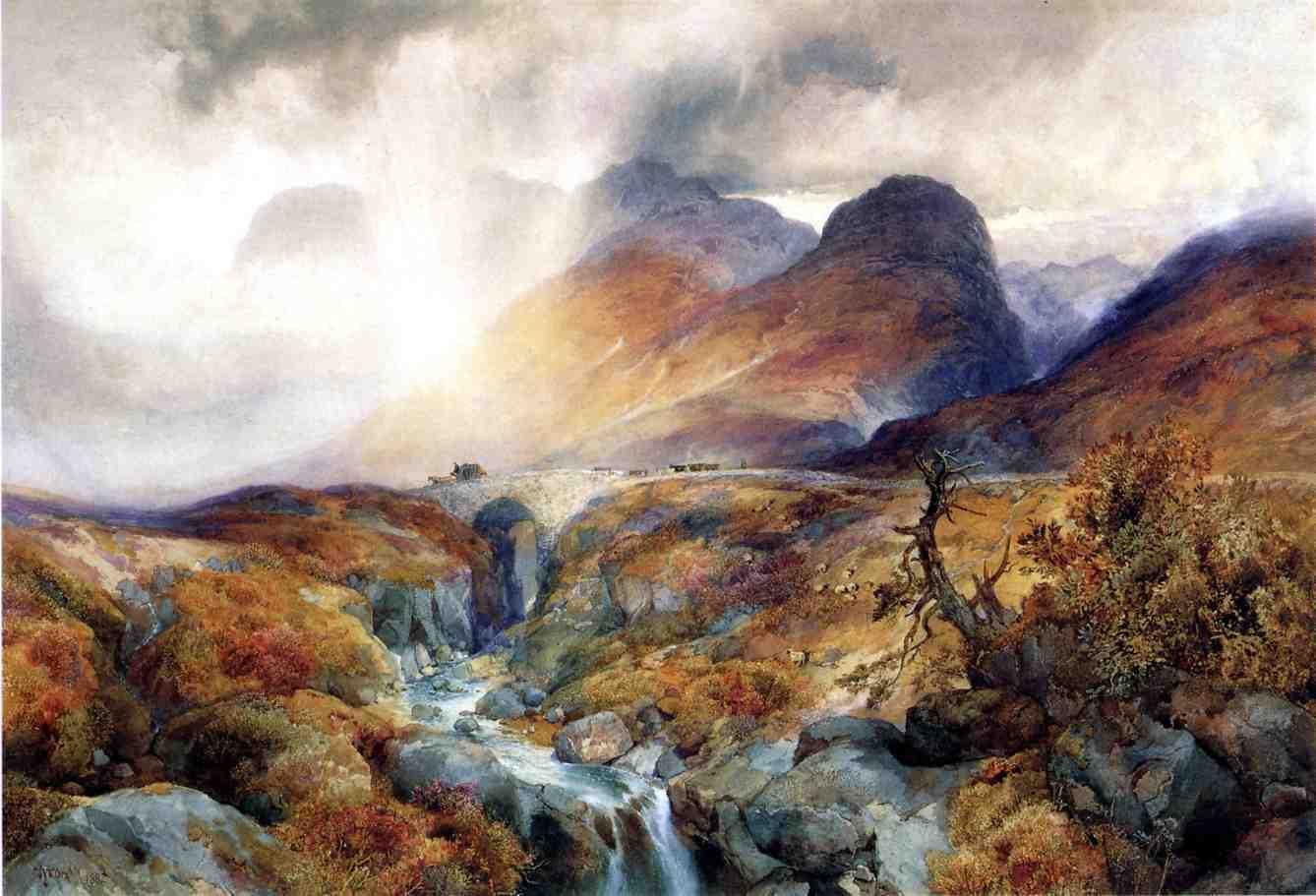
Pass at Glencoe, Scotland (1882) by Thomas Moran.
Rannoch Moor
Between Bridge of Orchy and Glencoe, the A82 crosses Rannoch Moor: roughly fifty square miles of open blanket bog, scattered lochans, and distant ridge lines. There is almost nothing else quite like it in Britain for sheer austere flatness beneath an enormous sky.
Access from the road is easy, and that is the straightforward part. The challenge Rannoch poses as a painting subject is compositional rather than physical: there is very little strong foreground, and the lochans, though beautiful in reflection, can feel disconnected from the sky without careful handling. Working on value studies here, focusing on the sky-to-land tonal relationship rather than trying to resolve too much detail, tends to produce more honest paintings than attempts at a fully resolved landscape. This is an excellent location for watercolour.
The moor is fully exposed to wind. A lap-based sketchbook setup or a pochade box on a low tripod is far more practical than a traditional field easel on anything other than a very calm day.
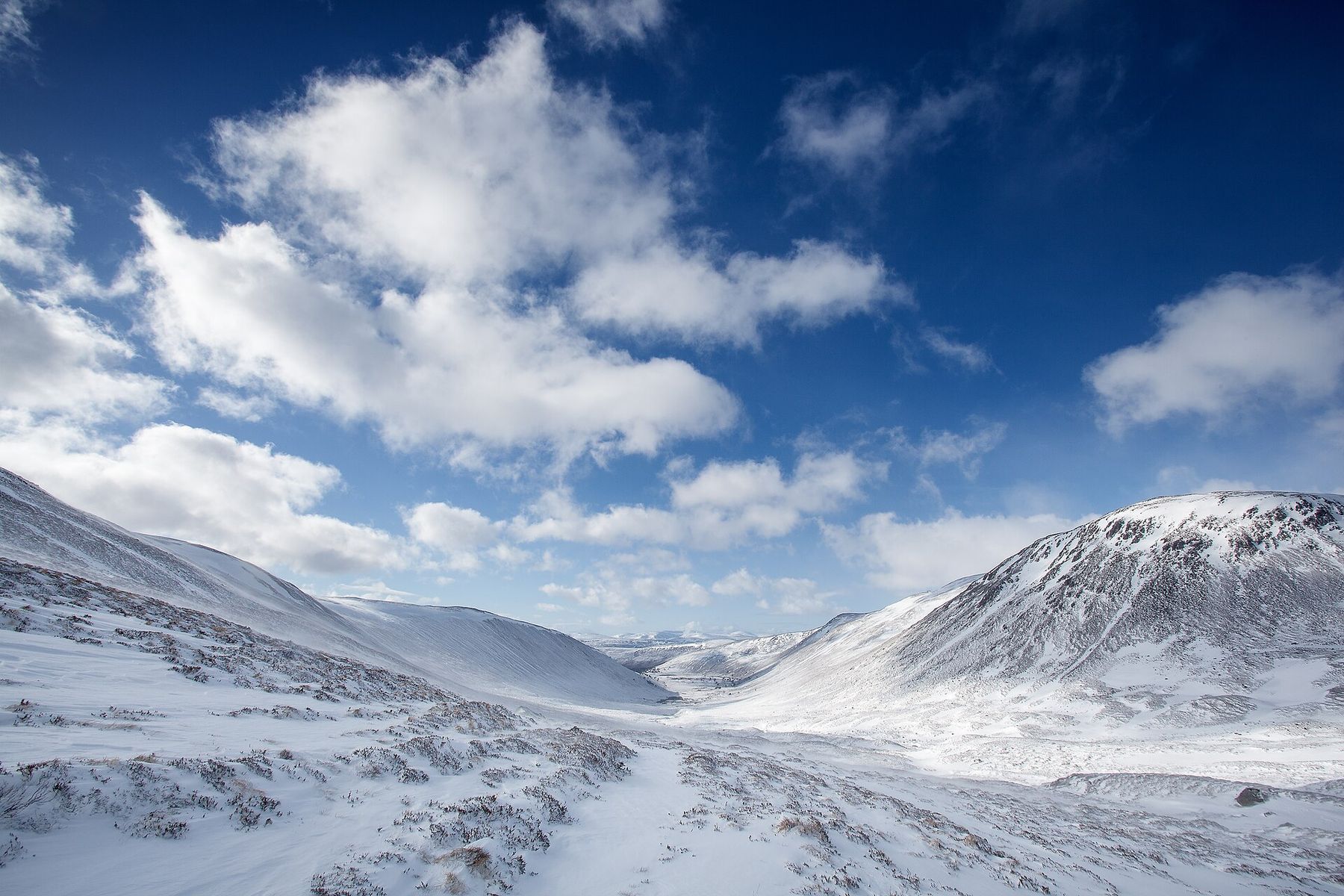
Cairngorms National Park — CC0.
Cairngorms National Park
The Cairngorms rewards painters who want variety without committing to a remote drive each morning. Within easy reach of Aviemore and Grantown-on-Spey you have Scots pine forest (Rothiemurchus is a particularly beautiful example), the River Spey with its shingle banks and reflections, open heather moorland, and the loch shore at Loch Morlich.
This is the most sheltered of the main Highland painting destinations, and the most accessible for anyone with limited walking fitness. Short forest paths and accessible loch shores mean you can find a quality subject within fifteen minutes of parking. The ski road up to Cairn Gorm itself gives access to high mountain subjects, but at altitude conditions change fast and it is not a place to be caught out.
The Cairngorms is a strong choice for a first Highland trip, and a reliable fallback if weather is preventing travel to the west coast.
Isle of Skye: Sligachan and the Trotternish Peninsula
The Sligachan area gives you the Black Cuillin silhouette from the old bridge: a jagged, near-black ridgeline rising from moorland and reflected in the river. It is a demanding compositional subject and a genuinely powerful one. The scale is deceptive on first encounter; the peaks are bigger than they appear from the road.
Further north, the Trotternish Peninsula offers something structurally different. The Old Man of Storr and the Quiraing are geological formations of an unusual kind, almost architectural in their verticals, and they reward painters who are interested in strong structure rather than soft atmospheric effects.
Skye in summer is busy. Popular viewpoints in July and August will have other visitors, sometimes many. Starting early, before nine, removes most of this. Weather on Skye changes very quickly; it is not unusual to set up in good light and pack up in heavy rain within forty-five minutes. Check the forecast on the morning of each session, not the night before.
The North-West Highlands: Torridon and Assynt
The Torridonian sandstone mountains around Liathach and Beinn Alligin have a warmth and a coarseness of texture that you will not find in the granite Cairngorms or the volcanic Cuillin. The rock is old, red-brown, and sculpted rather than jagged. Loch Torridon's foreshore at low tide, with those mountains reflected in calm water, offers reflection subjects of a quality that experienced painters travel specifically to paint.
Assynt, further north, centres on isolated peaks rising from a landscape of lochs and Lewisian gneiss. Suilven in particular is an extraordinary shape: a whale-backed ridge that rises abruptly from flat moorland on all sides. It does not look like a conventional mountain, and that is precisely what makes it so interesting as a painting subject.
The north-west is remote. Single-track roads are the norm, fuel stations are few, and you should fill your tank whenever you pass one. Build extra time into every journey; do not rely on a single forecast for a full day's plan, and tell someone your intended route if you are heading somewhere genuinely isolated.
Around Inverness and the Moray Firth Coast
Tip for first-time visitors
If this is your first Highland painting trip, Inverness makes an excellent base. It's easy to reach by train or road, and within 30–60 minutes you'll find lochs, rivers, forest edges, and coastal views in several directions. It also has the fallback of a town to retreat to if the weather turns.
Inverness and the surrounding area offer the most logistically forgiving introduction to Highland painting. The Beauly Firth, the River Ness through the town itself, Chanonry Point on the Black Isle (a lighthouse with estuary views in several directions), and the harbour villages of Fortrose and Cromarty all provide accessible subjects without committing to a long mountain drive.
The weather east of the Great Glen is consistently more settled than the west coast equivalents. For a first Highland trip, or for a group with mixed walking fitness, basing yourself in or around Inverness and exploring the Moray Firth coast gives you productive painting days with significantly less logistical pressure.
Dealing with the Challenges: Weather, Wind, and Midges
Wind
Wind is the most consistent limiting factor for plein air painting in the Highlands. A setup that works fine in a sheltered lane in Cornwall can become unworkable in twenty minutes on an exposed Highland ridge.
Use the landscape itself as a windbreak wherever possible: a car, a dry-stone wall, a large rock. Set your easel legs as low and wide as they will go, and add a weight bag to the centre column. A pochade box clamped to a sturdy tripod is generally more stable than a French easel in any meaningful wind. On very exposed moorland like Rannoch, working with a sketchbook in your lap is simply the most practical option.
Rain and Rapidly Changing Light
Have a Plan B for every day. When mountain passes are in cloud and rain is coming in from the west, rivers, woodland interiors, and harbour towns often remain paintable. Rothiemurchus Forest, a harbour at Cromarty, or the sheltered bay at Plockton can all provide usable conditions when higher ground is not.
Work to a scale you can finish in twenty to forty minutes. The light in the Highlands changes faster than most painters trained in the south are used to, and a painting started under grey overcast and finished under direct sun is usually a painting in trouble. Small panels and quarter-sheet watercolour blocks keep you within that window more reliably than larger formats.
Keep a small watercolour or ink kit in the car. On a genuinely bad day, car-based sketching from a layby gives you something, and something is better than nothing.
Midges
Highland midges (Culicoides impunctatus) are at their worst from late May through to September, peaking in July and August. They concentrate in sheltered glens, on loch shores with still water, and in woodland edges, particularly around dawn and dusk. The briefing is simple: a light breeze keeps them off almost entirely; still, damp air brings them in fast.
The midge window
Midges are worst in calm, damp conditions, especially around dawn and dusk in sheltered glens and near still water. A light breeze is your friend. If you're painting near a loch in summer and the air goes still, be ready to move or reach for your head net.
Smidge repellent is the most widely recommended UK product and is available from outdoor shops throughout Scotland. A head net takes up no space and is worth carrying from June to September. Coastal viewpoints and exposed ridges are usually midge-free even in peak season; if a glen location becomes intolerable, relocating to higher or more exposed ground almost always resolves it.
What to Pack for Painting in the Highlands
The key difference from painting in southern England is simple: portability and weather resilience matter more than anything else.
Keep your kit ruthlessly light
Many Highland locations involve a walk, even a short one. A setup that works fine from a car park in the Cotswolds may feel punishing on a hill path in the Cairngorms. Edit your kit before you go, not after your back starts aching on day two.
Specific adjustments to consider:
- Clothing layers: A midlayer fleece and a waterproof jacket are not optional, even in summer. Add a spare pair of gloves in spring and autumn. Temperatures drop fast at altitude and in wind.
- Paper weight: Watercolour painters should use 300gsm or heavier paper. Lighter paper buckles badly in damp Highland air before you have finished a wash.
- Panels over stretched canvas: Oil painters will find panels significantly more practical in wind; stretched canvas vibrates in a breeze and can make brushwork frustrating.
- Bulldog clips: Clip everything that can lift. Paper, reference sketches, anything loose.
- A lightweight camp stool: Many Highland locations have no natural seating. Even a compact folding stool saves a great deal of discomfort over a full day.
- Navigation and safety basics: Download an OS map of your intended area before you leave, as mobile signal in many Highland glens is unreliable or absent. Tell someone your rough plan if heading anywhere remote. Carry a basic first aid kit and more water than you think you need.
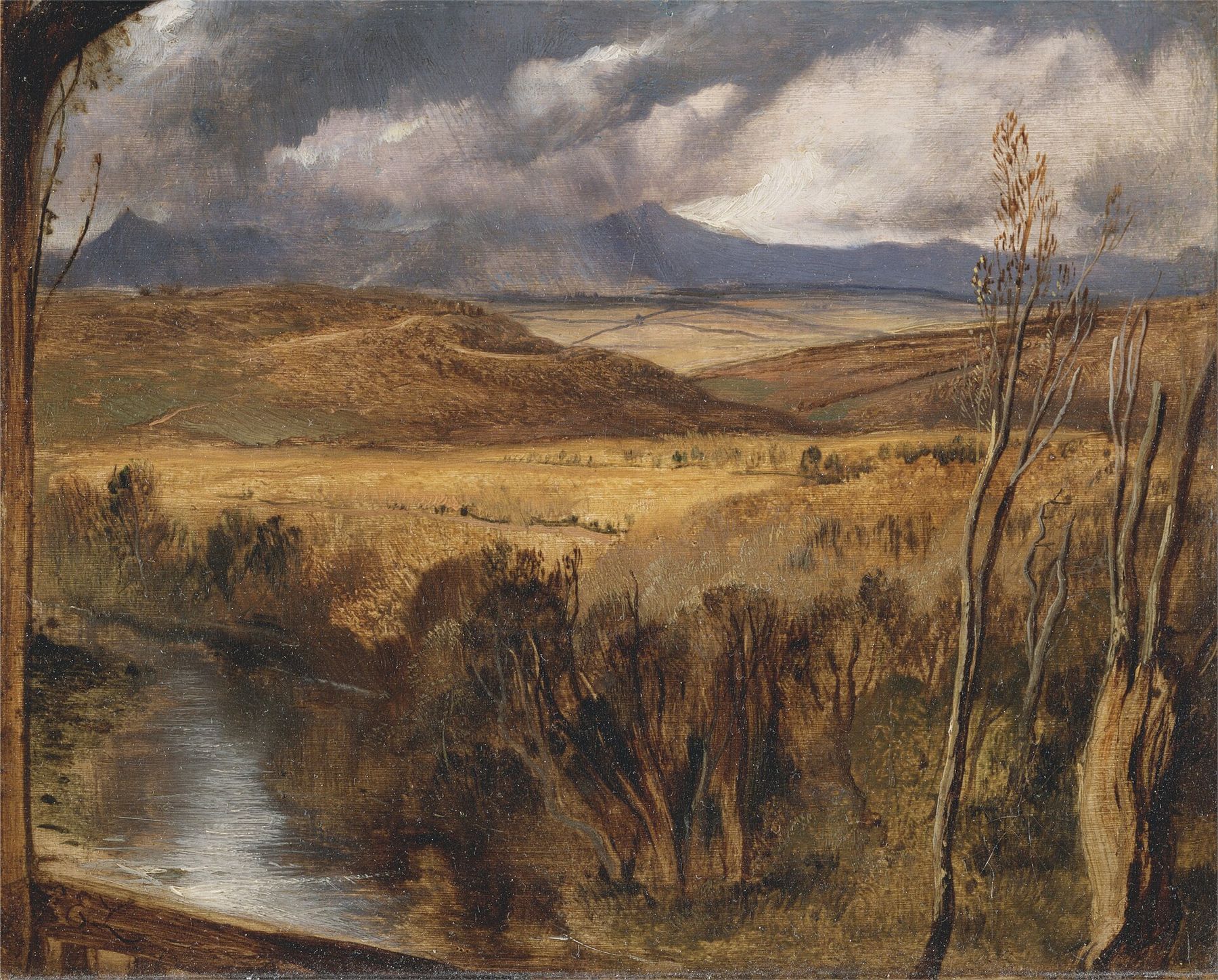
A Highland Landscape by Edwin Landseer.
The Highlands reward painters who commit to them properly. The logistics are real, the midges are real, and the weather will test your patience at least once. But plein air painting Scotland trips regularly produce some of the most interesting work painters in the UK ever make, and that is not an accident. There is no landscape quite like this one for teaching you to work quickly, to commit to a tonal reading, and to find something true in a scene before the light moves on.
FAQ
Frequently Asked Questions
Do I need permission to paint outdoors in the Scottish Highlands?
No. The Land Reform (Scotland) Act 2003 grants legal right of responsible access for recreation, which includes sketching and painting. Be considerate, avoid private curtilage, and follow the Scottish Outdoor Access Code.
When is the best time for plein air painting Scotland?
Spring and autumn are the best all round. Spring offers fresh colour and long days, autumn gives golden light and fewer midges. Summer has long evenings but peak midges. Winter is specialist only.
How do I cope with midges while painting?
Midges peak June to August in calm, damp spots. A light breeze usually keeps them away. Carry Smidge repellent and a head net, paint on exposed ridges when possible, and move if the air goes still.
What kit should I prioritise for Highland trips?
Keep kit light and weather resilient. Choose panels over stretched canvas, heavy watercolour paper (300gsm), a low stable pochade or lap sketchbook for wind, bulldog clips, layers of clothing, and a compact stool.
What are good backup options when weather ruins a mountain session?
Have a Plan B each day. Rivers, forests, sheltered loch shores, harbour towns, and car-based layby sketching often remain paintable when higher ground is clouded or wet.
Author

PleinAirPainting Editorial Team
PleinAirPainting.co.uk helps artists paint outdoors with confidence through UK-focused guides, equipment advice, resources and plein air inspiration.