The Heidelberg School: How Australian Impressionism Transformed Plein Air Painting
How the Heidelberg School transformed plein air painting in Australia by adapting palette, methods, and group practice while carrying complex colonial meaning.

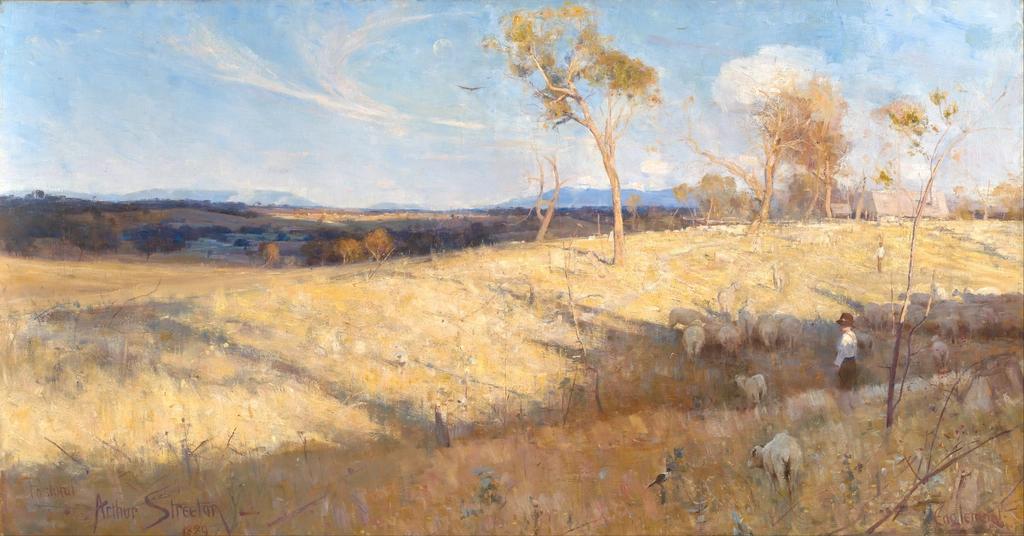
Golden Summer, Eaglemont (1889) by Arthur Streeton, a defining Heidelberg School landscape.
Credit: Arthur Streeton; image via rawpixel; CC0 1.0
Key takeaways
- • Heidelberg School Australian art refers to Australian Impressionism centred around Melbourne in the 1880s and 1890s.
- • Artists adapted European plein air methods to intense Australian light using warm ochres, pale skies, and muted greens.
- • The 9 by 5 Impression Exhibition made a public case for small plein air studies as complete works.
- • Painting camps offered collaborative problem solving and sustained creative momentum.
- • The work has technical brilliance and a colonial context that modern scholarship examines alongside its artistic achievements.
Stand in the Australian bush at midday and the light does something to you. It isn't the warm, flattering glow of a Turner sunset or the soft, silvered overcast that UK painters know so well. It bleaches. It flattens shadow into hard-edged shapes. It turns the eucalyptus leaves a dusty silver-grey and drains the sky to a pale, ringing blue. For a group of painters working on the outskirts of Melbourne in the 1880s, this light wasn't a problem to be managed. It was the whole point. Plein air painting didn't stop at Europe's edges: it travelled, adapted, and produced one of the most distinctive chapters in the history of outdoor painting. The Heidelberg School remains a vital, and in the UK still underappreciated, moment in that story.
What Was the Heidelberg School?
The name causes genuine confusion, and it's worth clearing up immediately. The Heidelberg School has nothing to do with Germany. It takes its name from Heidelberg, then a quiet rural district on the northeastern fringe of Melbourne, where artists gathered to paint in the late 1880s. The label itself was coined in 1891 by American critic Sidney Dickinson, and it stuck, though "Australian Impressionism" is increasingly used alongside it, particularly outside Australia. For practical purposes, the two terms refer to the same phenomenon: a loose gathering of painters who brought Impressionist and naturalist ideas from Europe and applied them, with serious intent and considerable originality, to the Australian landscape.
The movement was active mainly across the 1880s and into the 1890s. Its central catalyst was Tom Roberts, who returned to Australia in 1885 after studying in Spain, France, and the UK. He came back with new eyes and a head full of ideas, and found around him a small circle of painters who were ready to put them to work. The principal figures of Heidelberg School Australian art were Roberts, Arthur Streeton, Frederick McCubbin, and Charles Conder. Others, including Walter Withers and Arthur Loureiro, were also part of the broader community.
Why "Heidelberg"?
The name comes from Heidelberg, then a rural village on the outskirts of Melbourne, where artists set up informal painting camps in the 1880s. It has nothing to do with the German city. The term "Australian Impressionism" is increasingly used alongside it, particularly outside Australia.
The Artists Who Painted the Bush
These were working painters, not mythological figures. What made them compelling was the specific problem they were trying to solve: how do you translate a set of European techniques into a landscape that looked, felt, and behaved completely differently from anything those techniques were designed for?
Tom Roberts
Roberts is the natural starting point. European-trained and practically minded, he returned to Australia in 1885 carrying Impressionist ideas he'd absorbed in Paris and Madrid, alongside the influence of British naturalist painting. He became the organiser and driving force of the painting camps, the one who pulled people together and kept the momentum going.
What distinguishes Roberts from the others is his commitment to figures in landscape, specifically to the labour of the Australian countryside. His shearing shed paintings, including the monumental "Shearing the Rams" (1890), are extraordinary achievements: figure painting executed in working environments, under intense heat, with all the compositional challenges that come with combining people, animals, and architecture outdoors. If you've ever tried to paint a busy outdoor scene and felt the difficulty of making figures feel embedded in their light and environment, Roberts' work repays careful study.
Arthur Streeton
Streeton was primarily a landscape painter, and the most formally ambitious of the group. His compositions are expansive: high horizons, long distances, vast quantities of open sky. The palette he developed in response to Australian conditions, warm ochres and dusty golds, pale cream and blue at the horizon, limited and muted greens, gives his work a quality of stillness and scale that seems almost implausible given that much of it was painted on the spot.
"Still Glides the Stream" (1890) is a good entry point: the golden, sun-filled warmth of that painting is not a romantic imposition on the landscape. It is a careful, observed response to specific conditions of Australian light and season.
Golden Summer, Eaglemont (1889) by Arthur Streeton.
Credit: Arthur Streeton; image via rawpixel; CC0 1.0
Frederick McCubbin
McCubbin occupies a slightly different register. Where Streeton reaches for the monumental, McCubbin is drawn to atmosphere and mood. His figures are often partly absorbed by their surroundings: half-glimpsed among eucalyptus, caught in the particular dappled, grey-green light that filters through Australian bush vegetation. There's a psychological quality to his work that distinguishes it from the more purely optical concerns of the others.
His triptych "The Pioneer" (1904) is the obvious landmark, but his smaller plein air studies repay just as much attention. They show how patient observation of specific, localised light can produce something no amount of received technique can replicate.
Charles Conder
Conder is the most immediately Impressionist in feeling: lighter, faster, more interested in transient effects and decorative beauty. He arrived in Australia from England in 1884 and left for Europe in 1890, which means his Australian output covers a brief but productive window. His works have a freshness and spontaneity that makes them feel very much alive.
Conder is also a reminder that the Heidelberg School was never an isolated phenomenon. These painters were in dialogue with European ideas throughout, corresponding, travelling, comparing. The movement was porous and international, not a self-contained Australian invention.
The 9 by 5 Impression Exhibition
In August 1889, Roberts, Streeton, and Conder, with a small number of other contributors, mounted an exhibition in Melbourne that announced their intentions with unusual bluntness. The works were small: painted on cigar-box lids and wooden panels, roughly 9 by 5 inches (approximately 23 by 13 cm). There were around 183 of them. The title said plainly what they were: impressions, not finished paintings.
The 9 by 5 Impression Exhibition at a Glance
- Year
- 1889
- Format
- Small studies on wooden panels and cigar-box lids
- Approximate size of works
- 9 × 5 inches (approx. 23 × 13 cm)
- Number of works exhibited
- Around 183
- Critical reception
- Sharply divided
Melbourne
Largely by Roberts, Streeton and Conder
Attacked by some critics, championed by others
The critical reaction was, predictably, divided. Some reviewers dismissed the works as sketches presented dishonestly as paintings. Others recognised that something genuinely new was being proposed. The argument was familiar: a version of it had already played out in Paris, in London, and wherever Impressionist methods had encountered conventional critical expectations. In Melbourne, the debate was no less heated.
What the exhibition did, historically, was to state in public what the camps had been exploring in private: that capturing the immediate impression of a scene, honestly and without elaboration, was a legitimate and serious artistic act. The small format was part of the point. These were not studies for larger works. They were complete in themselves: each one a discrete moment of outdoor looking, fixed permanently.
Painting in Australian Light: What Made It Different
This is perhaps the most practically useful aspect of the Heidelberg School for UK painters to understand. The technical problem these artists faced was not simply a matter of transporting Impressionist methods to a new setting. The Australian environment required a fundamental rethinking of the palette, and in many cases the working method too.
| Factor | Australia (Heidelberg era) | UK (typical) |
|---|---|---|
| Light quality | Intense, high-contrast, bleached | Diffused, soft, frequently overcast |
| Predominant palette | Warm ochres, dusty golds, pale blue skies | Cool greens, greys, muted earth tones |
| Vegetation colour | Grey-green eucalyptus, dry grass | Rich, saturated greens |
| Working conditions | Extreme heat, insects, exposed terrain | Rain, wind, cold, muddy ground |
| Session length challenge | Heat and light change rapidly at midday | Weather can shift within the hour |
The quality of light in temperate Europe, and particularly in the UK, tends toward the diffused and the indirect. Shadows are soft. Greens are saturated. The palette that developed through French Impressionism reflected those conditions: cool blues, rich foliage greens, the silvery light of northern skies.
Apply that palette to an Australian summer landscape and it simply doesn't work. The shadows are too crisp, the greens too dull and grey, the sky too pale and too wide. The Heidelberg painters had to build a new visual vocabulary from observation: warm ochres and raw siennas for dry grass, a restrained and often limited green register for eucalyptus, pale cerulean or even whitened blues for the upper sky, bleached creams and fawns at the horizon.
It's reasonable to infer, from looking at the work, that they also adapted their approach to session timing. Australian midday light in summer is simply too intense and too rapidly changing to work in comfortably. Early morning and late afternoon, when the shadows lengthen and the light warms further, would have offered more manageable and more painterly conditions.
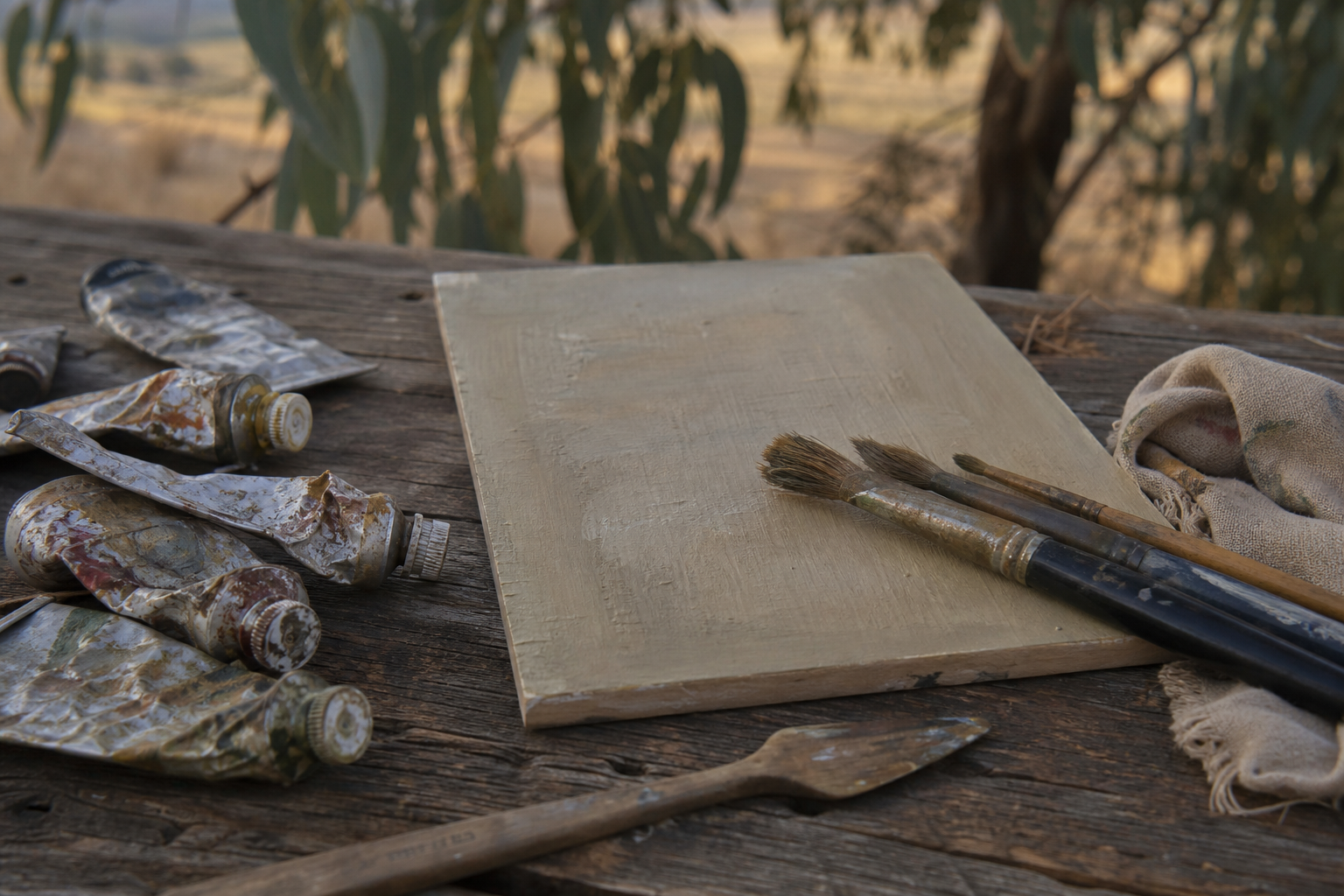
The physical challenges were also considerable. Heat, flies, exposed terrain with little shade, distances to reach locations with heavy equipment: none of this is romanticised in the historical record. These were real working conditions, and they shaped the work. The small format of the 9 by 5 studies wasn't only an aesthetic choice; it was also a practical one.
The Camps: Community as Creative Engine
The Heidelberg painters didn't work in isolation. They set up informal camps at Heidelberg, Box Hill, and other sites around Melbourne, living and painting together over extended periods. These weren't organised schools or funded residencies. They were improvisational, social, and productive in the way that good creative communities always are: people sharing ideas, critiquing each other's work, solving problems together, and sustaining momentum through proximity.

If you'd arrived at one of these camps with your paints and a blank panel, you'd have found a working environment that felt both serious and informal: painters heading out in the early morning, returning at midday to escape the heat, comparing the day's work in the evening. The atmosphere would have been collaborative in the best sense, each person's discoveries available to the group.
This pattern connects the Heidelberg painters to a broader tradition in plein air history. The Barbizon painters in the forest of Fontainebleau worked in similar communal arrangements. So did the artists who gathered at Newlyn in Cornwall, and at St Ives. Painting communities, it turns out, are consistently more productive than isolated practice, not because group conformity produces better work, but because the proximity of other people working seriously on the same problems accelerates the thinking.
UK plein air groups, painting weekends, and regional meet-ups operate on exactly the same principle. The Heidelberg model is a historical confirmation of something many painters already know from experience: getting outside with others is qualitatively different from getting outside alone.
The Colonial Context: What These Paintings Don't Show
The Heidelberg School paintings present the Australian landscape as wide, open, and full of possibility. They show settlers at work, the labour of farming and shearing, the bush as a place being made into something by human effort. The mood is predominantly optimistic, even celebratory. This is understandable: these were paintings being made in a particular cultural moment, by artists who were consciously constructing a visual identity for a settler colony.
Current art historians ask harder questions of this imagery. The land that appears so open and available in these paintings was not empty. It was, and remains, the Country of Aboriginal Australian peoples whose connections to those landscapes are tens of thousands of years old. The absence of Indigenous people from the Heidelberg School's paintings, and from the movement's founding narrative, is not an accident or an oversight. It reflects the broader colonial project within which these artists were working and from which their subject matter derived its meaning.
This doesn't diminish the technical achievement of the work, or make the paintings less worth studying. But it does change what we understand them to be doing. An image of settler labour in an apparently empty landscape is a political image as well as an aesthetic one. The bleached, golden beauty of a Streeton composition carries a cultural argument embedded within it, one that contemporary Australian scholarship has been examining seriously for several decades.
For UK viewers, this is worth knowing because it's part of what the art actually is. The most complete way to engage with the Heidelberg School is to hold both things in mind: genuine technical originality and real historical complexity. They aren't incompatible, but neither can be set aside for the other.
What Heidelberg School Art Can Teach UK Plein Air Painters
History earns its keep when it changes how you work. Here's what the Heidelberg School, looked at practically, actually offers to a UK painter heading out with an easel.
Calibrate your palette to your conditions, not to a received idea of what landscape looks like. The Heidelberg painters didn't try to paint Australia as if it were France. They looked at the specific light in front of them and rebuilt their palettes from observation. UK conditions are genuinely different from French Impressionist conditions, and different again from Australian ones: cooler light, more saturated greens, softer shadows. Your palette should reflect what you actually see, not what Impressionism tells you landscape looks like. This sounds obvious, but it's surprisingly easy to reach for colours that feel "painterly" rather than accurate.
Ordinary working landscapes are rich subjects. Roberts painted shearing sheds and drovers. He found something worth painting in the everyday labour of the countryside. UK painters have the equivalent: farms, docks, building sites, market gardens, fishing harbours. The Heidelberg precedent is a reminder that plein air painting doesn't require picturesque scenery. It requires attention.
Think bigger outdoors. Streeton's large outdoor compositions, ambitious in scale and spatial reach, suggest that confining yourself to small studies is a habit worth occasionally breaking. There's a different kind of thinking that comes with a larger format outdoors. It's harder and more demanding, but it produces results that small studies can't.
Paint with others when you can. The camp model isn't a historical curiosity; it's a tested creative strategy. If you have access to a painting group or a plein air weekend, the Heidelberg painters are evidence that the format works.
Technique travels, but meaning is made on location. The Heidelberg painters took European methods and transformed them through specific local observation. UK painters can apply exactly the same principle: bring whatever influences you carry, and then let the particular quality of a Dorset cliff, a Norfolk sky, or a Scottish loch transform them into something genuinely yours.
Where to Learn More About the Heidelberg School
The Tate's online glossary includes an authoritative and concise entry on the Heidelberg School, framed usefully for UK readers encountering the term for the first time. It's a good starting point.
For the paintings themselves, the National Gallery of Victoria holds the most significant collection and makes high-quality reproductions freely available through its digital collection, accessible from the UK. Streeton's "Golden Summer, Eaglemont" (1889) and Roberts' "Shearing the Rams" (1890) are both available there and repay close looking.
Britannica's entry on Australian Impressionism offers a clear, structured overview for anyone wanting a reliable factual reference alongside the more narratively focused material available elsewhere.
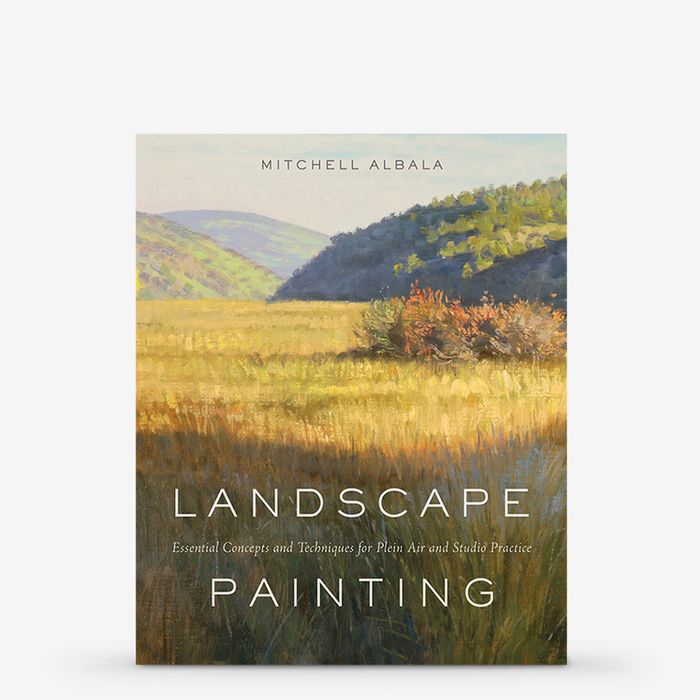
If reading about the Heidelberg School has sharpened your interest in outdoor landscape painting more broadly, Mitchell Albala's book is one of the most thoughtful practical guides available. It addresses the conceptual and perceptual foundations of landscape painting outdoors in a way that connects naturally to the concerns the Heidelberg painters were working through.
Jackson's
Landscape Painting: Essential Concepts and Techniques for Plein Air and Studio Practice : Book by Mitchell Albala
The Landscape Is Unique Among Subject Matter-in Its Grandeur, Complexity And Colour Dynamics. The Landscape Painter Is Continually Challenged To Find Ways Of Translating These Qualities Into A Convincing Representation Of Space And Light. This Is A Concise, Practical Guide To Lan
Plein air painting has always been a tradition that travels. It moves between countries and climates, picks up new problems, and produces new solutions. The Heidelberg painters remind us that the discipline at the heart of outdoor painting, looking honestly at a specific place under specific light and finding the means to describe it, is the same challenge wherever you are. The vocabulary changes. The palette changes. The conditions change. But the fundamental act doesn't. Whether you're standing on Dartmoor on a grey October morning or imagining yourself at a painting camp on the outskirts of 1880s Melbourne, the challenge is the same: look harder, paint honestly, and let the light do the talking.
FAQ
Frequently Asked Questions
What is the Heidelberg School?
A late 19th century Australian movement, also called Australian Impressionism, where painters in the Melbourne outskirts painted outdoors to capture local light and landscape.
Who were the principal artists of the movement?
Key figures include Tom Roberts, Arthur Streeton, Frederick McCubbin, and Charles Conder, with others like Walter Withers contributing to the wider circle.
Why was the 9 by 5 Impression Exhibition important?
Held in 1889, it showcased small cigar-box lid studies as finished impressions, publicly asserting plein air observation as a serious artistic act.
How did Australian light change painting techniques?
Intense, bleached light required a new palette of warm ochres, dusty golds, pale blues, and restrained greens and led artists to adapt session timing and formats.
What lessons can UK plein air painters take from the Heidelberg School?
Calibrate your palette to local conditions, value ordinary working landscapes, try larger outdoor formats, paint collaboratively, and let place shape technique.
Author

PleinAirPainting Editorial Team
PleinAirPainting.co.uk helps artists paint outdoors with confidence through UK-focused guides, equipment advice, resources and plein air inspiration.