The Barbizon School: The French Rebels Who Made Landscape Art
An accessible guide to Barbizon School painting: its forest roots, key artists, plein air methods, and practical lessons for British outdoor painters.

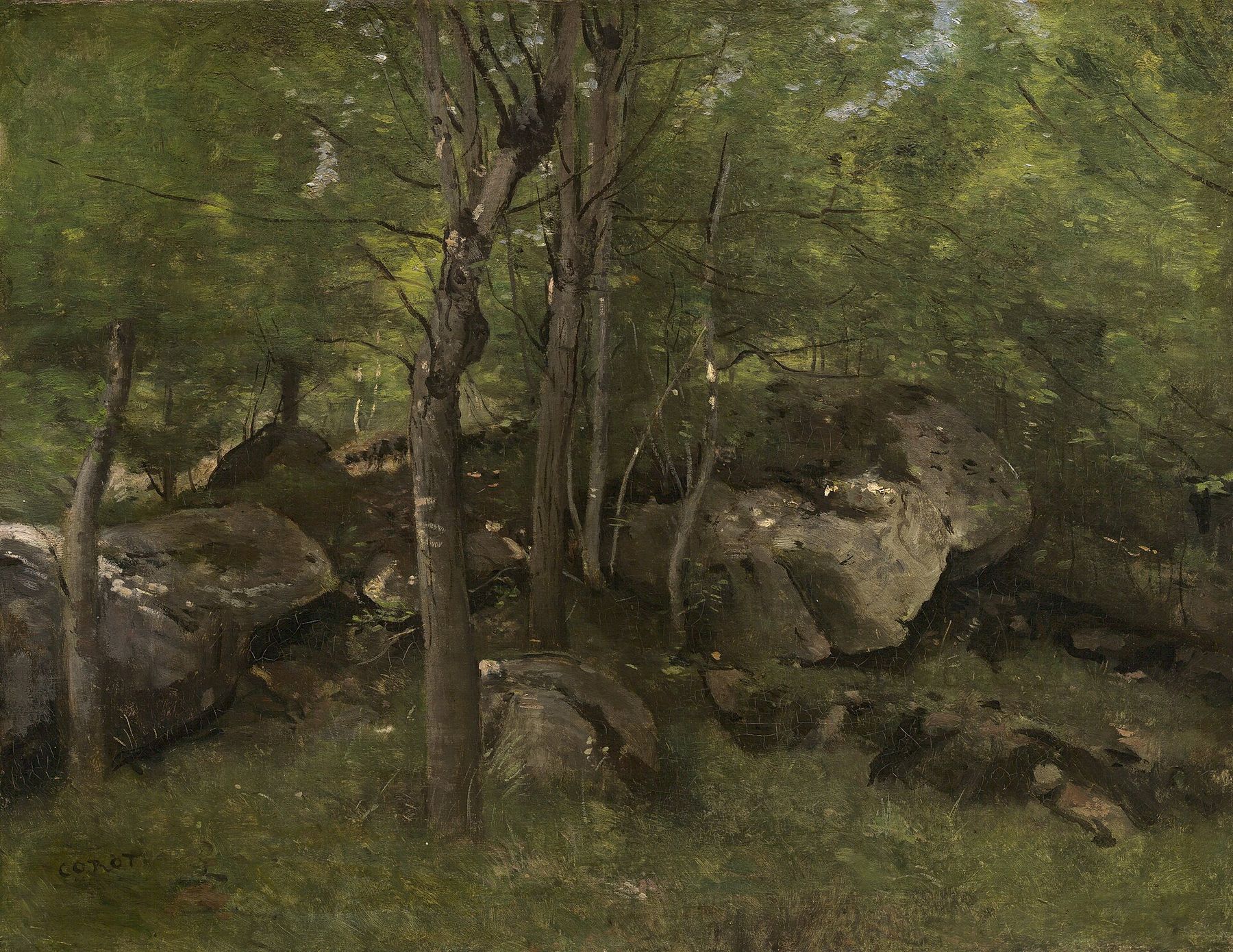
Rocks in the Forest of Fontainebleau (c. 1860–65) by Jean-Baptiste-Camille Corot.
Credit: Jean-Baptiste-Camille Corot; National Gallery of Art, Washington; CC0
Key takeaways
- • Barbizon School painting championed painting outdoors from direct observation around the Forest of Fontainebleau.
- • Artists like Corot, Rousseau, Daubigny and Millet taught lessons in tonal structure, mood, simplified brushwork, and figure integration.
- • The movement elevated plein air studies into finished works and influenced Impressionism while remaining distinct in palette and mood.
- • Practical tips: work small, prioritise value masses and atmosphere, choose ordinary subjects, and make figures part of the land.
- • UK painters can apply the Barbizon model by returning to the same local landscapes across seasons and studying museum and online collections.
In the 1830s, a loose circle of French painters began doing something that the Paris art establishment considered, at best, eccentric and, at worst, a waste of serious talent. They left the city. They set up in a small village on the edge of a forest south of Paris. And they spent their days painting trees, muddy tracks, peasants at work, and the slow shifting of light over ordinary rural land. No mythological heroes. No classical allegory. Just the landscape itself, observed directly, painted with honesty.
This was Barbizon School painting, and it changed the course of Western art.
The movement does not always get the attention it deserves. It tends to appear in art history books as a footnote before the Impressionists, a stepping stone rather than a destination. But spend time with the paintings of Corot, Rousseau, or Daubigny, and you start to see something more complete: a fully realised way of engaging with the natural world that still has a great deal to teach any painter who goes outdoors today.
A Group Defined by a Forest
The Barbizon School was never a formal academy. No manifesto was signed, no official membership was issued. "School" is a label historians applied later to a group of painters who shared a place, a set of values, and a common direction of travel.
What united them was the Forest of Fontainebleau. Located roughly 55 kilometres south of Paris, the forest had been a royal hunting ground for centuries. By the early nineteenth century it was accessible enough by road and later by rail for painters to reach it from the city in a few hours, yet wild enough to feel genuinely removed from Parisian life. The village of Barbizon sat on its northern edge, and from the 1830s onwards it became an informal gathering point for artists who wanted to work directly from the landscape.
The group active in and around Barbizon from the 1830s to the 1870s included Jean-Baptiste-Camille Corot, Théodore Rousseau, Charles-François Daubigny, Jean-François Millet, Narcisse Diaz de la Peña, Jules Dupré, and Constant Troyon. They did not all arrive at the same time, nor did they all share exactly the same aims. But they were bound by a shared conviction: that painting landscape and rural life from direct observation, without idealising or dramatising it, was a serious and worthwhile undertaking.
What Made Barbizon School Painting So Radical
To understand why the Barbizon painters were significant, you need to understand what they were pushing against.
Rejecting the Paris Salon
The Paris Salon was the dominant institution of French art in the nineteenth century. It set the standards, conferred prestige, and shaped careers. And its hierarchy of subject matter was rigid. History painting sat at the top: grand canvases depicting scenes from classical antiquity, mythology, or scripture, often with heroic figures in idealised landscapes. Pure landscape painting, with no narrative justification, sat considerably lower.
Even landscape, to be acceptable, was expected to follow academic conventions. Scenes were composed in studios, often from sketches and imagination, with a classical tidiness applied to nature. Trees were arranged. Distances were softened. Light was made noble.
The Barbizon painters wanted none of this. They wanted to paint a particular oak tree in a particular forest at a particular time of morning. They wanted mud, gnarled roots, the honest grey of overcast French skies. The subjects they chose were deliberately unheroic: farm tracks, field edges, peasants bent over their work, patches of undergrowth that no academic painter would have considered worth the canvas.
Plein Air as a Central Method, Not a Sketch
This is the pivotal shift, and it is worth pausing on it. Before Barbizon, working outdoors was largely preparatory. A painter might sketch and note-take outside, then return to the studio to compose and finish the real painting. The outdoor study was a tool, not an end in itself.
The Barbizon painters began to change this. Not overnight, and not uniformly across the group, but consistently over time they treated the outdoor study as the artwork. The directness of observation, the responsiveness to actual light and atmosphere, the particular quality of marks made in the presence of the subject: these became things to preserve rather than to refine away in the studio.
This single shift, elevating the outdoor study from process to product, is the thread that runs from Barbizon through to the Impressionists and directly into the contemporary plein air practice that many UK painters engage in today.
The British Connection: How Constable Sparked a French Revolution
Here is something that might surprise you, particularly if you paint in Britain.
In 1824, John Constable exhibited at the Paris Salon. His paintings, including The Hay Wain, caused something close to a sensation among younger French painters. What astonished them was not technical virtuosity in the academic sense but something almost the opposite: an absolute commitment to observed truth. Constable painted the weather of Suffolk as it actually was. He painted light as it moved and changed. He painted a particular stretch of English countryside with the attention most painters reserved for figures from history.
French painters looking at those canvases recognised something they had been reaching towards themselves. Constable gave them a precedent. If a British painter could treat an unremarkable English meadow with that level of seriousness, French painters could do the same with the Forest of Fontainebleau.
This is not to claim that Barbizon was simply a response to Constable. The movement had its own energy, its own internal logic, and its roots in French Romantic painting as well. But the Constable connection is genuinely meaningful, particularly for a UK painter. The origins of French plein air painting, which shaped everything that came after it, run partly through England.
A surprising link for UK painters
The Forest of Fontainebleau and the plein air movement it inspired did not emerge in isolation. When Constable showed *The Hay Wain* at the Paris Salon of 1824, French painters were astonished by its naturalism. The Barbizon circle was, in part, a French response to a British painter's way of seeing.
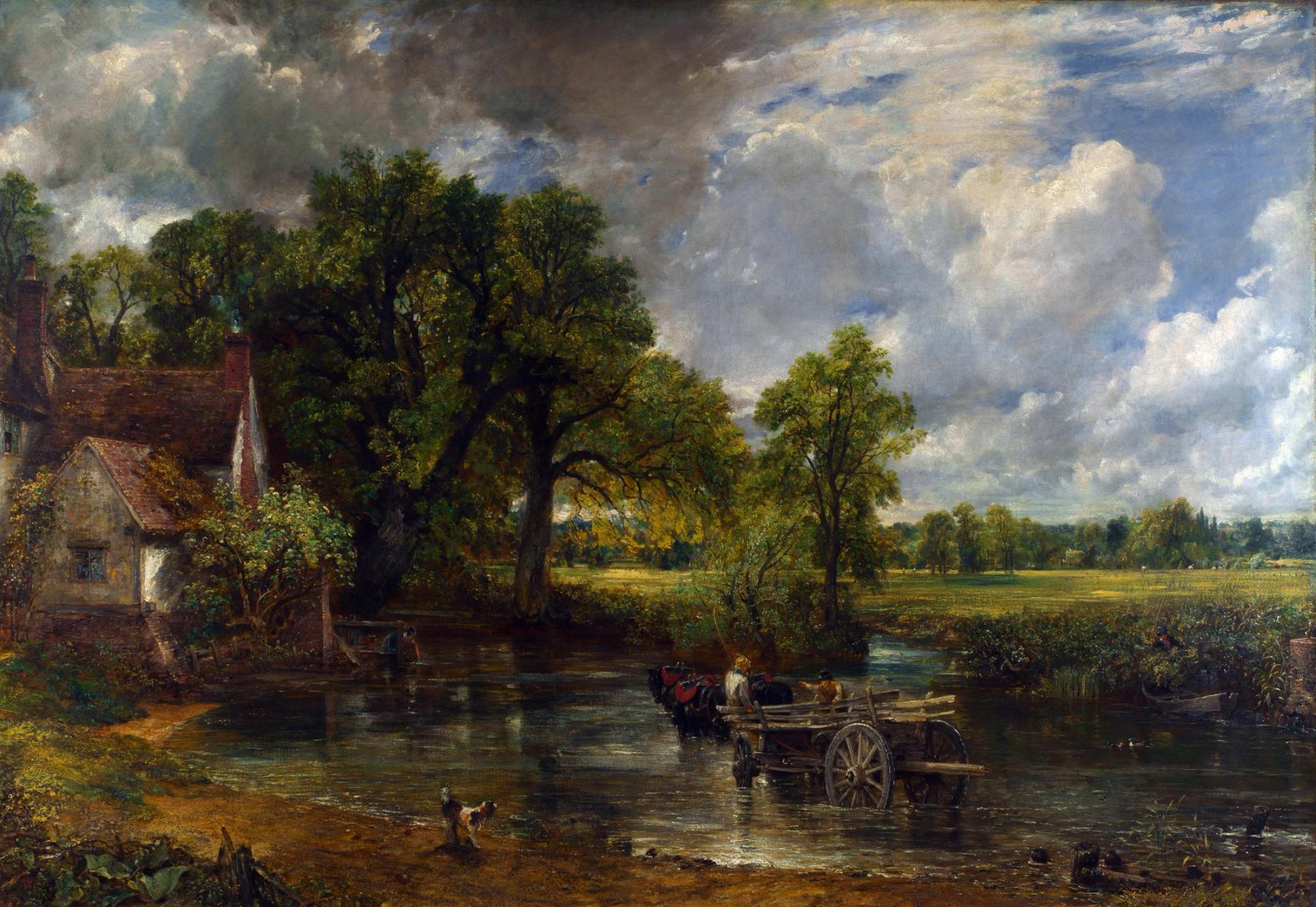
The Hay Wain (1821) by John Constable, whose naturalistic landscape painting helped shape French attitudes to working directly from nature.
Credit: John Constable; National Gallery, London; Public domain
The Key Barbizon Artists and What Each One Teaches
This is where the movement becomes practically useful. Each of the major Barbizon painters developed a particular set of preoccupations, and each of those preoccupations offers something concrete to a painter working outdoors today.
Jean-Baptiste-Camille Corot (1796–1875)
Corot is often the first name that comes up in connection with Barbizon, though he remained something of a figure apart, spending time at Fontainebleau but also travelling widely through France and Italy. What he developed over a long career was a way of organising a painting through tonal unity rather than through detail.
His landscapes have a silvery, atmospheric quality that is not quite mist and not quite light but something in between: a consistent tonal key that makes the whole painting feel coherent. He worked from large value masses first, establishing the relationships between sky, mid-ground, and foreground before committing to any specific forms. Detail, where it appears, feels earned rather than forced.
The lesson for a plein air painter: think in masses before you think in marks. Get the value structure right across the whole picture before you start describing individual leaves or branches.
Théodore Rousseau (1812–1867)
Rousseau was perhaps the most committed forest painter in the group. He was drawn to forest interiors: dense arrangements of ancient trees, powerful silhouettes against the sky, the brooding quality of a woodland that has been growing for centuries. His paintings can feel heavy and immersive in a way that Corot's more lyrical works do not.
What Rousseau understood was the importance of mood as an organising principle. Before he decided anything about composition or colour, he knew what feeling the painting needed to carry. Everything else was in service of that.
The lesson: before you set up your easel, ask yourself what single mood you want the painting to hold. Then make every decision, value, colour temperature, edge quality, in response to that.
Charles-François Daubigny (1817–1878)
Daubigny is arguably the most directly influential member of the group on what came after, because he was a personal connection to Claude Monet. He was also the painter among the Barbizon circle who worked most fluently with water, painting the rivers Seine, Oise, and Marne repeatedly in studies that capture the horizontal quality of a river landscape with particular economy.
He famously had a studio boat built so he could paint directly from the water, a gesture that speaks to his commitment to being in the landscape rather than above it. His brushwork is loose and responsive, particularly in the way he handles reflections: horizontal strokes that suggest movement without describing it literally.
The lesson: simplify. Use the horizontal rhythms of a river or pond composition to create unity. Let the brushwork do the work of describing movement, rather than trying to paint every reflected ripple individually.
Jean-François Millet (1814–1875)
Millet is the odd one out in some ways: he was as interested in figures as in landscape, and his most famous paintings are of peasants at work in the fields rather than of fields alone. But this is precisely what makes him instructive. In paintings such as The Gleaners and The Angelus, the figures are not placed in front of a landscape backdrop; they grow out of the land. Their weight, posture, and mass are inseparable from the ground beneath them.
He reminds us that when figures appear in a plein air painting, they need to be structurally integrated into the composition, not placed on top of it as an afterthought.
The lesson: treat any figures you include as part of the compositional architecture. Their relationship to the horizon line, the ground plane, and the surrounding forms is as important as their human detail.
Others Worth Knowing: Diaz, Dupré, Troyon
Narcisse Diaz de la Peña brought something different to the group: a richness of colour and a delight in surface texture that made his forest subjects feel almost jewel-like up close. He was particularly interested in the way light filters through canopies and picks out the colour in foreground vegetation. If you paint in woodland and struggle to make close-range foliage feel alive rather than flat, Diaz is worth studying carefully.
Jules Dupré was drawn to dramatic weather: big skies, building storms, the moment before rain. Where Rousseau found brooding in the forest interior, Dupré found it in the sky. His paintings are a lesson in orchestrating the sky as the dominant force in a composition rather than treating it as a neutral backdrop.
Constant Troyon specialised in animals within landscape, particularly cattle and sheep in open pasture. What he brought to this apparently simple subject was a genuine feeling for the weight and mass of animals in relation to the ground, the light, and the distance. He is a useful painter to look at if you want to understand how to give any large form real physical presence in an outdoor painting.
| Artist | Known for | Lesson for plein air painters |
|---|---|---|
| Corot | Tonal unity, silvery atmosphere | Organise the painting in large value masses before adding detail |
| Rousseau | Forest interiors, brooding mood | Commit to one strong mood and build the whole painting around it |
| Daubigny | River scenes, low horizons | Simplify forms, use horizontal rhythms, let brushwork suggest water movement |
| Millet | Peasant life, figures in landscape | Integrate figures structurally into the land, not pasted on top of it |
| Diaz | Rich colour, textured foliage | Use colour and texture to make close-range vegetation feel alive |
| Dupré | Dramatic skies and storms | Orchestrate the sky as the dominant force in the composition |
| Troyon | Animals in landscape | Give figures and animals real mass and weight within the scene |
Fontainebleau and the Landscape That Shaped the Style
It is worth spending a moment with the forest itself, because the landscape was not incidental to what the Barbizon painters developed. It shaped them.
The Forest of Fontainebleau is not a neat, managed woodland. It is ancient and varied: massive oaks and beeches, dramatic sandstone rock formations breaking through the ground, open sandy glades giving way suddenly to dense undergrowth, paths that disappear into shadow. The light behaves differently here than in open countryside. It filters, it rakes, it creates strong contrasts between sunlit clearings and dark interior passages.
The painters were drawn to subjects that academic painters would have considered unpicturesque: a tangle of roots at the base of an old tree, a boulder half-buried in leaf litter, a path that curves away into darkness with no heroic destination. The point was precisely this ordinariness. They were training themselves to find pictorial value in what was actually in front of them, not in what they had been told was worth painting.
For UK painters, there is a direct and useful parallel here. Fontainebleau's appeal to Parisian artists in the 1840s is remarkably similar to what draws a painter from London or Manchester to Epping Forest, the New Forest, or the woodlands of the Peak District today. Close enough to reach regularly, varied enough to hold your interest across seasons, wild enough to feel genuinely immersive. The Barbizon model of returning to the same patch of landscape repeatedly, in different weather and different seasons, building a body of work rooted in a specific place, is as applicable to a Surrey hillside as to the edge of a French royal forest.
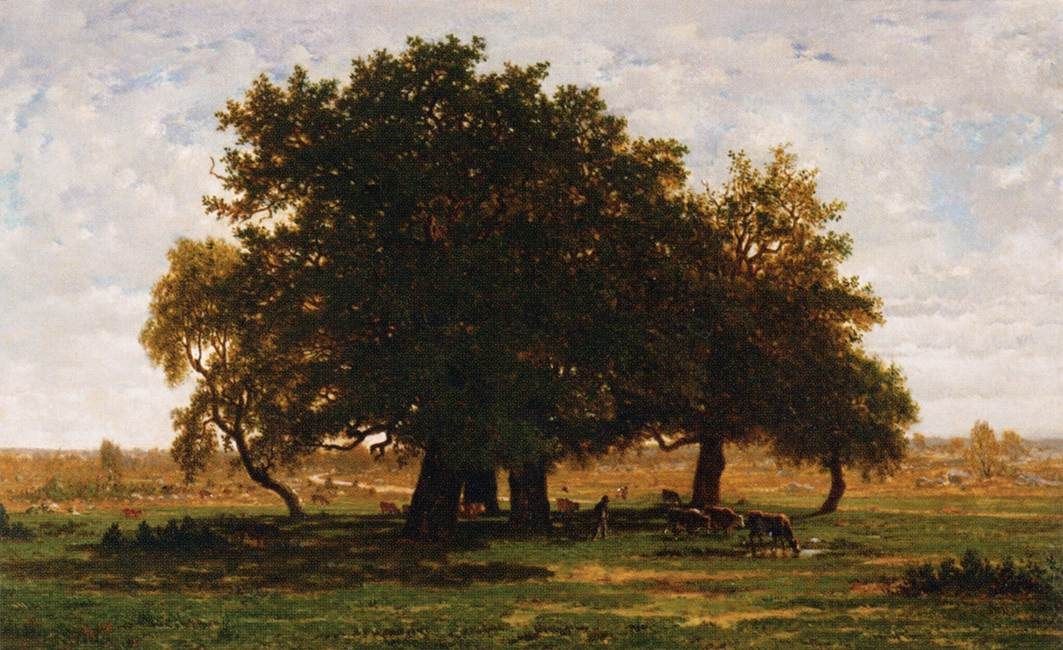
Oak Grove, Apremont by Théodore Rousseau, a central painter of the Barbizon School.
Barbizon School Painting and the Bridge to Impressionism
The Barbizon School is often described as a precursor to Impressionism, and the relationship is real. But framing Barbizon only as a prologue does it a disservice, because the movement has a coherence and an integrity that stands entirely on its own terms. Think of it less as a rough draft and more as a parallel language, one that shares certain roots with Impressionism but says something different.
The specific connections are worth understanding. The Barbizon painters established plein air practice as artistically serious. They demonstrated that ordinary landscape was a worthy subject. They loosened brushwork in the direction of direct observation. And in Daubigny's case, the personal influence on Monet was direct and acknowledged.
But there are real differences, and they matter practically.
The two movements can be usefully distinguished along several lines. Barbizon works in a tonal and earth-based palette: strong darks, rich ochres and umbers, controlled colour temperature. It favours low or raking light, the quality of dawn and dusk rather than the full intensity of midday. Its subjects are humble and rural: forests, fields, peasants, the edges of villages. And the outdoor study, though it became increasingly the finished work, retained a degree of structural solidity and compositional intention.
Impressionism moved in a different direction. The palette lightened dramatically. Colour was broken into separate strokes that blend in the eye rather than on the canvas. Midday light and optical colour became central interests. Subject matter expanded to include modern urban life, railway stations, leisure on the Seine. And the emphasis shifted decisively towards transient sensation: the moment of perception rather than the structured mood.
Barbizon vs Impressionism: how they differ
Pros
- + Barbizon: tonal and earth-based palette, strong darks, structured forms
- + Barbizon: low or raking light, dawn or dusk conditions
- + Barbizon: humble rural subjects, forests, fields, peasants
- + Barbizon: outdoor study treated as finished work in its own right
Cons
- - Impressionism: higher key, broken colour, visible separate brushstrokes
- - Impressionism: midday light and optical colour effects
- - Impressionism: modern life, urban leisure, railways as well as landscape
- - Impressionism: transient sensation prioritised over structural solidity
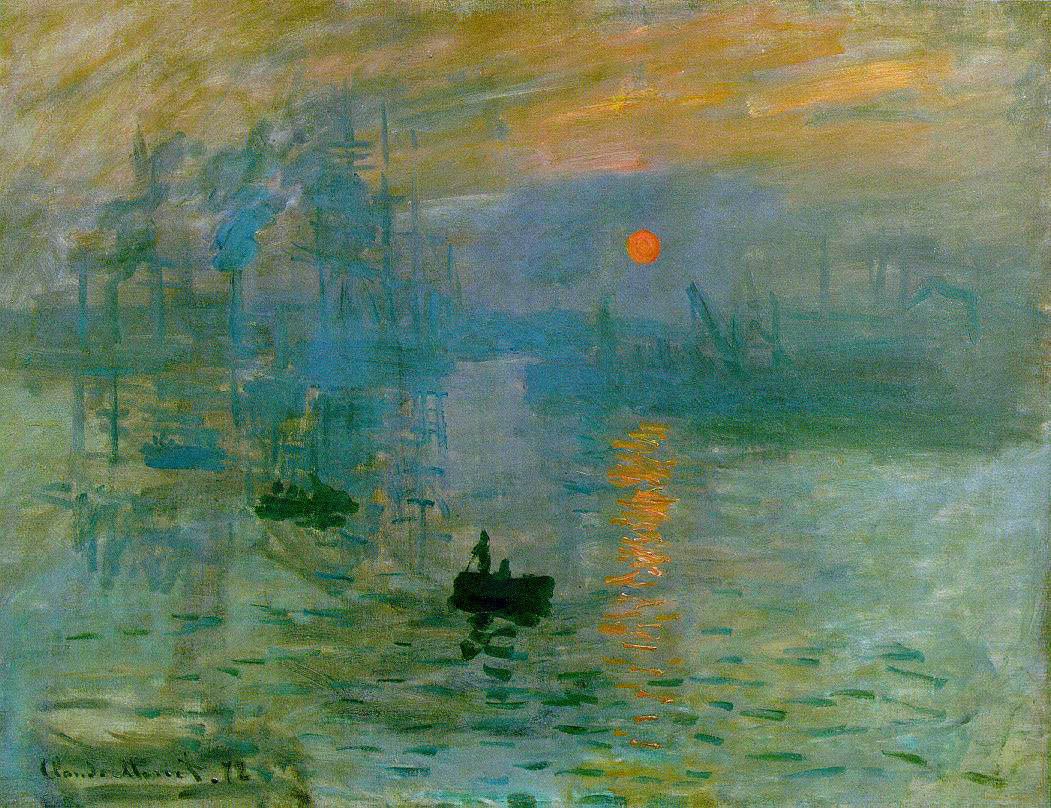
Impression, Sunrise (1872) by Claude Monet, illustrating the later Impressionist emphasis on transient light that grew from the Barbizon legacy.
Credit: Claude Monet; Wikimedia Commons; Public domain
For a UK plein air painter, Barbizon is arguably the more immediately useful school when you are learning to organise a painting. Its emphasis on tonal structure, mood, and the coherence of large masses gives you a framework that works in the field before you have developed the speed and confidence that Impressionist methods demand. Impressionism builds on those foundations, but the foundations themselves are worth understanding first.
What Barbizon School Painting Can Teach You Today
History is only useful if it changes how you work. Here, then, is what Barbizon painting actually suggests for a session outdoors in Britain today.
Work small and finish in one sitting. The Barbizon painters regularly completed paintings on modest supports in a single outdoor session. A panel in the 6x8 or 8x10 inch range forces a useful discipline: you have to commit to one idea, one effect, one set of conditions before the light shifts. There is a clarity that comes from small scale, an inability to fuss. Treat each session as a study of one specific effect: backlit trees against a grey sky, mist lifting from a valley floor, the quality of shadow on wet ground after rain.
Start small
The Barbizon painters regularly completed paintings on small supports in a single sitting outdoors. A 6x8 or 8x10 panel forces you to commit to one idea before the light changes. Try treating each session as a study of a single effect: backlit trees, mist on a hillside, or reflected light on wet ground.
Build from tonal structure and atmosphere before you add detail. This is Corot's lesson, and it is perhaps the most transferable idea in the whole Barbizon tradition. Before you reach for specific colours or start describing forms, establish the painting in three or four value families. Where is the darkest dark? Where is the lightest light? What is the mid-tone that holds the rest together? Getting this right gives you a painting that works even if every detail is simplified. Getting it wrong means no amount of detail will save it.
Choose ordinary subjects, not spectacular ones. This takes more courage than it sounds. A spectacular view is seductive precisely because it seems to do some of the work for you. An ordinary subject, a hedgerow, a farm gate, the edge of a field where the light is doing something interesting, asks you to find the painting through observation rather than through the inherent drama of the scene. The Barbizon painters made this their consistent practice, and it produced an extraordinary body of work. Your local woodland, the field behind the car park, the riverbank ten minutes from home: these are all legitimate subjects treated seriously.
When figures appear, make them part of the land, not decorations on it. This is Millet's contribution. If a dog-walker crosses your scene, or a figure appears at the edge of a field, resist the temptation to paint them as a separate element. Think about how they relate to the ground plane, how their weight connects them to the earth, how their position within the composition serves the painting as a whole. A figure integrated into the land creates a sense of real presence. A figure pasted onto a completed landscape feels like a separate species.
None of this requires historical exactitude. You do not need to paint with Barbizon-era materials or follow a prescribed method. A pochade box, a lightweight easel, and fast-drying oils are entirely suited to working in the spirit the Barbizon painters established: directly, responsively, in the presence of the subject. The goal is the same it was for Rousseau in the Forest of Fontainebleau: to be genuinely present in a landscape and honest about what you find there.
Where to See Barbizon Paintings in the UK and Online
You do not need to travel to the Musée d'Orsay to study these painters, though if you ever find yourself in Paris it is well worth going.
Major UK museums hold works by Corot, Daubigny, Millet, and their contemporaries. It is worth checking the permanent collections of larger regional galleries as well as the national institutions: Barbizon paintings were popular with British collectors in the nineteenth century, and they entered UK collections in significant numbers. A visit to a regional gallery with a strong Victorian collection is often more productive than you might expect.
For digital study, the Metropolitan Museum of Art in New York has a substantial and freely accessible online collection that includes major Barbizon works in high resolution. Google Arts and Culture carries additional works from French and European museums. Both platforms allow you to zoom in on individual passages of paint in a way that reveals brushwork, layering decisions, and the handling of edges in considerable detail.
One specific suggestion: look for smaller studies and sketches alongside the finished exhibition works. The studies are often where the plein air quality is most visible, where you can see how the painter organised the picture quickly in response to what was actually in front of them. The finished works can show you compositional strategy and tonal architecture. The studies show you the method in action.
Taken together, the Barbizon painters represent a moment when landscape painting found its confidence. They left the studio, walked into the forest, and decided that what they found there was worth the full attention of serious art. That conviction, once established, did not go away. It runs directly through to the Impressionists, through to the plein air revival of the late twentieth century, and through to anyone who puts a panel in a bag and heads outside to paint on a weekend morning in Britain today.
FAQ
Frequently Asked Questions
What is Barbizon School painting?
A mid 19th century French movement of artists who worked outdoors around the Forest of Fontainebleau, painting ordinary rural scenes from direct observation.
How did the Barbizon painters influence Impressionism?
They legitimised plein air practice, emphasised tonal unity and direct observation, and loosened brushwork, creating a foundation that Impressionists later built on.
Which Barbizon artists are most important to study and why?
Key names include Corot for tonal massing, Rousseau for mood, Daubigny for river horizontals, Millet for figures integrated into landscape, and Diaz for colour and texture.
What practical techniques from Barbizon painting help plein air painters today?
Work small and finish in one sitting, establish large value masses before detail, choose ordinary subjects, and integrate any figures structurally into the scene.
Where can I view Barbizon works in the UK or online?
Major UK museums and regional galleries often hold works. Online, the Metropolitan Museum and Google Arts and Culture offer high resolution images and studies to examine.
Author

PleinAirPainting Editorial Team
PleinAirPainting.co.uk helps artists paint outdoors with confidence through UK-focused guides, equipment advice, resources and plein air inspiration.