How the Paint Tube Changed Art Forever
John Goffe Rand's 1841 tin paint tube made oil paint portable and reliable. It enabled plein air painting, broadened access to oils, and helped make Impressionism possible. The basic tube endures.

Key takeaways
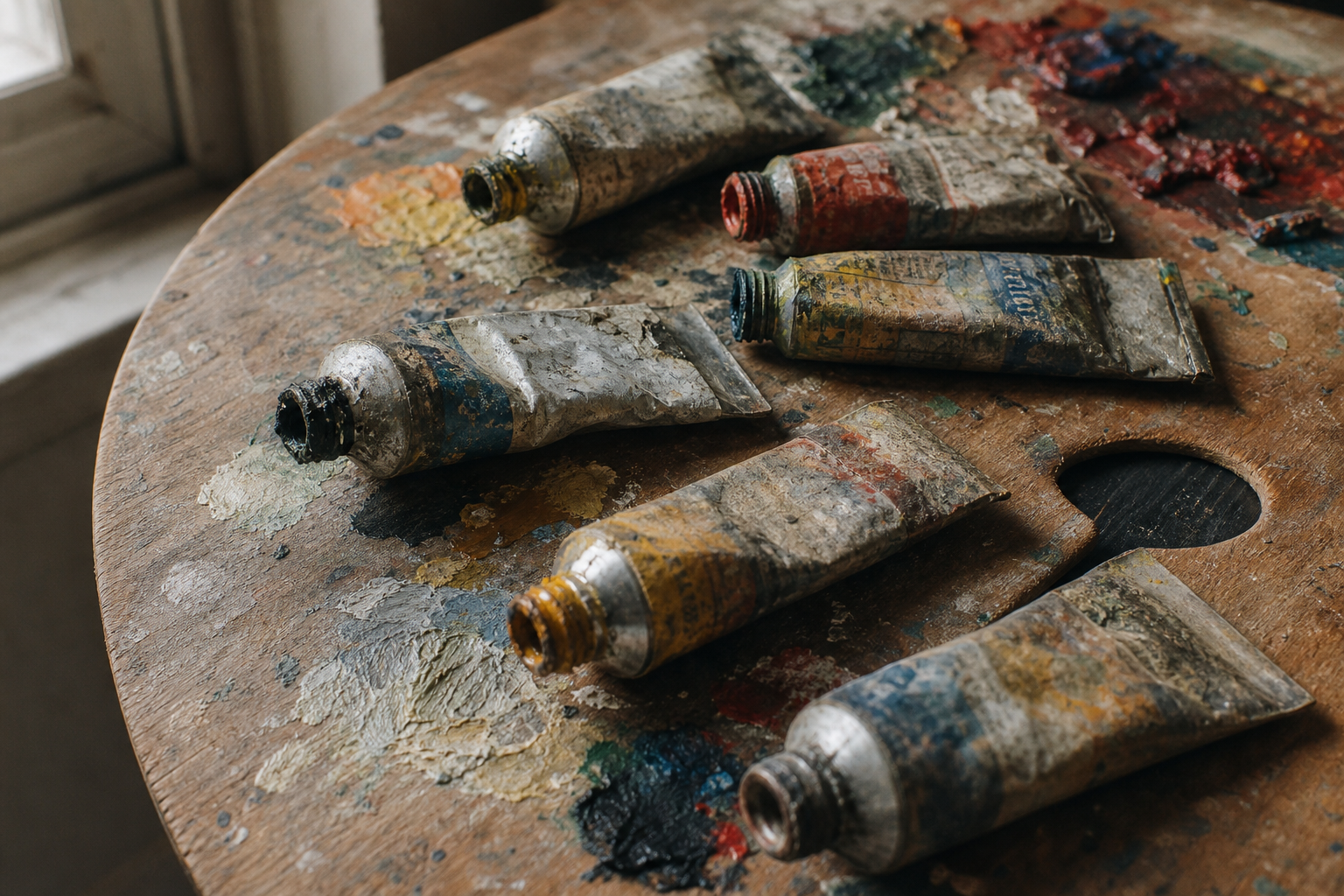
- • John Goffe Rand patented a tin paint tube in London in 1841, solving storage and transport problems for oil paint.
- • Tubed paint replaced pig bladders and fragile glass syringes with a portable, airtight solution that kept colours workable.
- • The tube made plein air painting practical, supporting the observational methods central to Impressionism.
- • Mass production of tubes lowered barriers to oil painting and broadened access for students and hobbyists.
- • Though Rand was American, the invention was commercialised and spread through London colourmen and manufacturers.
Pick up a tube of paint. It's an entirely ordinary object: a little metal cylinder, crimped at one end, capped at the other, probably a bit battered and smeared from use. You've almost certainly never given it a second thought. But here's the thing: without this unremarkable little tube, Impressionism as we know it probably wouldn't exist. The French painter Pierre-Auguste Renoir put it simply: "Without colours in tubes, there would be no Cézanne, no Monet, no Pissarro, and no Impressionism." That's a large claim for such a small object. What follows is the story of why Renoir was right, who actually invented the paint tube, and why that story begins not in Paris, but in London.
Before the Tube: Painting Was a Messy, Studio-Bound Business
To understand why the paint tube mattered, you need to understand what painters were dealing with before it existed. The history of paint tubes begins with a problem that was, by any measure, genuinely unpleasant to work around.
What Painters Actually Used (And Why It Was a Problem)
For centuries, oil painters stored their mixed colours in small pouches made from animal bladders, typically a pig's. The bladder would be cleaned, filled with paint, and tied shut with a piece of string. To get paint out, you'd puncture the bladder with a sharp tack, squeeze out what you needed, and then plug the hole back up. If you were lucky, the improvised seal held. Often, it didn't.
The problems were considerable. Bladders weren't airtight, so paint dried out faster than you'd want. They burst in transport, or simply leaked, turning a bag into a ruinous mess of hardened pigment. Resealing them reliably was essentially impossible; in practice, they were closer to single-use than reusable. And because the whole system was so fragile and prone to failure, painters were largely tied to their studios, where they could grind fresh pigments, work in controlled conditions, and not worry about a bladder of vermilion exploding on the way to a hillside.
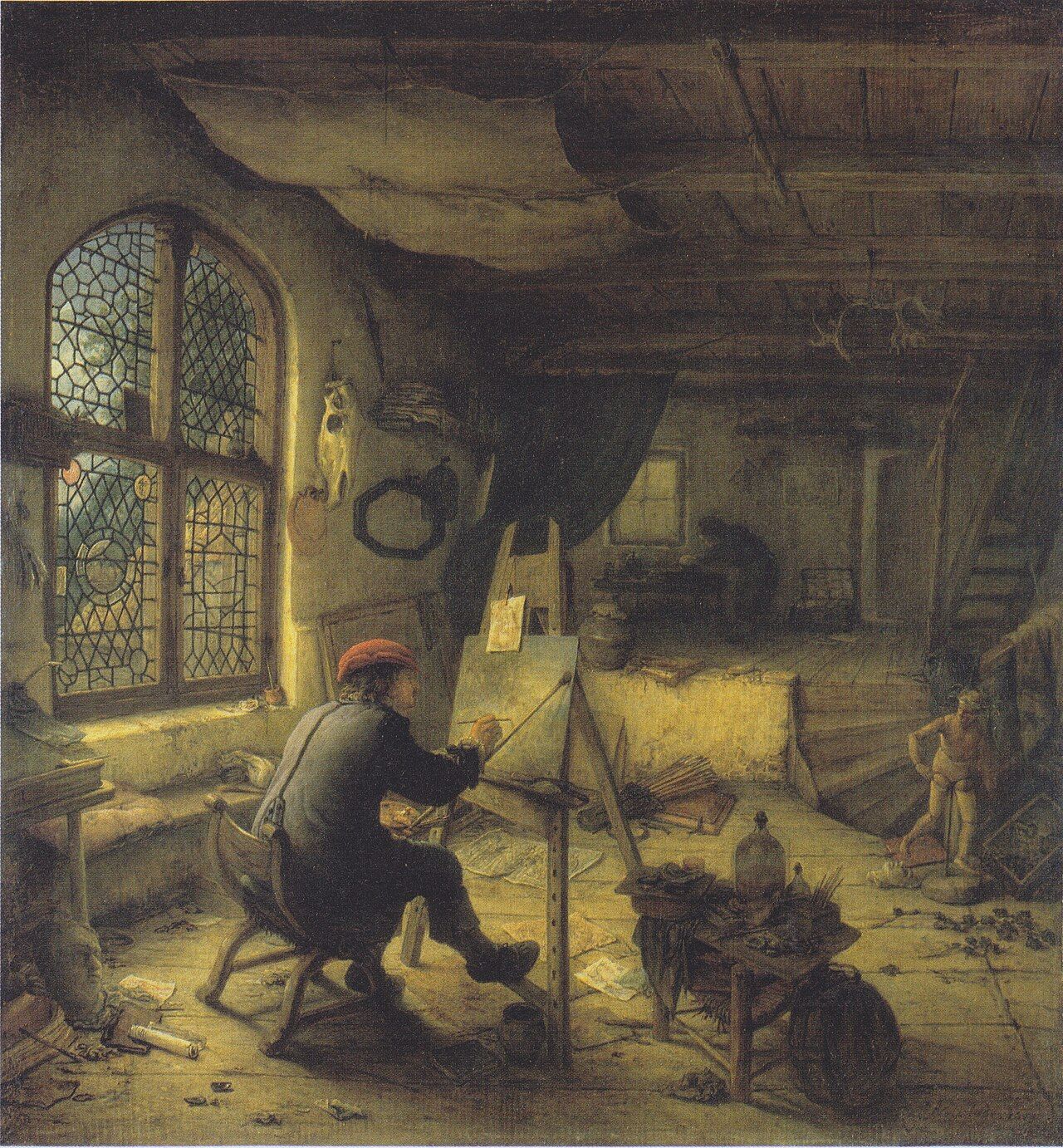
The Painter in His Studio, Adriaen van Ostade, 1663. Public domain, via Wikimedia Commons.
Painting outdoors wasn't unheard of, but it was a genuine logistical undertaking. John Constable, who was deeply invested in capturing the English landscape directly from nature, produced his famous outdoor oil sketches with considerable technical effort behind the scenes. The loose, immediate quality of those sketches was hard won. The equipment simply wasn't designed for spontaneity.
Early Attempts at a Solution
By the 1820s, colourmen and inventors had begun trying to solve the problem. Glass syringes with pistons appeared on the market, offering a more reliable seal than a knotted bladder. One such design was patented in 1840. They were an improvement in principle, but a frustrating one in practice: glass breaks, and a glass syringe full of cadmium yellow doesn't survive a tumble from a hillside stile particularly well.
The real question wasn't whether paint could be stored more reliably. It was whether it could be stored reliably and cheaply and portably, in something robust enough to travel without anxiety. That was the gap nobody had filled. Until 1841.
John Goffe Rand and the 1841 Patent That Changed Everything
The Man Behind the Tube
John Goffe Rand was born in New Hampshire in 1801. He trained as a painter and by the 1830s had established himself as a portraitist of some reputation. He was working in London when the problem of paint storage was still, for every painter around him, simply an irritating fact of professional life.
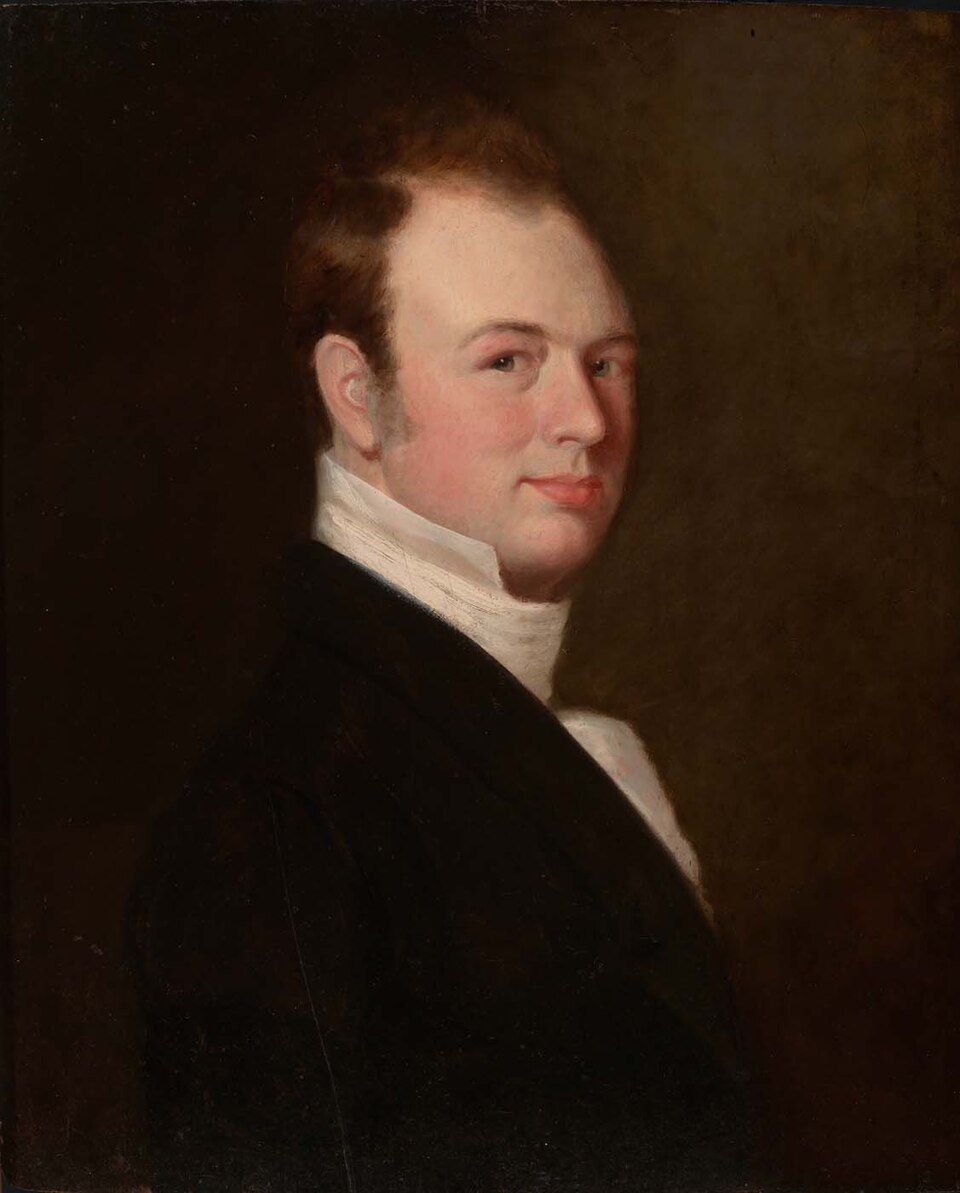
John Goffe Rand - Self Portrait (1836)
That context matters. Rand wasn't a chemist or an engineer approaching the problem from the outside. He was a working painter, using the same unsatisfactory bladders as every other artist around him, and he decided to do something about it. The solution he arrived at was elegant: a small, flexible tube made from tin, filled with paint from one end, then folded and crimped shut to keep air out. When you needed paint, you squeezed the tube. When you'd used some, you rolled the crimped end up a little further. Simple, robust, portable, and airtight enough to keep paint workable over time.
Rand patented his design in England on 6 March 1841. The United States patent followed on 11 September 1841. That sequence is important, and it's consistently underreported: the paint tube was, from its very first day as a protected invention, a British patent. The story of the paint tube invention doesn't begin in America or France. It begins in London.
Why the Tube Was Different
The tin tube solved problems that glass syringes couldn't. Flexible metal deforms rather than shatters; you could squeeze it, fold it, drop it, and carry it in a bag without treating it like it was fragile. As paint was used, the tube could be rolled flat from the crimped end, keeping the remaining contents pressed forward and away from air. The seal held.
Rand's invention was quickly taken up by the London colourman Thomas Brown, who marketed the first commercially produced tubes. Within a few years, Winsor and Newton, already one of the leading colour manufacturers in Britain, secured rights to the design and began producing tubed paints at scale. This wasn't a foreign technology being imported into British painting practice. It grew directly out of the London colourmen's trade, was first commercialised by British suppliers, and was developed and refined by British manufacturers. From the very beginning, the history of paint tubes is a British commercial story as much as anything else.
How a Tin Tube Helped Invent Modern Art
This is where paint tube invention and art history become inseparable. The practical changes Rand's design made possible were small in themselves, but their cumulative effect was profound.
Painting Outside Became Possible
Pre-mixed tubed colours changed the logistics of outdoor painting entirely. A painter heading out for the day no longer needed to grind pigments before leaving the studio or carry fragile, leaking bladders. The tubes were compact, they didn't dry out, they travelled without disaster, and they could be organised on a palette in minutes. Larger selections of colour became practical to carry. Sessions could happen spontaneously, in response to weather and light, rather than requiring careful logistical preparation.
The studio dependency, which had been a practical constraint rather than an aesthetic choice for most painters, began to ease. Painting outdoors became a normal working day, not an expedition. And that shift in what was routine had consequences that went far beyond convenience.
Renoir's Quote and What It Actually Means
"Without colours in tubes, there would be no Cézanne, no Monet, no Pissarro, and no Impressionism."
Whether Renoir said those words in precisely that form is, as historians tend to note, not perfectly documented. But the sentiment is broadly accurate, and Renoir was in a position to know. The Impressionists didn't just paint outdoors occasionally; they made outdoor observation the central method of their practice. Capturing the specific quality of light on a particular afternoon, the flicker of sunlight on water, the way shadows change colour as the day moves: these were things you could only do if you were actually there, in front of the subject, with your materials to hand.
The tube didn't create Impressionism by itself. New synthetic pigments were also important, expanding the colour palette and making vivid, stable colours more affordable. The expansion of the French railway network opened up the countryside to painters based in Paris. Changing patterns of patronage shifted artists away from dependence on grand historical subjects toward landscape and contemporary life. These were all part of the picture.
But the tube was the practical enabler. It removed the friction that had kept painters largely indoors. It made the outdoor session routine. Without that shift in the texture of daily working life, the particular kind of sustained, repeated outdoor observation that defines Impressionist painting would have remained, for most painters, more aspiration than practice.
The Tube Democratised Oil Painting
There's a dimension to this story that's often missed in accounts of the paint tube invention's significance, and it's worth dwelling on.
Before tubed paint was widely available, oil painting required studio infrastructure. You needed space and equipment to grind pigments, access to reliable suppliers, and enough time to prepare materials before you could put a brush on canvas. That wasn't prohibitive for professional painters, but it was a substantial barrier for students, hobbyists, and the growing middle class who might have wanted to paint as a leisure pursuit.
Mass-produced tubed paint changed that. Manufacturing at scale brought the cost per unit down. The studio grinding setup became unnecessary. A beginner could buy a set of tubes, a canvas board, and a small palette, and be outdoors painting within the hour. UK colourmen began selling tubed colour sets to exactly this market, and the leisure painting boom of the late Victorian period was, in part, a consequence of that accessibility.
Oil painting was no longer the exclusive domain of the professional or the wealthy amateur with a studio. It was something a much wider range of people could take up, take outside, and genuinely enjoy. The accessibility that Rand's invention made possible is, in a direct line, the same accessibility that makes plein air painting the broad community it is today.
A London Story We've Mostly Forgotten
Most accounts of the paint tube's history treat it as an American invention (Rand was American) or tell the story primarily through the lens of French Impressionism. What gets lost in that framing is how thoroughly British this story actually is.
Rand's English patent came first. The invention was commercialised from the outset through London's colourmen trade. Thomas Brown brought the first tubes to market in the city. Winsor and Newton, a London firm, secured the design and gave it the manufacturing scale it needed to reach painters across Britain and eventually beyond. Records of British artists' suppliers document the shift across the mid-nineteenth century, as loose pigments and bladders gradually gave way to tubed paints in the stock carried by colour merchants up and down the country.
The tube didn't arrive in British painting from somewhere else. It was developed here, by someone embedded in the city's art world, and spread through the British supply chain. That's the version of the story worth telling.
As for the tubes themselves: the object Rand patented in 1841 and the tube you'd find in any UK art shop today share the same fundamental design. A flexible cylindrical body, filled from one end, sealed at the other. The alloys have changed, the closure mechanisms have improved, and the same basic form now works for oils, watercolour, gouache, and acrylic. But the principle is Rand's, and it's remained essentially unchanged for nearly two hundred years.
What This Means When You Open a Tube Today
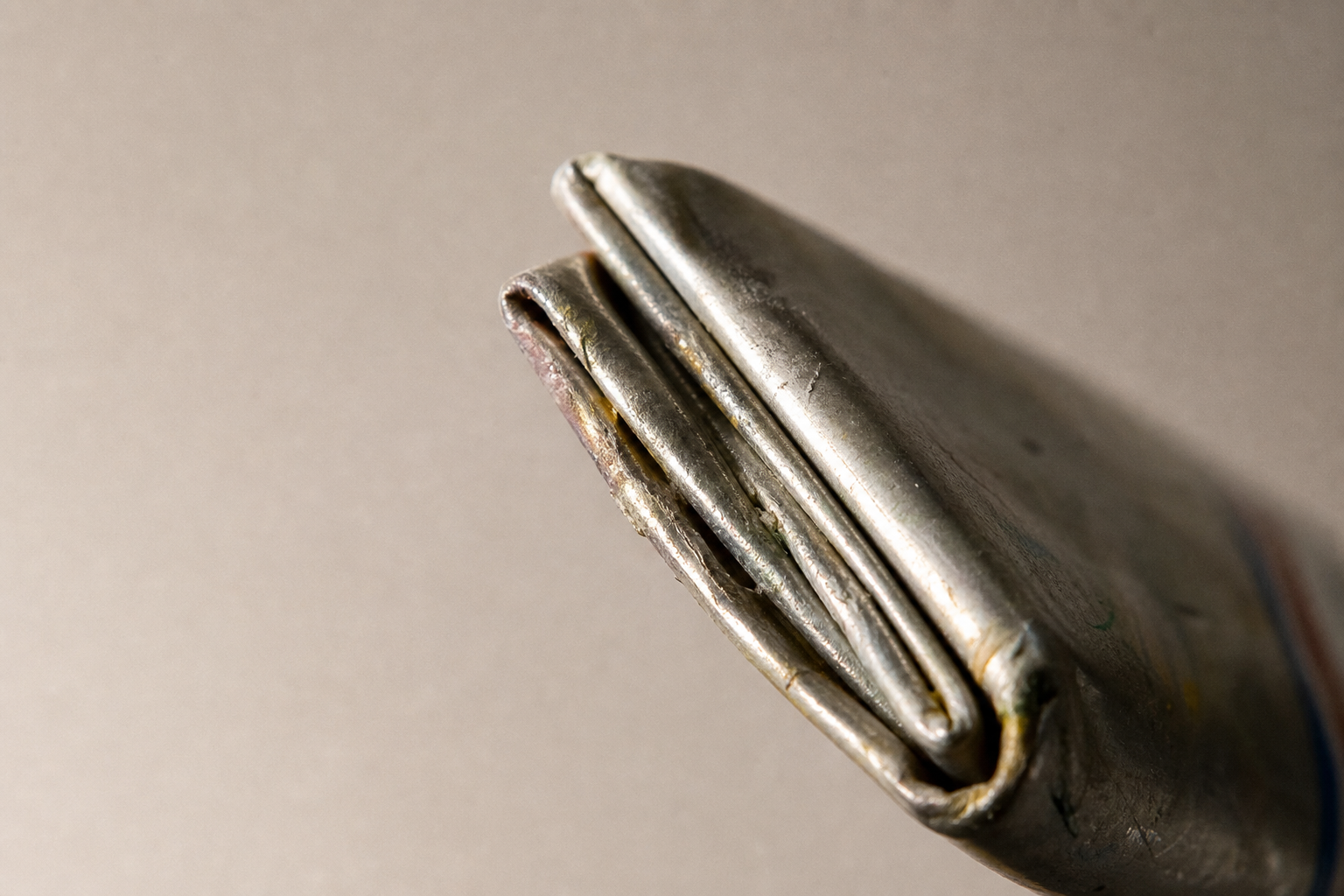
The next time you're loading your bag for a morning's painting, think briefly about what you're actually handling. Every tube of colour in there is a direct descendant of Rand's 1841 tin: the same principle, the same basic form, the same solution to the same problem.
Rand invented the tube because he was a painter who found the existing situation genuinely unworkable. He understood the frustration from the inside, in exactly the same way any painter today understands the minor irritations of outdoor practice. He didn't set out to change art history; he set out to fix something that was broken. The consequences turned out to be larger than anyone could reasonably have anticipated.
The Victorian painter poking a tack into a pig's bladder on a studio morning and the painter heading out on a grey Tuesday with a bag full of tubes are separated by the same practical problem, solved by one man in London in the winter of 1841. That's a remarkable piece of history to be carrying around in a painting bag.
FAQ
Frequently Asked Questions
Who invented the paint tube and when?
The paint tube was invented by John Goffe Rand, a painter, who patented a tin tube design in London on 6 March 1841 and in the United States in September 1841.
What problem did the paint tube solve for painters?
It replaced fragile pig bladders and glass syringes with a flexible, airtight container that kept paint usable, was portable, and could be carried without breaking or leaking.
How did the tube affect the development of Impressionism?
By making pre-mixed oil colours portable and reliable, tubed paint enabled routine plein air painting, which let artists observe changing light and colour directly and helped fuel Impressionist practice.
Was the paint tube a British or American invention?
Although Rand was American, his English patent came first and the design was commercialised through London colourmen. The early manufacturing and spread of tubed paint was rooted in Britain.
Is Rand's basic tube design still used today?
Yes. The basic principle of a flexible, crimp-sealed tube remains essentially the same, though alloys and closures have improved and the form now serves oils, watercolour, gouache, and acrylics.
Author

PleinAirPainting Editorial Team
PleinAirPainting.co.uk helps artists paint outdoors with confidence through UK-focused guides, equipment advice, resources and plein air inspiration.