Constable Country, Suffolk: Painting in the Footsteps of a Master
A practical plein air guide to Constable Country Suffolk, with key painting sites, travel routes, timing tips, and where to see The Hay Wain in the landscape that inspired Constable.

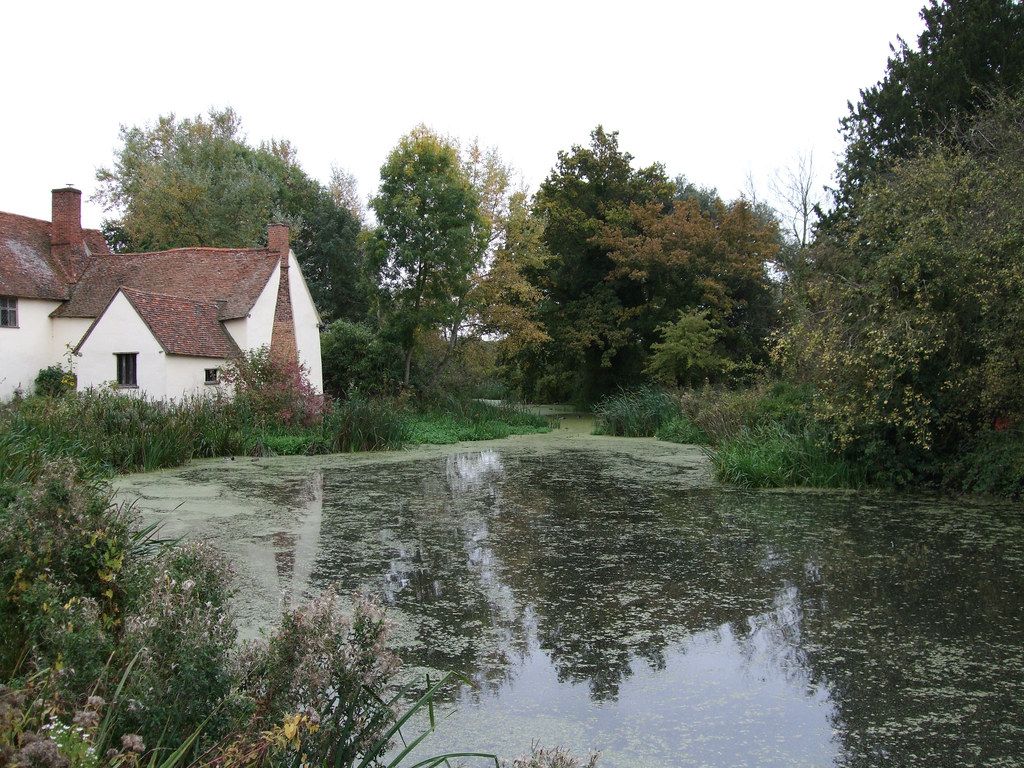
Flatford Mill, the location of The Hay Wain, on the River Stour in Suffolk.
Credit: Jim Linwood / Flickr — CC BY 2.0
Key takeaways
- • Constable Country Suffolk is the Stour valley around Flatford, East Bergholt, Dedham and Gun Hill, preserved for its historic landscape.
- • Key paintable sites include Flatford Mill and Willy Lott's House, the River Stour towpath, Dedham village and the Gun Hill viewpoint.
- • Travel light and walk or cycle the classic loop from Flatford to Dedham to Gun Hill to experience connected views and practical access.
- • Visit at quieter times for painting: weekdays in spring or autumn, early mornings in summer, or overcast days for steadier light.
- • Plan to combine exhibition visits with plein air work during the Constable 250 events, including the rare loan of The Hay Wain to Ipswich.
There is something genuinely unusual about Constable Country in Suffolk. Most of the landscapes that shaped the history of Western painting have been swallowed by suburbs, straightened by agriculture, or simply worn into something unrecognisable over two centuries of change. The Stour valley has not. Stand at the river's edge near Flatford on a quiet morning, look across the millpond towards Willy Lott's House, and you are looking at almost exactly what John Constable looked at. The buildings are there. The water is there. The particular flatness of the light over the water meadows, the enormous Suffolk sky pressing down on the treeline: still there.
For a plein air painter, this is a rare thing. You can do more than admire a landscape that inspired great work; you can set up in it, paint in it, and feel the specific quality of light that drove one of the most significant outdoor painters Britain has ever produced. This guide is for anyone who wants to do exactly that.
What Is Constable Country and Where Exactly Is It?
The name "Constable Country" refers broadly to the Stour valley along the Suffolk and Essex border, stretching roughly from the village of Nayland in the west to Manningtree in the east. The heart of it lies in a comparatively compact area: Flatford, East Bergholt, Dedham and the surrounding lanes and footpaths, with Gun Hill offering elevated views across the whole. You can walk between the key sites in a single day, and the distances are short enough that the landscape feels unified rather than spread out.
The area falls within the Dedham Vale National Landscape, formerly designated as an Area of Outstanding Natural Beauty. That designation matters practically: it means the landscape is actively managed and protected from major development, which is a significant part of why it still looks the way it does. The National Trust manages the Flatford estate, including the mill buildings and Willy Lott's House, while the wider Dedham Vale is overseen by its own partnership of local authorities and conservation bodies. Together, these organisations maintain the footpaths, interpret the landscape, and balance visitor access with genuine conservation.
For a painter, this means well-maintained access routes, clear signage connecting the key Constable viewpoints, and a landscape that has been deliberately kept from the worst kinds of change. It also means some management of the visitor experience, which is worth knowing about before you arrive.
The landscape Constable grew up in
Constable did not choose this valley at random. His family owned Flatford Mill; he grew up in East Bergholt, less than two miles to the north. This was the landscape of his childhood before it was the landscape of his painting career, and the intimacy shows in the work. He knew where the light fell on the river at different times of year. He knew the barges, the locks, the exact angle of the cottage reflected in the water. When he made his outdoor oil sketches along the Stour, he was working in a place he understood in the way that only long familiarity produces. For painters visiting today, that context adds something real to the experience: you are not just visiting a picturesque valley, you are standing in someone's home ground.
The Painting Locations You Can Still Visit Today
Constable Country painting locations range from the extremely well-known to the quietly overlooked. The sites below are the ones that connect most directly to his paintings and that remain accessible and paintable today.
Flatford Mill and Willy Lott's House
The mill buildings at Flatford are managed by the National Trust, and the approach from the car park along the river path brings you quickly to the view that has become one of the most recognised in British art. Willy Lott's House, the timber-framed cottage that appears in [The Hay Wain](https://www.pleinairpainting.co.uk/inspiration/the-hay-wain-story), stands essentially unchanged on the far bank of the millpond. The National Trust now marks the Hay Wain viewpoint explicitly on their walking routes: look for the signed stop along the river path, where the angle across the water corresponds most closely to the composition in the painting.
In terms of what to actually paint: the millpond view is the obvious choice, but there are many angles along this stretch. The lock, the wooden bridge, the mill building from the towpath, the reflections in still water in early morning light all offer strong material. The Field Studies Council runs a residential centre in the mill buildings themselves, which is worth noting if you're considering an extended stay in the landscape.
Honest note: Flatford is popular, and the area immediately around Willy Lott's House will have other visitors, particularly on weekends and during school holidays. In high summer this can feel quite busy at the prime viewpoints. It does not make the place unpaintable, but it is worth factoring into your timing.
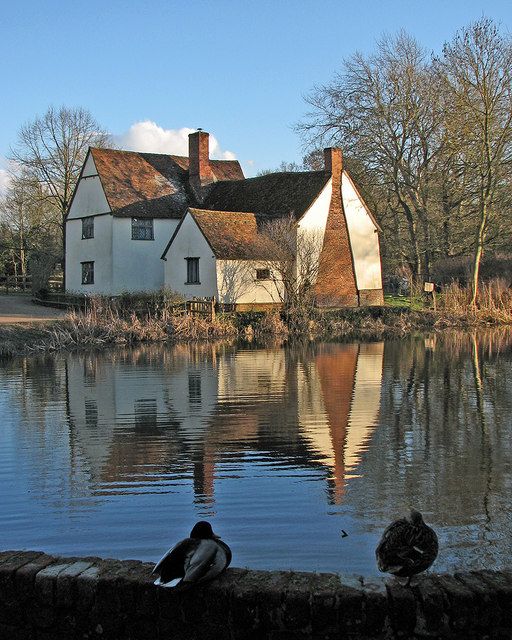
Flatford millpond with Willy Lott's House visible on the riverbank in winter. by John Sutton / geographorguk — CC BY-SA 2.0
The River Stour towpath
East of Flatford, the footpath follows the river through a sequence of views that appear across Constable's Stour valley paintings. The lock, the water meadows, the grazing cattle on flat ground with sky above: Scene on a Navigable River and related works connect directly to this landscape as it still appears today. Walking the towpath on a grey morning in October, or on a clear afternoon in late spring, you begin to understand why the sky dominates so many of his compositions. The valley floor is low and flat; the sky is enormous. There is nowhere else for the eye to go.
For painters, the towpath offers more solitude than Flatford itself. You can find a position along the bank away from the main visitor cluster, settle in, and work from a view that has barely changed in two hundred years.
Dedham village
Dedham is around two miles east of Flatford along the river path, and it offers a different quality of painting subject. The church tower of St Mary the Virgin rises above the village in a way that appears repeatedly across Constable's work; the Suffolk Pink houses along the main street and the village's quiet scale make it one of the most paintable settlements in the region.
Contemporary painters work here regularly, including watercolourists and urban sketchers who find the architectural detail and the softer light in the village centre easier to manage than the river views. Dedham is also noticeably less crowded than Flatford, which gives you more freedom in choosing where to position yourself. The car park in the village centre is a useful alternative arrival point if the Flatford lane is busy.
Gun Hill and the Dedham Vale viewpoint
Gun Hill, above Dedham, offers elevated views south across the Vale, with the river winding through the flat valley floor below and Dedham's church tower visible in the middle distance. Constable 250 heritage materials identify this as the vantage point for his broader Dedham Vale compositions, and the relationship between the elevated viewpoint and the expansive landscape below is immediately apparent when you stand there.
One honest note: tree growth over the past two centuries means the horizon lines from Gun Hill are not identical to those in the paintings. The fundamental character of the view remains, but do not expect a precise match. Go with curiosity rather than expecting an exact overlay of paint and landscape, and you will find it genuinely rewarding.
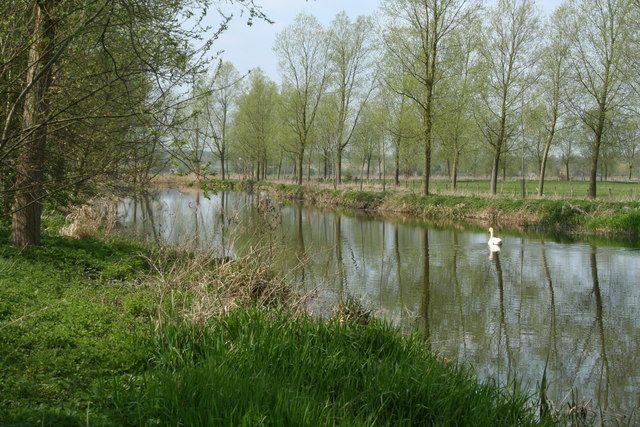
The River Stour at the Suffolk–Essex border. by John Lemay / Wikimedia — CC BY-SA 2.0
East Bergholt and the surrounding lanes
East Bergholt is Constable's birthplace, and the lanes and field structures around the village retain much of their character. There is less that maps directly to a specific famous painting here, and that is part of the point. For painters who want to move beyond the main visitor circuit and work in the landscape that shaped Constable's earliest sketching habits, the footpaths and lanes around East Bergholt offer a quieter, less mediated experience. This is where to go if you want to understand the landscape rather than just document the landmarks.
Getting There and Getting Around
By rail
Manningtree station, on the London Liverpool Street to Ipswich line, is the main gateway to Constable Country Suffolk from outside the area. From Manningtree, Flatford is approximately 2.5 miles, around 45 to 50 minutes on foot using the signed walking routes. The Painters Trail cycle route also connects Manningtree to Flatford and Dedham, and is well suited to anyone travelling light with sketching kit on a bicycle. There is no direct bus to Flatford; the nearest bus stop in East Bergholt involves a walk of roughly 40 minutes to the mill, so arriving by rail via Manningtree is generally the more practical choice for those without a car.
By car
From the A12 between Colchester and Ipswich, take the exit for East Bergholt. The National Trust car park at Flatford is signed from there. The access lane into Flatford is narrow; in summer, arriving early is strongly recommended. By 10am on a summer weekend, the lane and car park can be at capacity.
On foot between sites
The classic loop from Flatford to Dedham to Gun Hill and back covers the main Constable painting locations and is walkable in a full day at a comfortable pace. This is genuinely the recommended way to experience the landscape as a painter: you see the connections between the views, understand the geography of the valley, and arrive at each site having walked through the landscape rather than driven into it.
A note on gear
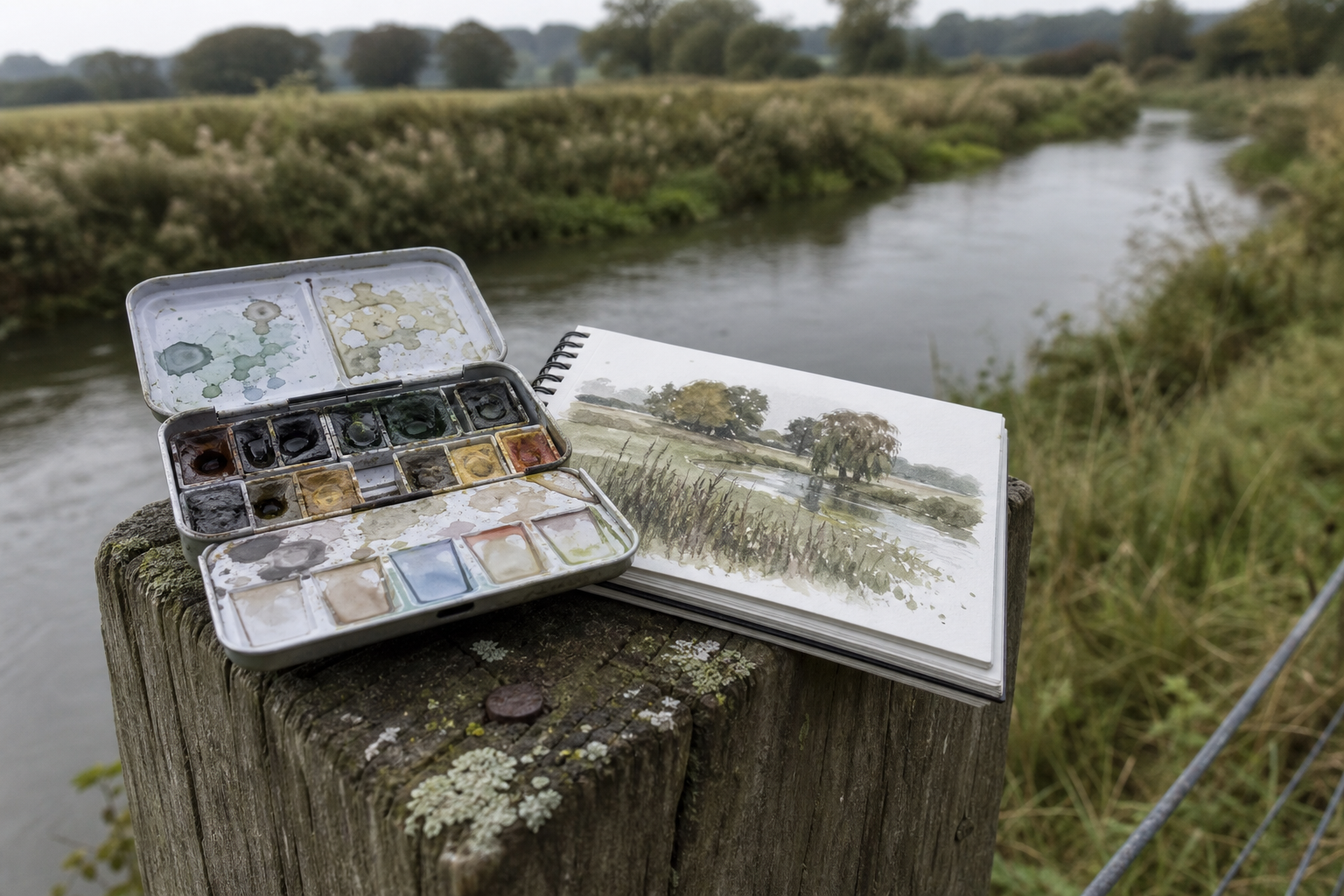
If you are arriving by train and walking the loop, or walking any significant distance between sites, go light. A compact watercolour kit and a small sketchbook, or a pochade box with a handful of oil colours and a few panels, is far more practical than a full field easel and a heavy oil painting bag. The paths are well-maintained, but the distances are real, and painting energy matters more than gear capacity once you are out there.
Painting Here in Practice: What to Expect
Crowds and timing
Flatford in July and August is a busy place. The Hay Wain viewpoint and the area immediately around the mill buildings attract a steady stream of visitors throughout the day in high season, and on fine summer weekends the narrow paths around the millpond can feel genuinely crowded. This is worth knowing and planning around, not grounds for avoiding the place.
The most practical advice: aim for weekday visits in spring or autumn, or arrive before 10am in summer if you want the classic viewpoints to yourself. Overcast days in October, or still mornings in April before the school holidays begin, offer the most space and the most paintable light.
Where you can set up
The National Trust estate, the Stour towpath, and the rights of way across the Dedham Vale are all accessible for casual painting and sketching. A solo painter working from a public footpath requires no specific permission. If you are organising a group or workshop, it is worth contacting the National Trust at Flatford and the Dedham Vale National Landscape team before you go: the landscape is protected, visitor numbers are managed, and groups painting in organised sessions are treated differently from individual visitors.
Stay on footpaths, respect crops and riverbanks, and avoid blocking narrow points such as bridges and lock gates. These are practical courtesies that keep the landscape accessible and the relationships with land managers positive.
Painting the light Constable loved
Constable's sky studies and his fascination with shifting natural light are inseparable from this specific landscape. The quality of light over the Stour valley water meadows, particularly in morning and evening, is unlike anywhere inland: it is reflected upward from the river, filtered through the enormous cloud formations that build over the flat ground, and constantly shifting. His paintings capture something that is genuinely still present here.
Morning light from the east, in the hour or two after sunrise, gives the mill buildings and the river a warm, raking quality that appears across his work. Overcast days flatten the shadows and reduce contrast, which can actually suit painters working on values who find the drama of full sunlight harder to manage.
It is also worth remembering that Constable's large studio canvases, the "six-footers" including The Hay Wain, were developed in London from oil sketches made outdoors on the Stour. When you set up with a small panel or a watercolour block and work directly from the landscape, you are doing precisely what he did here: gathering visual material in the field, responding to the light in the moment, building something you will develop later. The practice is the same. The scale is the same.
The Constable 250 Anniversary: A Particularly Good Time to Visit
The years 2026 and 2027 mark the 250th anniversary of Constable's birth, and the programme of events connected to the landscape is genuinely significant for painters who want to experience the full scope of what the area offers.
A coordinated exhibition programme at Ipswich Museum and Colchester's cultural venues is running across the anniversary period, bringing together works connected to the Stour valley and Constable's development as a painter. For plein air painters, the most significant event in the programme is the loan of The Hay Wain to Christchurch Mansion in Ipswich in early 2027. This will be the first time the painting has been exhibited in Suffolk, and it creates a genuinely unusual opportunity: you can stand in front of the actual canvas in Ipswich, then drive or take the train to Flatford and stand at the viewpoint the painting depicts within the same afternoon.
That is a rare thing. The combination of seeing the finished work and then experiencing the landscape it came from, on the same day, in the same light, is the kind of encounter that tends to stay with a painter for a long time.
The current Constable exhibition at Bridge Cottage, Flatford, run by the National Trust and open daily, provides good interpretive context on the ground at the site itself. The Dedham Vale National Landscape has also published updated materials for 2026 connecting the walking routes to specific paintings, which are worth picking up when you arrive.
A practical note for readers searching online: searches for "Suffolk plein air festival" may return results for an unrelated event in Suffolk, Virginia, in the United States. The two are entirely separate. The relevant events for Constable Country are in Suffolk, England.
Making the Most of Your Visit as a Painter
The best single-day approach for a painter combining an exhibition visit with time in the landscape: begin at Bridge Cottage or Christchurch Mansion (in 2027, when The Hay Wain is on loan to Ipswich), then drive or travel to Flatford for morning painting along the river, and finish with an afternoon at Dedham village or on the footpath to Gun Hill.
Two sessions work well in the landscape itself: Flatford and the towpath in the morning, when the light comes from the east and the visitor numbers are lower; Dedham or Gun Hill in the afternoon, when the softer light from the west gives the village and the elevated views a different quality.
The Painters Trail cycle route is excellent for painters travelling light: it connects the key sites in a logical order and keeps you in the landscape between them rather than in a car park queue.
If you are interested in spending more than a day, the Field Studies Council's Flatford Mill centre runs residential courses and is one of the more unusual bases available for a painting retreat in the UK: you sleep in the mill buildings and walk out to paint along the Stour each morning.
Paint Out Suffolk, which would have been the main organised plein air event for the area, was paused in mid-2026 due to the founder's ill health. It is worth keeping an eye on whether it resumes, but do not plan a trip around it for the moment.
Plan around the light, not the landmarks
Constable's greatest paintings weren't just about the buildings — they were about the sky and the water. Some of the most paintable moments at Flatford happen when you turn away from Willy Lott's House and look out across the meadows instead.
Why Constable Country Still Matters for Plein Air Painters
There is a temptation, when visiting a famous landscape, to treat the experience as essentially confirmatory: you go, you recognise the view, you feel that the painting has been explained. Constable Country rewards a different approach entirely.
The landscape here is not a backdrop for a famous image. It is the actual source of a way of seeing. Constable did not come to Flatford because it was scenic in any obvious tourist sense: it was flat, agricultural, working, modest. He came because he knew it, and because knowing it allowed him to observe it with the kind of patient, precise attention that produced the sky studies, the movement of light across water, the specific weight and texture of clouds over low ground. That attention is available to any painter who brings it.
The fact that the landscape has changed so little in two centuries is not a heritage quirk: it is an active choice, made repeatedly by the people and organisations who manage it. Standing at the Hay Wain viewpoint and recognising the geometry of the composition in the actual space in front of you is a genuinely strange and valuable experience. But the more interesting challenge, and the one that will produce the better paintings, is to keep looking after the recognition fades. What is the light doing right now, on this particular morning? What is the sky doing that Constable's sky is not?
He worked in this valley for decades, producing work that changed the way European painters thought about outdoor light and atmosphere. He never treated it as finished, never felt he had fully painted it. Painters who visit Constable Country Suffolk with that same spirit, curious rather than confirmatory, patient rather than ticking off viewpoints, tend to leave with something worth having. It is a trip worth making, and it repays the effort every time.
References and Further Reading
FAQ
Frequently Asked Questions
Where exactly is Constable Country Suffolk?
It is the Stour valley on the Suffolk–Essex border, centred on Flatford, East Bergholt, Dedham and Gun Hill, within the Dedham Vale National Landscape.
Can I paint on the paths and at the viewpoints?
Yes. Casual sketching and painting from public footpaths and the National Trust estate is allowed. If you are organising a group or workshop contact the National Trust or Dedham Vale team first.
When is the best time to visit for painting and fewer crowds?
Aim for weekdays in spring or autumn, or arrive before 10am in summer. Overcast days and still mornings in April or October give excellent, manageable light.
How do I get there by public transport?
Manningtree station is the nearest rail gateway. Flatford is about 2.5 miles on signed walking routes. The Painters Trail is a good cycle route for travelling light.
Where can I see The Hay Wain and the corresponding viewpoint?
The Hay Wain viewpoint at Flatford is signed by the National Trust beside the millpond. The painting is on loan to Christchurch Mansion in Ipswich in early 2027 per the anniversary programme.
Author

PleinAirPainting Editorial Team
PleinAirPainting.co.uk helps artists paint outdoors with confidence through UK-focused guides, equipment advice, resources and plein air inspiration.