Why The Hay Wain Is Britain's Most Loved Landscape Painting
How a Suffolk millpond, oil sketches and Paris praise made The Hay Wain painting a national icon. Its cleaning, protests, and lessons for painters keep it alive.

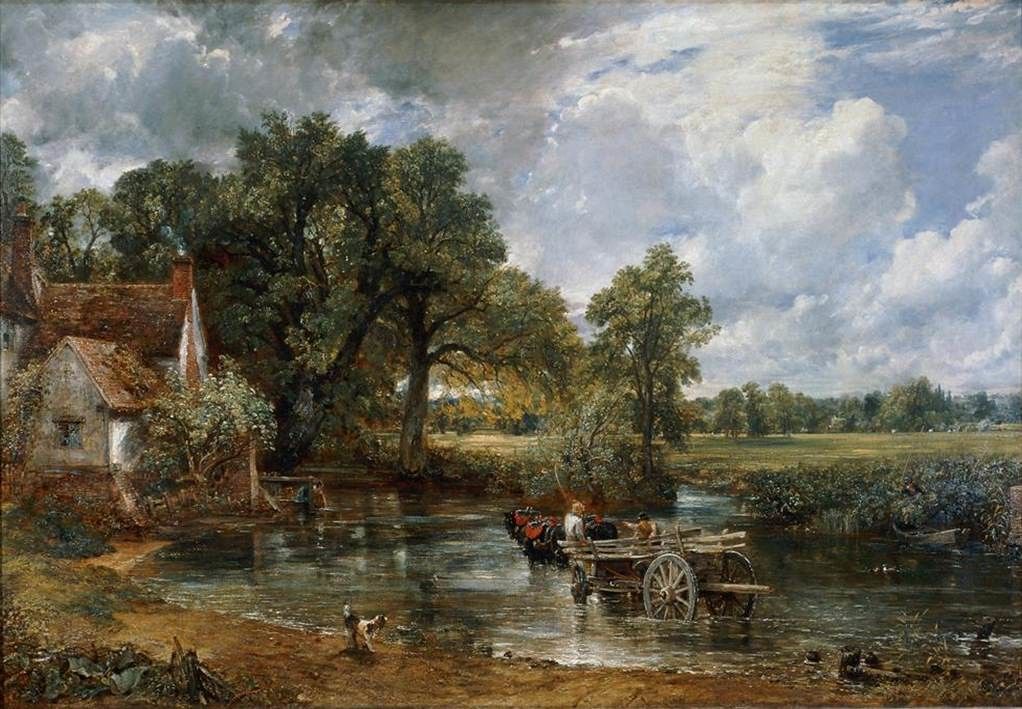
The Hay Wain (1821) by John Constable.
Credit: KCC246F / Flickr — CC BY-ND 2.0
Key takeaways
- • Painted by John Constable from lifelong observation of the Stour Valley and first shown at the Royal Academy as "Landscape: Noon".
- • It failed to sell in England but won a gold medal at the 1824 Paris Salon and influenced French landscape painters.
- • Constable built the large studio canvas from many outdoor oil sketches, combining loose skies with tighter architectural detail.
- • The painting was cleaned in 2025, revealing brighter skies, truer greens and evidence of the artist's revisions.
- • You can see the work at the National Gallery, sometimes on loan to Christchurch Mansion, and visit the Flatford location in Suffolk.
The Hay Wain painting is probably the most recognised landscape in British art. You've almost certainly seen it: the cart in the shallows, the thatched cottage, the wide Suffolk sky. It appears on biscuit tins and tea towels, in school textbooks and National Gallery postcards. And yet very few people know the full story behind it. It didn't sell in England when it was first exhibited. It won a gold medal in Paris. It's been the target of climate protesters. And it was recently cleaned for the first time in decades, revealing colours that surprised even the curators who knew it best.
This is the story of how a cart crossing a Suffolk millpond became the defining image of British landscape art, and why it still provokes strong feelings more than two centuries after John Constable put down his brush.
From Suffolk Fields to the Royal Academy
Constable didn't choose the Stour Valley as a picturesque backdrop. He grew up there. His father owned Flatford Mill and several properties along the river. The fields, the water, the light over the meadows in summer: these were the landscapes of his childhood, not scenes he travelled to find.
That personal connection matters. When he painted the Stour, he wasn't composing a pleasing view. He was recording something he knew with the familiarity of someone who had walked those banks his entire life. The painting's authority comes, in part, from that rootedness.
The work was first exhibited at the Royal Academy in 1821 under the title Landscape: Noon. That title is significant. Constable was placing himself in a tradition of paintings organised around times of day, connecting his work to Claude Lorrain and others who treated light as a subject in its own right. The painting was admired at the exhibition. It was not sold.
The title we know today, The Hay Wain, came not from Constable but from his close friend Archdeacon John Fisher. Constable himself tended to refer to it as his "Stour" pictures or simply by its location.
A Cart in the Water: What's Actually Happening?
Many visitors to the National Gallery puzzle over the central image. Why is a horse-drawn cart sitting in the middle of the river? Is it stuck? Has something gone wrong?
Nothing has gone wrong. The hay wain is crossing the millpond at Flatford on its way to the meadows on the far bank, where haymakers are already at work in the distance. The horses are pulling an empty cart out to be loaded with hay. The shallow ford was a regular crossing point. The water would have cooled the horses' hooves and helped soak the wooden wheel rims, which expanded and tightened in the heat.
This is ordinary agricultural work on a summer midday. There is no drama in the scene. That, as we'll see, was rather the point.
The Paris Triumph That Changed Everything
In 1824, Constable sent The Hay Wain to the Paris Salon alongside two other works. What happened there changed the painting's reputation permanently.
French painters were struck by its directness. The handling of natural light, the broken, energetic brushwork in the sky and foliage, the sense of air and atmosphere: these qualities seemed fresh and alive compared to the more polished surfaces many of their contemporaries were producing. Eugène Delacroix reportedly went back to repaint sections of his own Salon entry after seeing Constable's work.
The Hay Wain story at the 1824 Salon is one of the most satisfying ironies in British art history. The painting that England had left unsold became a sensation in Paris. King Charles X awarded it a gold medal. The influence on what would later become the Barbizon School was significant, and through the Barbizon painters, on the Impressionists after them.
It returned to England with its reputation transformed. The gold medal from a French king had a way of clarifying minds.
Why The Hay Wain Painting Was Radical, Not Quaint
This is the part that most popular summaries get wrong. We look at The Hay Wain today and see something comfortable and familiar: a country scene, reassuringly English, a little nostalgic. In 1821, it was none of those things.
The dominant mode for serious landscape painting at the time was classical or picturesque. Ambitious painters composed vistas with historical associations, bathed their scenes in golden Italian light, and arranged their foregrounds in smooth, receding layers. The subject matter was expected to carry some elevation: ruins, mythological figures, dramatic geography.
Constable chose instead an unremarkable stretch of river in an unfashionable part of England. His foreground is genuinely muddy. His cottage is weathered and sagging. His sky is overcast in places, with the particular turbulence of an English summer afternoon. His brushwork in the foliage and clouds is broken and agitated, not smooth and finished. Contemporaries described it as looking like the paint had been applied with a palette knife and scattered with flecks of white, what they called "Constable's snow."
There's a social dimension here too, though Constable was not a polemicist. The painting was made during a period of real agrarian unrest. Rural labourers were under pressure from early industrialisation and enclosure. The peaceful, working countryside Constable depicted was already changing around him. His vision was partly a record, partly a kind of mourning for a world he could see disappearing.
What "Landscape: Noon" tells us
Constable's original title points to something important: this painting is about light and time of day, not just a rural scene. He was interested in the transient effects of midday weather, the quality of a specific moment. That concern with capturing the passing moment connects him directly to the plein air tradition.
How Constable Actually Made It
Here is something that surprises many people: the finished canvas was not painted outdoors. Constable made it in his London studio.
That's not a contradiction of everything the painting represents. It's the key to understanding how Constable worked, and what painters today can learn from him.
Over many years, Constable made dozens of oil sketches along the River Stour. Small, rapid, intensely observed studies of sky, water, vegetation, and light. He went out in all weathers and at different times of day. He wasn't making casual notes. He was training his eye and his hand to capture specific, transient conditions: the quality of light through clouds, the colour of water in shade, the movement of air through summer trees.
The Hay Wain is one of his "six-foot" canvases, a series of large studio paintings synthesising years of outdoor observation into a single composed work. Back in London, Constable assembled the painting from his accumulated studies, adjusting the composition and working carefully with the light to achieve the effect he wanted.
The handling varies noticeably across the canvas. The sky and foliage are painted with loose, broken marks, alive with the energy of direct observation. The cottage and the mill architecture are handled more tightly, with greater precision. Both qualities serve the painting. Neither would work without the other.
How Constable built The Hay Wain
Sketch outdoors
Constable made repeated oil sketches along the River Stour, capturing sky, water, light and vegetation from direct observation.
Study the motif
Specific elements, including the cottage, the mill and the water, were studied in detail across multiple sessions and visits.
Scale up in the studio
Back in London, Constable assembled the large canvas, adjusting the composition and working from his outdoor material.
Refine the light
Details like the position of the sun and the quality of midday light were carefully worked and reworked to achieve the painting's luminous atmosphere.
A Symbol Under Pressure: The Hay Wain Today
The painting has had a long life beyond the studio and the gallery wall.
In a 2005 BBC Radio 4 poll of Britain's greatest paintings, it came second, behind Turner's The Fighting Temeraire. Rankings of this kind vary, but that result reflects something real: The Hay Wain is consistently near the top when British people are asked what they love in art. It has become shorthand for "the English countryside" in a way that goes well beyond the canvas. Advertisers have used it. Politicians have invoked it. It appears on packaging and in magazine features as a kind of visual shorthand for a certain idea of England.
That symbolic weight made it a target in 2022, when climate protesters at the National Gallery glued themselves near the work and displayed a reimagined version of the scene, updated to show an industrial, degraded landscape. The choice of The Hay Wain was deliberate. The protesters understood exactly what the painting stands for in the cultural imagination, and used that weight to make their point. Whatever your view of the action, the episode illustrates something important: this painting is not just a pretty picture. It carries a version of England inside it, and that version is contested.
The National Gallery responded with its own engagement with those questions. Between October 2024 and February 2025, it staged the exhibition Discover Constable and The Hay Wain, which examined the painting's history, its cultural resonance, and the environmental and political dimensions that now surround it. The exhibition has closed, but its framing tells you something about how seriously the gallery takes the painting's place in public life.
What the 2025 Conservation Tells Us
In 2025, The Hay Wain underwent a significant cleaning. Layers of discoloured varnish that had accumulated over the decades were carefully removed, restoring the original colour balance that Constable intended.
The results were striking. Areas of the sky that had appeared brown and flat came back to life. The greens of the foliage shifted from a dingy olive to something cooler and more varied. The overall luminosity of the canvas, that quality of outdoor light which the Paris painters found so remarkable in 1824, became much easier to see.
The technical examination that accompanied the cleaning also revealed aspects of Constable's working process: revisions, paint layers, and decisions he made and changed along the way. The painting now looks closer to how it appeared when it left his studio than it has in generations. For anyone who thought they already knew The Hay Wain, seeing it now is a genuine rediscovery.
Where to See The Hay Wain and the Landscape Behind It
There are three ways to encounter this painting, each quite different.
The National Gallery, London is its permanent home. Entry to the collection is free, and the painting is catalogued as NG1207. At the time of writing, the painting is on loan, so it is worth checking the National Gallery's website before making a visit specifically to see it.
Christchurch Mansion, Ipswich is hosting the painting on loan from March 2026 for approximately one year. This is the first time The Hay Wain will have been shown in Suffolk, the county where its landscape was born. For anyone in the region, this is a significant opportunity. Check the Christchurch Mansion website for current details, as opening times and booking requirements may change.
Flatford and Dedham Vale, on the Suffolk and Essex border, is where it all began. Willy Lott's Cottage still stands beside the millpond at Flatford. Flatford Mill itself is now managed by the Field Studies Council. The surrounding area forms part of the Dedham Vale Area of Outstanding Natural Beauty, and walking routes allow you to compare Constable's painted scene with the landscape as it exists today. The essential character of the place is still recognisable: the low sky, the wide meadows, the slow-moving river.
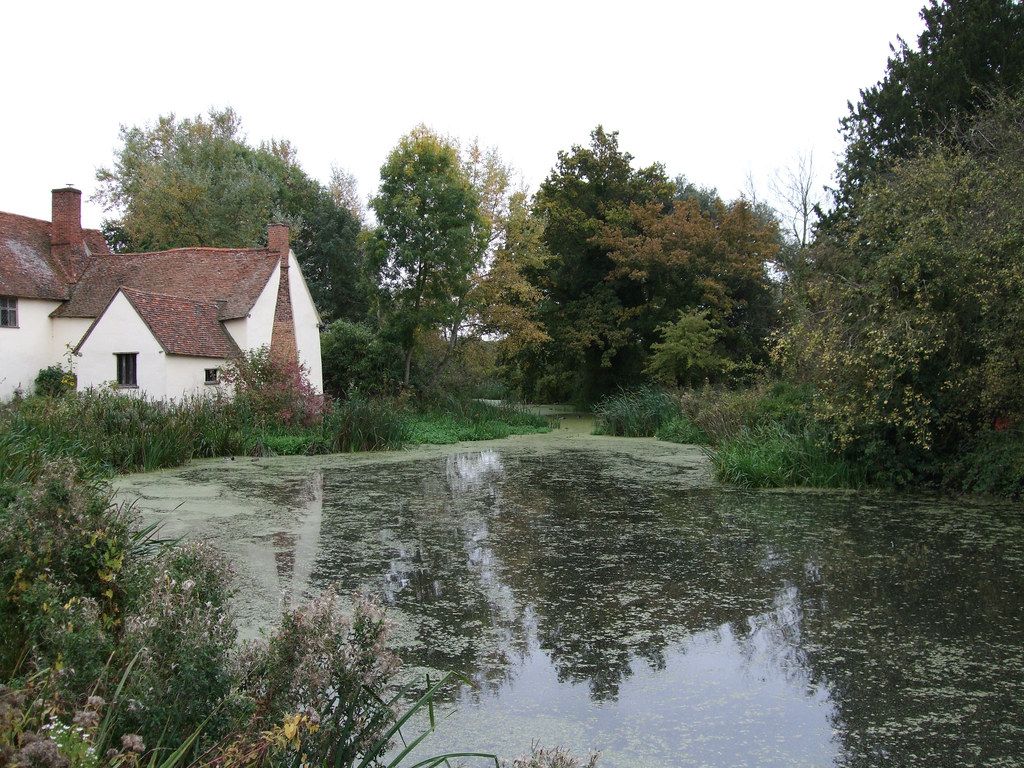
Flatford Mill and the River Stour in Suffolk, the landscape depicted in The Hay Wain.
Credit: Jim Linwood / Flickr — CC BY 2.0
Visiting Flatford as a painter
The Flatford area is one of the most rewarding destinations for any UK painter interested in the plein air tradition. The light over the Stour meadows and the low Suffolk sky are still recognisably Constable's. Take a sketchbook, not just a camera — and try painting the millpond from the bank where Constable himself stood.
What Painters Can Take from The Hay Wain
The Hay Wain has something specific to offer anyone who paints outdoors, beyond the pleasure of looking at it.
Outdoor sketching as serious practice. Constable didn't nip outside for the occasional atmospheric study. He made hundreds of oil sketches over years, in different seasons and conditions. Quantity was part of the method. The discipline of repeated observation is what gave him the visual vocabulary to build a six-foot canvas in the studio. Treat your field sketches as training, not just reference.
The relationship between study and finished work. The energy in Constable's skies and foliage comes from direct observation. The coherence of the whole canvas comes from careful studio assembly. These aren't opposites. The plein air work fed the larger painting rather than replacing it. If you paint small studies outdoors, think about how they might inform something larger in the studio, without losing what made them feel alive in the first place.
Weather and sky as subject, not backdrop. Constable's clouds are precisely observed. They belong to a specific time of day and a specific weather condition. He kept a meteorological journal and corresponded with a meteorologist. Painting outdoors trains you to notice what he noticed, because you have no choice. The sky you're looking at right now will look different in twenty minutes. That urgency sharpens observation.
Painting a known place repeatedly. Constable came back to the Stour again and again across his career. The same millpond, the same mill, the same bends in the river. Familiarity didn't make the place boring to him; it deepened what he could see. There's something in that for any painter who worries they've exhausted their local landscape. You haven't. You've barely started.
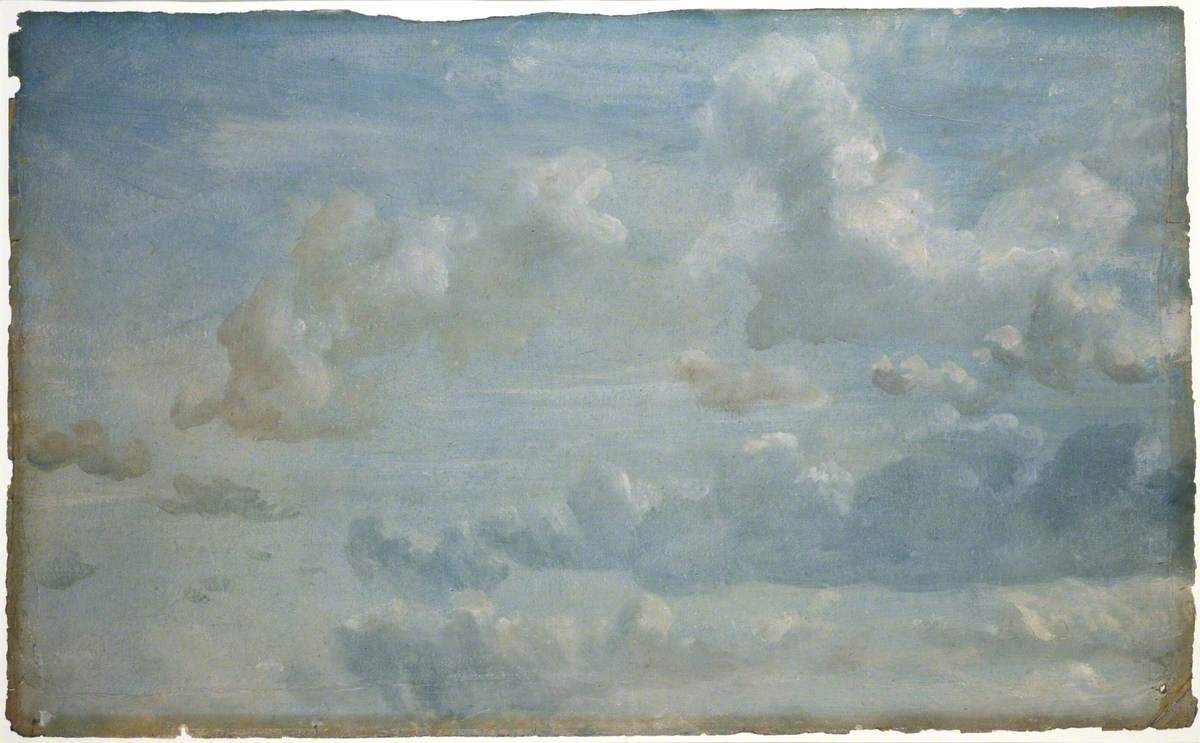
Cloud Study (1822) by John Constable, showing the close observation of weather that informed his finished landscapes.
Credit: John Constable / Art UK — Public domain
The painting has been a biscuit tin, a protest banner, and a masterclass in outdoor observation, sometimes all at once. That's what makes it extraordinary. For any painter interested in landscape, it rewards looking closely, not just once but repeatedly. Whether you see it in Ipswich, in London when it returns, or standing on the bank at Flatford with a sketchbook in your hand, The Hay Wain is still asking the same question Constable was asking: what does this particular light, in this particular place, look like right now?
FAQ
Frequently Asked Questions
Why is The Hay Wain painting so famous?
It combines Constable's personal Stour Valley subject with energetic brushwork and a Paris gold medal. The result made it both a technical milestone and a lasting symbol of the English countryside.
Why is the cart shown in the middle of the river?
The cart is crossing a shallow ford to reach the hay meadows. The water cooled the horses and helped the wooden wheels while the empty cart went out to be loaded.
Was The Hay Wain painted outdoors?
No. Constable painted the final six-foot canvas in his London studio, assembling it from many small oil sketches and studies made outdoors along the River Stour.
What did the 2025 conservation reveal about the painting?
Cleaning removed discoloured varnish and restored brighter skies and cooler greens. Conservators also found revisions and paint layers that shed light on Constable's working process.
Where can I see The Hay Wain painting and the landscape that inspired it?
Its home is the National Gallery, London, but it may be on loan. Christchurch Mansion, Ipswich, hosts it on loan at times, and Flatford Mill on the River Stour is the real landscape to visit.
Author

PleinAirPainting Editorial Team
PleinAirPainting.co.uk helps artists paint outdoors with confidence through UK-focused guides, equipment advice, resources and plein air inspiration.