The St Ives Artists Colony: Where British Art Met the Atlantic
A concise guide to the St Ives artists colony: its Atlantic light, key figures from Wallis to Hepworth, Tate St Ives and practical tips for plein air painting in Cornwall.

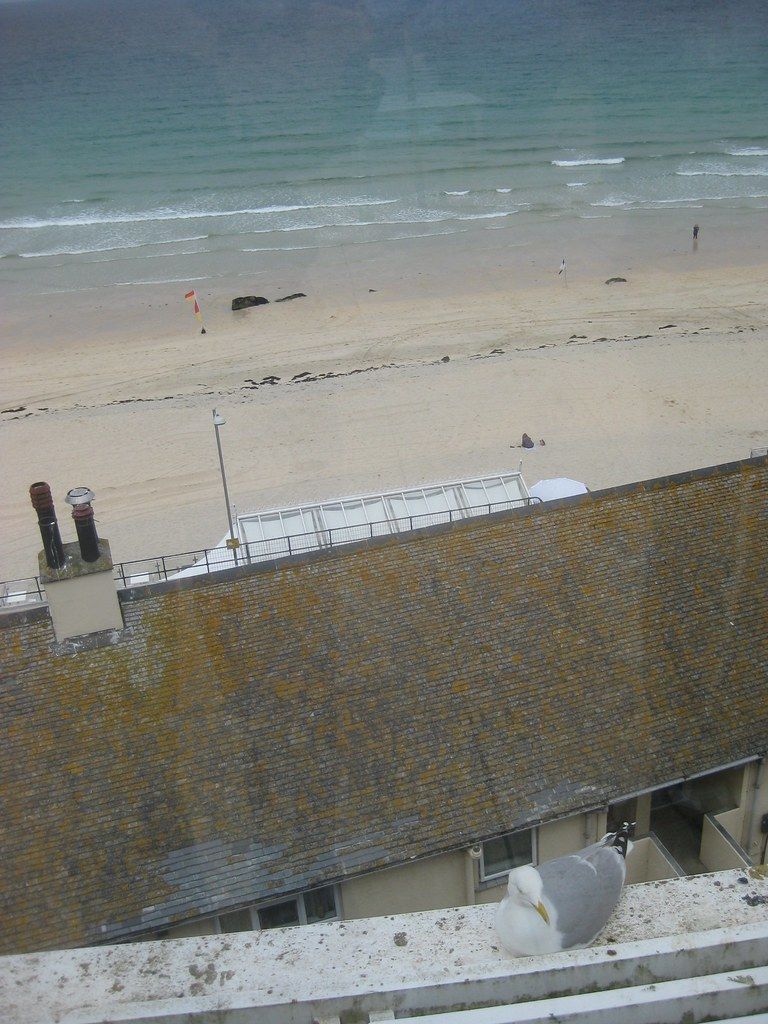
View from the Tate St Ives cafe looking out over Porthmeor Beach and the sea.
Credit: Matt From London — Flickr — CC BY 2.0
Key takeaways
- • St Ives attracted generations of artists because of its compact coastal geography and a unique Atlantic light.
- • The colony evolved from Victorian harbour naturalism to influential postwar abstraction shaped by Wallis, Nicholson and Hepworth.
- • The St Ives School is defined by attention to underlying structure, rhythm and spatial logic rather than by a single style.
- • Essential sites include Tate St Ives, the Barbara Hepworth Museum, Porthmeor Studios and the Leach Pottery.
- • Practical advice: travel light, expect quick changes in light, prefer spring or early autumn, and use compact, protected equipment.
There are places that seem to call artists toward them, and St Ives is one of the most persistent examples in British art history. The St Ives artists colony drew painters to this far corner of Cornwall for well over a century, producing work that ranged from Victorian harbour naturalism to some of the most significant abstract painting made anywhere in post-war Britain. That is not a small claim, and it is one this town earns.
What makes St Ives unusual is the continuity of that pull. It was not a single moment or a single group. It was generation after generation of painters responding to the same physical facts: a working fishing harbour, a wide Atlantic-facing beach, pale granite buildings that seem to absorb and return light rather than simply reflect it, and a sky that can shift from brilliant clarity to sea-fret in the time it takes to mix a colour. Understanding that story properly changes how you see the work in Tate St Ives, and it changes what you look for when you set up your easel here.
Why St Ives Became a Place Apart
St Ives sits at the western tip of the Penwith peninsula, further into the Atlantic than almost anywhere else in mainland Britain. The geography is the point. The town wraps around a natural harbour on one side while Porthmeor Beach opens to the full force of the Atlantic on the other. Walk the few hundred metres between them and you move between two entirely different relationships with sea and sky.
The light here is a specific thing, not just a vague atmospheric quality. The combination of white sand, pale granite and the sea's proximity creates a luminosity that is noticeably different from inland Cornwall, let alone from the grey light of most of England. Shadows are rarely heavy. The sand reflects upward. The sea reflects sideways. A painter working here is dealing with light coming from multiple directions at once, which makes the place both difficult and endlessly rewarding.
Turner was on the Cornish coast in 1811, an early indication that artists had sensed what this stretch of coastline offered. He was not the last. By the late nineteenth century, painters were arriving in St Ives not just for a sketching trip but to stay, because the place offered something they could not find closer to London. Affordable studio space, a community of fellow painters, and a subject that had not yet been exhausted by too much previous attention.
The geography is compact in a way that suits working painters. Porthmeor Beach, the harbour, Porthminster Beach and the tangle of narrow streets between them form a circuit you can walk in under an hour. The motifs are concentrated. You are never far from the next thing to paint.
The Early Colony: Harbour Painters and the Victorian Tradition
The first sustained wave of artists arrived in St Ives in the 1880s, and the colony they formed was shaped by the same broad European impulse that produced Newlyn just down the coast and, before that, the Barbizon painters in France. The idea was straightforward: go to a place where ordinary working life was still being lived in ways the industrialised cities had left behind, and paint it directly, in the open air, with honesty.
The St Ives colony of this period was genuinely international. British painters came alongside Scandinavians, Americans and other Europeans, all drawn by the fishing harbour and the quality of coastal light. The work was broadly naturalistic and impressionistic: fishermen and their boats, net-mending on the quay, the harbour at dusk. It was accomplished painting, recognisably connected to the European plein air tradition, and it established St Ives as a working artists' community rather than simply a holiday destination.
The St Ives Arts Club, founded in 1890, gave that community its social and professional infrastructure. It held exhibitions, brought painters together, and created the kind of sustained critical conversation that any serious artistic community needs. This is part of the St Ives art history that tends to get compressed into a single sentence in most accounts, which is a pity, because without this foundation the later, more famous story does not make sense. The Victorian colony normalised the idea that St Ives was a place you came to work seriously, not just to paint a few holiday sketches.
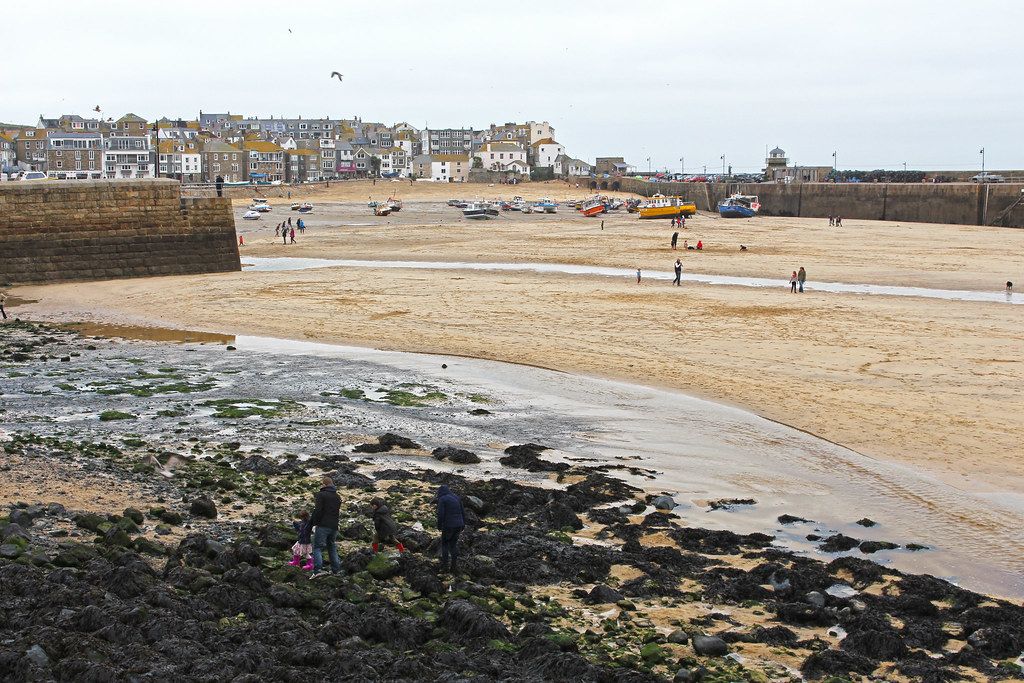
St. Ives harbour at low tide on the Cornwall coast. by travelmag.com — CC BY 2.0 (flickr)
The Turning Point: Alfred Wallis, Nicholson and the Shift Towards Modernism
In 1928, the painters Ben Nicholson and Christopher Wood visited St Ives and, walking through the town's back streets, came across an old man painting on cardboard with ship's paint. His name was Alfred Wallis.
Wallis had spent much of his life as a mariner and a rag-and-bone merchant. He began painting in his early seventies after his wife died, using whatever he could find: scraps of cardboard, pieces of driftwood, paint left over from boats. He had no formal training and no interest in the conventions of fine art. He painted what he knew: boats, harbours, the sea, the town as he understood it. His pictures had a flattened perspective that owed nothing to traditional representation. Space in a Wallis painting works by felt logic rather than geometric rules: a boat might be shown from several angles at once; the sea fills the picture not as receding depth but as a living force. There is something in his handling that feels completely unmediated, as if the painting and the thing being painted exist at the same distance from the viewer.
For Nicholson and Wood, encountering Wallis was a kind of shock in the best sense. Here was a painter who had arrived at something they were searching for through entirely different means: a directness, a willingness to let form and composition follow feeling rather than convention. Nicholson recognised it immediately and continued to visit Wallis, and to champion his work, until Wallis died in 1942.
The 1928 encounter is often cited as the moment modern St Ives began, but that framing slightly misrepresents what happened. Wallis did not become a modernist, and Nicholson did not simply borrow from him. What happened was more interesting: Wallis showed that it was possible to respond to this specific place, these specific boats and this specific sea, with formal intelligence and emotional directness at the same time. That became, in different ways, the central preoccupation of nearly every significant painter who came to St Ives afterward.
War, Refuge and Radical Art: The St Ives School Takes Shape
In the summer of 1939, with war imminent, Ben Nicholson and Barbara Hepworth travelled to St Ives with their three young children. They came partly for safety, partly because affordable studio space was available, and partly because the place had already proved its pull. Shortly afterward, the Constructivist sculptor Naum Gabo joined them.
This was not a planned artistic programme. It was a group of people making the best of difficult circumstances. But the effect on St Ives was transformative. Nicholson and Hepworth brought with them a direct connection to the most advanced European artistic thinking of the time: Cubism, Constructivism (an approach to art that emphasises geometric abstraction and the relationship between form, space and structure), and the international circle of abstract artists they had been part of throughout the 1930s. Gabo, who had been central to the Russian Constructivist movement before emigrating to western Europe, added rigour and range.
Around this core, through the 1940s and 1950s, a younger generation of painters gathered. Peter Lanyon, the only one among the major figures who was actually born in St Ives, became central to that group. Terry Frost, Bryan Wynter, Roger Hilton, John Wells and Wilhelmina Barns-Graham all came to work in the town during these years. Patrick Heron arrived later, settling not in the town itself but above Zennor to the west. The group that formed was never formally organised and never issued a manifesto. "St Ives School" is a retrospective label, applied by critics and art historians to a loose community of painters who shared a location and certain broad concerns, not a formal movement with agreed principles.
What they did share, though, was real enough. The defining characteristic of the St Ives School painters is not a style but a method of attention: treating the Cornish landscape not as a picturesque view to be described, but as a source of spatial and rhythmic structure to be understood. The cliffs, the tidal changes, the movement of light over the Atlantic, the weight of granite and the weightlessness of reflected water: these were not backgrounds or subjects in the conventional sense. They were the underlying logic that abstract painting could make visible.
What Made the St Ives School Different
Stand on Porthmeor Beach for long enough and you begin to understand what the painters were responding to. The horizon is a hard line between blue and blue. The waves arrive with a rhythm that is almost musical: not random, but not mechanical either, varying within a pattern. The beach curves in both directions. The light comes from in front of you, from the sand below you, and bounces off the water around you.
A painter thinking conventionally about this scene would try to capture its appearance at a particular moment. What the St Ives School painters did, particularly in the generation after Nicholson, was something different: they looked for the structure beneath the appearance. How does the bay organise space? What is the rhythm of the wave sequence? How does the curve of a headland impose a geometry on everything within view? These were questions that could only be answered in paint, and the answers looked like abstraction rather than description. The landscape was not left behind; it was translated into form.
That distinction matters for any painter who stands on the same beach today. You do not have to paint abstractly to benefit from thinking this way. Looking for structure rather than surface, rhythm rather than incident: that is a habit of mind any plein air painter can develop, and St Ives is one of the best places in Britain to develop it.
The Artists Themselves: Painters Worth Knowing
Key figures of the St Ives School
- Alfred Wallis
- 1855–1942
- Ben Nicholson
- 1894–1982
- Barbara Hepworth
- 1903–1975
- Naum Gabo
- 1890–1977
- Peter Lanyon
- 1918–1964
- Patrick Heron
- 1920–1999
- Terry Frost
- 1915–2003
- Wilhelmina Barns-Graham
- 1912–2004
- Bryan Wynter
- 1915–1975
Self-taught mariner-painter; raw, flattened harbour scenes that influenced Nicholson and Wood
Abstract reliefs and paintings; brought European modernism to West Cornwall
Sculptor; organic forms and pierced geometries in direct dialogue with landscape
Constructivist sculptor; briefly but significantly based in St Ives during the war
Local-born; dynamic near-aerial abstraction rooted in cliffs, moors and gliding
Intense colour and interlocking forms; linked to garden and coastal motifs
Rhythmic abstract compositions; sun, sea and harbour movement as structural force
Abstract forms drawing on glaciers, rock and the structural patterns of nature
Moorland and coastal light; atmospheric abstraction with a strong spatial sense
A few of these painters are worth a closer look before you visit Tate St Ives, because knowing something about how they worked changes what you see in the paintings.
Peter Lanyon is arguably the most fascinating figure in the whole St Ives story. Born in the town, he grew up understanding the landscape from the inside: the moors behind St Ives, the coastal path, the specific angle of light in winter. As his painting developed, he felt he needed a different physical vantage point, so he took up gliding. His mature paintings have the quality of landscape seen from multiple heights simultaneously, which is exactly what they are: responses to the coast and moorland experienced from the air as well as on foot. He died in 1964 from injuries sustained in a gliding accident, aged 46, just as his international reputation was fully taking shape.
Patrick Heron came to the group slightly later and is perhaps the most immediately pleasurable of the St Ives painters for a colour-oriented eye. His work became increasingly concerned with colour as the primary carrier of form and space, influenced by his engagement with American Abstract Expressionism but always retaining the specific greens, blues and ochres of the Zennor coast. He was also an important critic, writing about painting with uncommon clarity.
Terry Frost found his way to abstract painting through watching the harbour from a prison camp during the war: boats moving in arcs, light falling across water, the structural rhythm of a working harbour. That origin stayed with him. His paintings are full of the physical sensation of movement and light organised into a rigorous geometry.
Wilhelmina Barns-Graham is less well known than she deserves to be, a situation Tate St Ives has worked to address in recent years. Scottish-born, she came to St Ives in 1940 and stayed for much of her life. Her abstract language drew on glaciers as much as on the Cornish coast: the patterns of ice, rock fracture and geological time visible in natural forms.
Ceramics, Sculpture and the Wider Creative Circle
The painters are the most visible part of the St Ives creative story, but the colony always extended beyond painting. Two other threads matter particularly.
Bernard Leach founded the Leach Pottery in St Ives in 1920, in partnership with the Japanese potter Shoji Hamada. Leach had trained in Japan and came back with a philosophy rooted in the integration of art, craft and daily life: the idea that a well-made bowl is as valid an artistic object as a gallery painting. The Leach Pottery became a meeting point for the wider creative community, and its approach to form, weight and rhythm crossed over constantly into the conversations the painters were having about space and structure. For a painter, the Leach tradition is a useful prompt: how does a form occupy space? What does physical weight feel like as a visual quality? These are not purely sculptural questions.
Barbara Hepworth's work offers a similar prompt, though at a grander scale. Her sculptures engage directly with the landscape around them: pierced forms that frame views, organic curves that echo cliff edges and hillsides, surfaces that respond to light in ways that connect directly to what the painters were doing on flat surfaces. She often spoke about her work in terms of the Cornish landscape, and the connection is not metaphorical. Standing in her sculpture garden, with the forms she made surrounded by the plants she chose, the relationship between sculpture and place is immediate and physical.
Where to Go: Key Sites in St Ives for Painters and Art Tourists
Tate St Ives
Tate St Ives opened in 1993 on the site above Porthmeor Beach, in a building that is itself an argument about the relationship between art and place. The gallery presents the St Ives School within the broader context of British and international modernism, and it continues to expand its account of the colony to include figures who were marginalised in earlier tellings, including several women artists and others whose contributions were long undervalued.
For a painter, spending time here before going out to work is genuinely useful. The paintings in the collection were made from the same beaches and headlands you will be working on. Seeing how Lanyon or Frost or Barns-Graham translated those locations into abstract form is not an instruction in how to paint, but it is an education in how to look. On a wet day, it is also the most rewarding indoor option in the town.
The Barbara Hepworth Museum and Sculpture Garden
Hepworth's studio and garden in the Trewyn area of St Ives are preserved largely as she left them at her death in 1975, now managed by Tate. What makes this place distinctive is not just the sculpture, though the sculpture is exceptional. It is the experience of being in the place where the work was made. You can see the tools, the working surfaces, the unfinished pieces, the garden she designed as a deliberate extension of her artistic practice. For a painter thinking about process and environment and the relationship between where you work and what you make, this is more valuable than any gallery display.
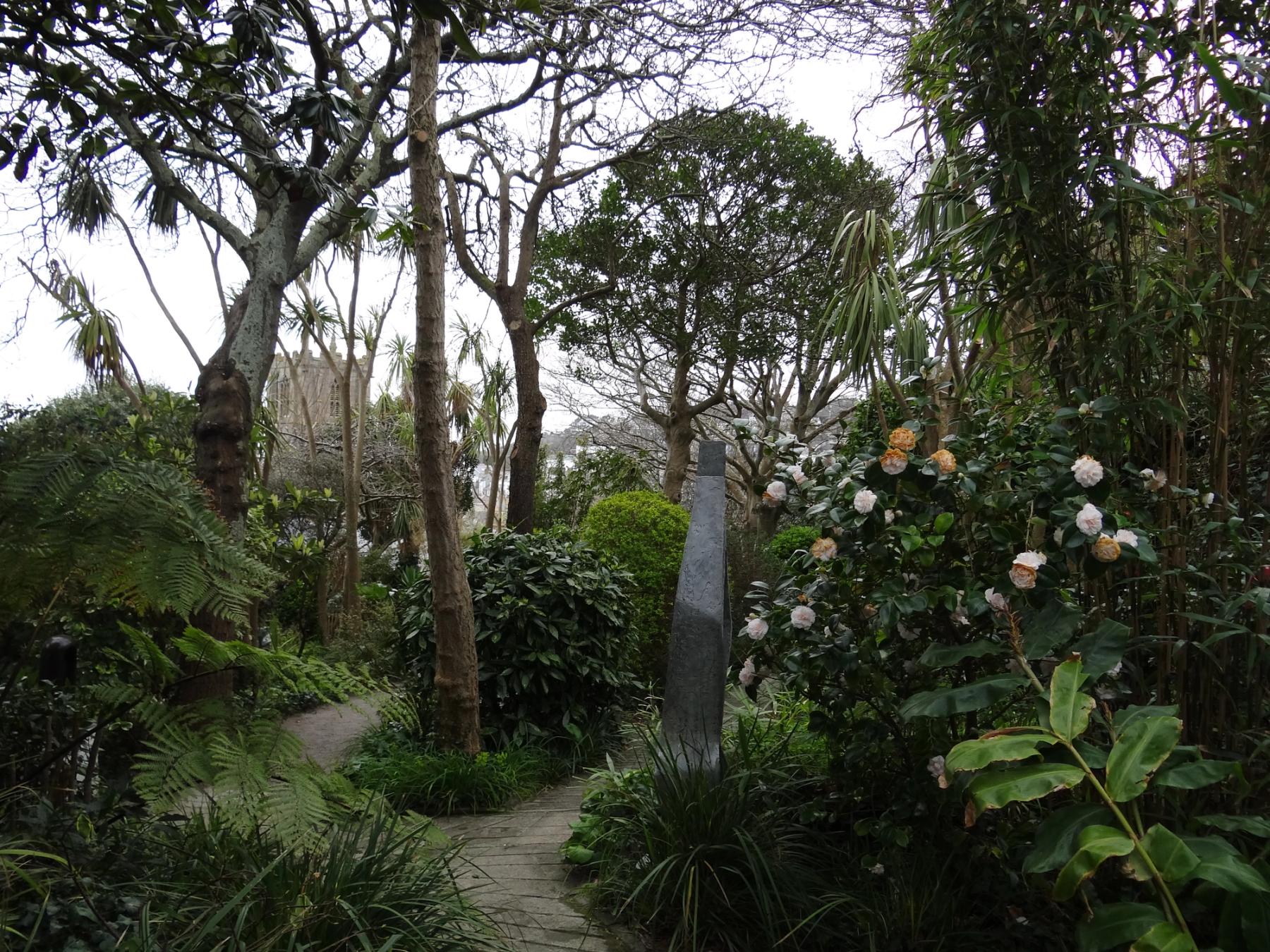
Sculptures displayed in the Barbara Hepworth Sculpture Garden in St. Ives. by Esther Westerveld — Wikimedia — CC BY 2.0
Porthmeor Studios and the St Ives School of Painting
The studios on Porthmeor Beach have housed working artists since the Victorian colony, and their connection to the historic St Ives painters is direct and material. Nicholson worked here. Lanyon worked here. The building faces the beach that shaped the work made inside it.
The St Ives School of Painting, founded in 1938 and based at Porthmeor Studios, is the oldest art school in the town. It has historically offered tuition across a range of media and levels. Course schedules change regularly, so if you're planning a visit around a painting course, check current availability directly with the school rather than relying on any secondary source.
The Leach Pottery
Bernard Leach's original pottery in Higher Stennack is now a museum and working studio, and it retains a genuinely working quality that distinguishes it from purely heritage attractions. Visiting connects you to the craft and philosophical dimension of the St Ives creative community in a way that deepens the painting story rather than distracting from it. Short courses and tuition have historically been offered here; check current availability directly before planning a visit around them.
Painting in St Ives Today: Practical Notes for a Plein Air Visit
A note on timing
St Ives in summer is busy. Very busy. If you want to paint without navigating crowds on the quayside, aim for spring or early autumn. The Atlantic light is still strong, the tourist numbers are thinner, and you'll find quieter spots far more easily.
The light and how it behaves. The luminosity that drew painters here for over a century is real, but it is also relentless in its changeability. The Atlantic weather moves fast, and the quality of light on Porthmeor can shift completely within twenty minutes. Plan for shorter studies rather than extended single sittings. A sequence of quick tonal notes often serves better here than a single sustained painting, at least until you know the place well enough to anticipate its rhythms.
Wind and exposure. Porthmeor Beach faces due west into the Atlantic and can be very exposed. It is a genuinely exciting location to paint, but on a blustery day it will test your setup. The harbour side of the town offers considerably more shelter, along with a different set of motifs: boats at various stages of tide, the quay walls, the reflections in still water at low tide. It's worth having a plan for both sides of the town depending on conditions.
Gear for this environment. Sea spray and blown sand are real concerns on Porthmeor and along the coastal path. Loose sheets of paper are not practical in any wind. Work on board-mounted surfaces and consider how you'll protect your palette between strokes. A compact, low-profile easel is more sensible here than anything tall and wide-footed. The narrow streets of the old town mean you're carrying your kit further than in most locations; travelling light is not just a preference but a practical necessity.
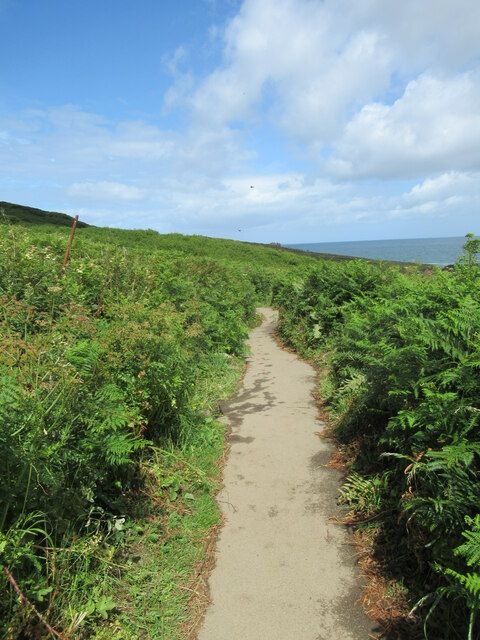
The South West Coastal Path near Zennor by Carrick Du, St Ives. by Roy Hughes / Wikimedia (CC BY-SA 2.0)
Getting there. The St Ives branch line from St Erth is genuinely the most sensible way into the town during any busy period. The journey takes about twelve minutes from St Erth, where you change from the mainline service, and it deposits you near the harbour. Parking in the old town is very limited and the approach roads back up quickly in summer. If you're driving to West Cornwall, park at St Erth or Lelant Saltings and take the train in.
Beyond the town itself. The coastal path heading west from St Ives towards Zennor gives access to the broader landscape that shaped painters like Lanyon and Heron. This is not gentle coastal walking: the path climbs onto open moorland above cliffs, and the scale and exposure of the landscape changes significantly within a mile of leaving the town. If you want to understand why Lanyon's paintings feel the way they do, stand on those headlands. The motifs are different from anything in the town, more austere, more ancient-feeling, with granite outcrops and the Atlantic horizon as the dominant elements.
Practical cautions. Be aware of tidal changes if you're working on the harbour beach or near the water's edge: the tide comes in faster than it sometimes appears. Keep your setup compact and unobtrusive on the narrow quays; you share them with working boats and with RNLI equipment and access must never be blocked. The harbour slipways in particular should always be kept clear.
| Factor | Consideration | Practical note |
|---|---|---|
| Best season | Spring or early autumn | Thinner crowds, strong light, changeable weather |
| Getting there | Train to St Ives via St Erth | Avoids parking problems in the old town |
| Most exposed location | Porthmeor Beach | West-facing; wind can be strong |
| Most sheltered location | The harbour | Better protection, varied motifs |
| Key outdoor locations | Porthmeor, harbour, coastal path west | Range of motifs within walking distance |
| Wet weather option | Tate St Ives | Free entry on some days; check before visiting |
| Easel advice | Compact and stable | Narrow streets and sea spray both argue for lighter kit |
What the St Ives Legacy Means for Painters Now
The St Ives artists colony produced some of the most significant painting in British art history. That is worth saying plainly. The St Ives School painters were not working in a provincial backwater while the real action happened elsewhere; they were engaging directly with the central questions of European modernism, filtered through the specific experience of one of the most physically compelling landscapes in Britain.
But the legacy for a painter today is not primarily a matter of art-historical prestige. It is a matter of method. The progression from the Victorian harbour painters, who looked at St Ives and painted what they saw, to Lanyon and Heron and Frost, who looked at the same coastline and painted its underlying spatial and rhythmic logic, is not a story of one kind of painting replacing another. It is a story of deepening attention. Each generation looked harder and found more.
Tate St Ives continues to reframe that story, bringing forward artists whose contributions were overlooked in earlier accounts, including several women artists whose work is now recognised as central rather than marginal. The broader West Cornwall coast, from St Ives to Zennor and beyond, continues to draw painters who are working through exactly the same problems the colony painters were working through a century ago: how do you translate a specific, physical experience of this light and this landscape into something that carries that experience to someone who wasn't there?
The answer the St Ives painters found is not a formula but it is a principle: look for structure, not just surface. The landscape is not a backdrop to paint in front of; it is the underlying logic you are trying to understand. Whether you work representationally or abstractly, whether you're on Porthmeor Beach or on the cliffs above Zennor, that principle holds. It is, in the end, what makes the place worth the journey.
FAQ
Frequently Asked Questions
What is the St Ives artists colony?
A long‑running community of painters and makers in St Ives, Cornwall, where distinctive Atlantic light and local landscape shaped work from Victorian harbour scenes to major postwar abstraction.
Why did artists keep coming to St Ives?
The town's compact geography, pale granite, white sand and changing Atlantic light created a unique luminosity and concentrated motifs that rewarded sustained attention and study.
Who was Alfred Wallis and why does he matter?
Alfred Wallis was a self taught mariner painter discovered in 1928. His direct, flattened vision impressed Ben Nicholson and Christopher Wood and helped open St Ives to modernist ideas.
Which sites should painters visit in St Ives?
Key places are Tate St Ives, the Barbara Hepworth Museum and Sculpture Garden, Porthmeor Studios and the Leach Pottery. Also explore Porthmeor Beach, the harbour and the coastal path toward Zennor.
When is best to paint in St Ives and what should I prepare?
Visit in spring or early autumn to avoid crowds. Expect fast changing light and wind. Use board mounted supports, a compact easel, protect gear from spray and plan short studies.
Author

PleinAirPainting Editorial Team
PleinAirPainting.co.uk helps artists paint outdoors with confidence through UK-focused guides, equipment advice, resources and plein air inspiration.