Essential Plein Air Painting Supplies: What You Actually Need for Your First Session
A practical UK guide to plein air painting supplies for beginners. Covers oils and watercolour, pochade boxes, supports, brushes, wet carriers and three budget starter kits to get you painting outdoors.

Key takeaways
- • Start simple: minimal kit is enough to get outside and learn.
- • Pochade boxes suit oil painters; paint tins work well for watercolour.
- • Bring 6 to 8 colours for oils or a 12 to 24 pan set for watercolour.
- • Use rigid panels for oils and 300gsm cold press paper for watercolour.
- • Carry a wet carrier, basic clips, a small palette knife and weatherproof clothing.
Getting the right plein air painting supplies together before your first outdoor session can feel surprisingly complicated. There are easels to consider, pochade boxes to decipher, and a whole vocabulary of kit that seems obvious to experienced painters but opaque to everyone else. This guide cuts through that. It covers what you actually need, what you can skip for now, and where to find it all in the UK, at a range of price points.
Start Simple and Build From There
The instinct to research every piece of kit before going outside is understandable, but it can quietly become a reason not to go at all. The truth is that your first plein air session does not require a sophisticated setup. It requires paint, something to paint on, and the willingness to sit outside for an hour or two.
This article focuses on the two most popular plein air mediums in the UK: oil paints and watercolour. If you already paint in one of these mediums, you are closer to ready than you think. The sections below work through each category of kit in turn, covering what matters for a beginner and what can wait.
Don't wait until you have everything
The biggest mistake beginners make is spending months researching kit instead of getting outside. A basic set of oils or watercolours, a sketchbook, and a folding chair is enough to start. You can refine your setup as you learn what you actually need.
Choosing How to Carry and Mix Your Paints
Pochade Boxes
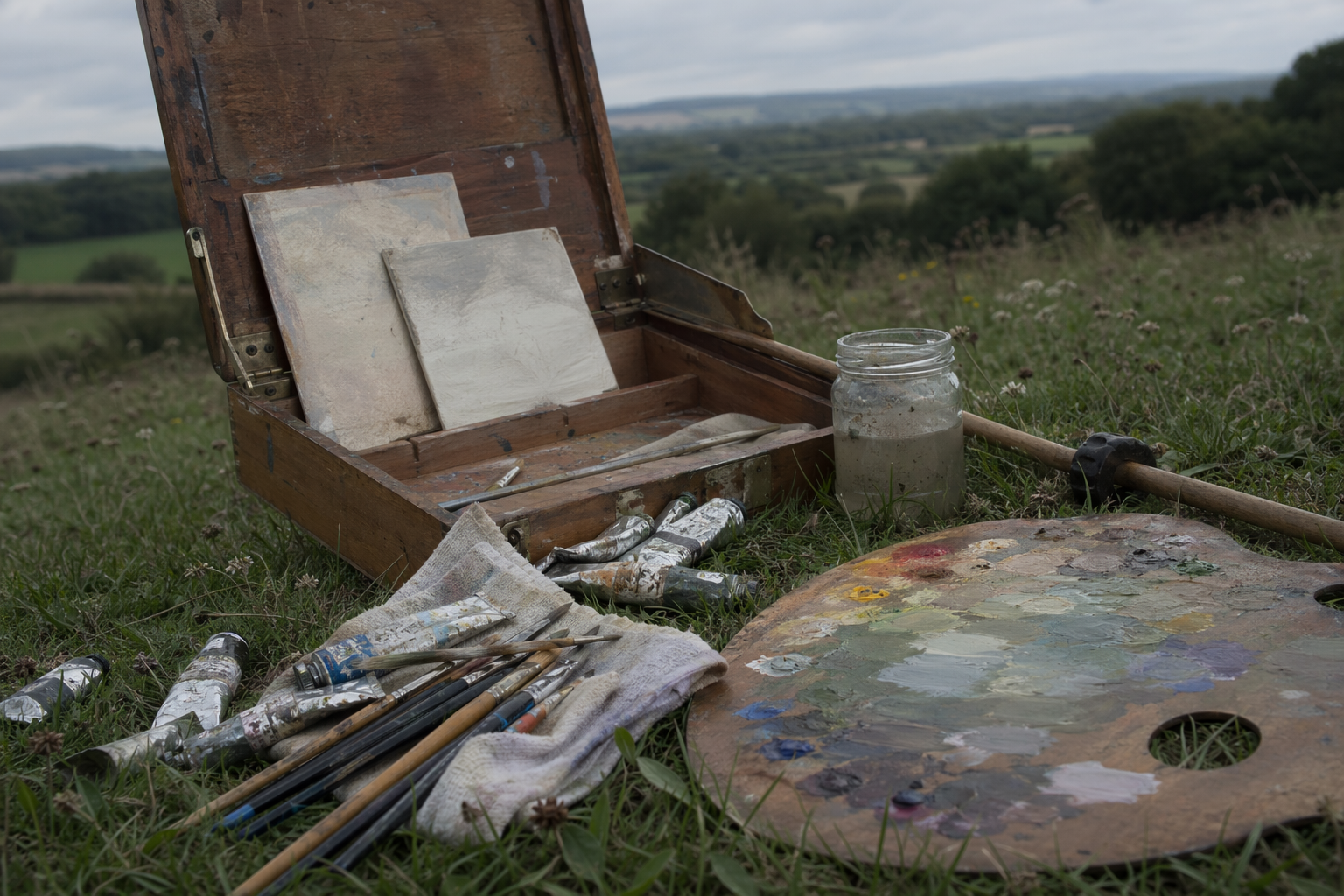
A pochade box is a compact, self-contained unit that combines a palette, paint storage, and a panel holder in one. Most attach to a standard camera tripod, which means they function as both palette and easel for smaller work. For oil painters especially, a pochade box is one of the most practical investments you can make once you are painting regularly outdoors.
Entry-level wooden pochade boxes are available from Jackson's Art and Ken Bromley, typically starting around £60 to £100. Mid-range options like the New Wave U.Go and the Richeson Sienna sit in the £150 to £250 range and offer better build quality, more secure panel holding, and a more comfortable palette area. If you are just starting out, a basic wooden box is perfectly adequate.
Because there is quite a lot to consider when choosing a pochade box, this article keeps that detail brief. The main point is that if you are painting with oils outdoors, a pochade box will make your sessions considerably more comfortable than improvising a palette and propping a panel against a bag.
Paint Tins and Budget Alternatives
For watercolour painters, or for anyone who wants to start with minimal outlay, a compact metal paint tin is a practical first option. The Winsor & Newton Sketcher's Pocket Box and the Schmincke Horadam compact tin are both well-regarded and available from most UK art suppliers. They fold open to reveal a mixing palette and hold a selection of half pans or tubes.
A tin works perfectly well to start with. It is light, inexpensive, and easy to slip into a bag. The trade-off is that as your sessions get longer, the limited mixing space and lack of panel holding can start to feel restrictive. At that point, a pochade box becomes worth the investment.
Paints for Plein Air: What to Bring and What to Leave at Home
Oil Paints Outdoors
The most important rule when packing oil paints for a plein air session is to bring less than you think you need. Six to eight colours is plenty for most outdoor work. A typical approach is to use warm and cool versions of the primary colours alongside a versatile earth tone and titanium white: something like cadmium yellow light and yellow ochre, cadmium red and alizarin crimson, ultramarine blue and cerulean blue, burnt sienna, and titanium white. You can paint almost anything with that selection.
For beginners, student-grade paints are a perfectly reasonable starting point. Winsor & Newton Winton and Daler-Rowney Georgian are both widely available in the UK, competitively priced, and good enough to learn with. As your practice develops, upgrading to artist-quality paints like Winsor & Newton Artists' Oils gives you richer colour and better lightfastness, but it is not a necessary first step.
You will also need a medium. Linseed oil is the standard choice. Outdoors, low-odour alternatives are worth considering: Zest-It and Gamblin Solvent-Free Gel are both accessible in the UK and reduce the need to carry liquid solvent in the field.
Watercolour Outdoors
Watercolour is excellent for plein air work. It is lighter to carry than oils, dries quickly, and requires far less supporting kit. The pan format is ideal outdoors: a 12-pan or 24-pan compact set gives you a useful colour range without adding much weight to your bag.
For quality on a budget, Winsor & Newton Cotman is a reliable student-grade option available at Cass Art and most UK art shops. If you want to move straight to artist-grade, Schmincke Horadam and Daniel Smith both produce excellent compact sets and are stocked at Jackson's Art and Ken Bromley.
One thing that matters considerably outdoors is paper quality. In the UK, where humidity and light rain are regular companions, cheap watercolour paper becomes a liability. It buckles badly when wet and is difficult to work on. Aim for 300gsm cold press as a minimum. Fabriano Artistico and Bockingford are both good choices, both available in the UK, and both cope well with outdoor conditions.
Oils vs watercolour outdoors
Pros
- + Oils give longer working time, which suits slower-paced sessions
- + Watercolour dries fast and requires minimal kit
- + Watercolour is much lighter to carry
- + Oils allow easier blending and reworking in changing light
Cons
- - Oils need solvent for cleanup, which adds kit and raises disposal considerations outdoors
- - Watercolour is harder to control in very bright or windy conditions
- - Oil paintings take longer to dry, requiring a wet canvas carrier
- - Watercolour can be tricky to get right for complete beginners
Supports: What to Paint On
Panels and Boards
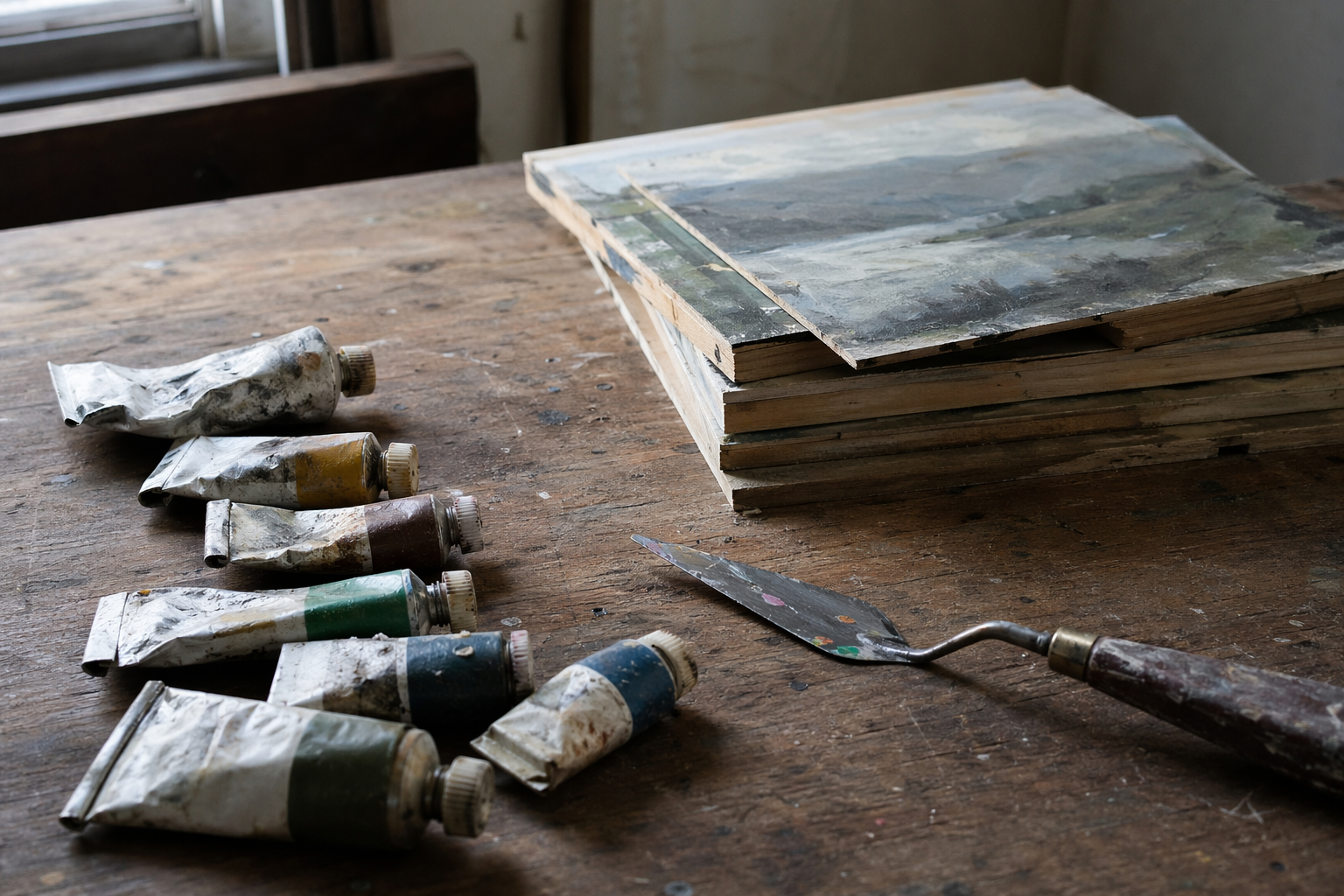
For oil painters working outdoors, rigid panels are the preferred support. They sit securely in a pochade box, do not flex or warp, and take paint well. Gesso-primed MDF or wood panels are the standard choice. Jackson's Art stocks their own-brand panels at a reasonable price, and Ampersand Gessobord is available through UK suppliers for those who want a more refined surface.
The practical advantage of panels over stretched canvas outdoors is stability. Canvas can flex slightly in pochade box clips, which becomes noticeable when you are working quickly. For most plein air oil painters, panels are simply easier.
Canvas Boards and Watercolour Paper
Canvas boards are lighter and cheaper than rigid panels, and they work perfectly well as a starting support. Daler-Rowney produces canvas boards that are widely available in UK art shops. The slight flex is not a serious problem for most sessions; it is more of a consideration once you are working at speed or in blustery conditions.
For watercolour, the support question comes down to paper weight and format. As noted above, 300gsm cold press is the right starting point. You can use a watercolour block (which eliminates the need for stretching or taping) or a pad, provided you secure the paper to a board before painting.
One practical note: cut or buy your panels to size before you go out. Do not assume you will be able to improvise the right size on the day.
| Size | Best for | Notes |
|---|---|---|
| 6x8 in | Very fast studies, changing light | Fits most pochade boxes; easiest to finish |
| 8x10 in | General beginner sessions | Good balance of space and portability |
| 9x12 in | Slightly longer sessions | Heavier but gives more room to work |
| 11x14 in | Half-day sessions with stable light | Harder to finish before light shifts |
Brushes for Outdoor Painting
Beginners rarely need more than three to five brushes for a plein air session. More brushes tend to mean more to carry and more to clean, without adding much to the painting.
For oil painting outdoors, a medium filbert (size 6 or 8) does most of the work. A small flat (size 4) is useful for edges and tighter passages. A rigger or liner brush handles fine detail when you need it. Hog hair bristles are a sensible choice outdoors: they are durable, hold paint well, and stand up to the rougher handling that outdoor sessions inevitably involve.
For watercolour, a good round brush in size 8 or 10 covers most situations. A smaller round (size 4) handles detail, and a flat wash brush is worth having for large areas of sky or water.
On quality: brushes that shed bristles onto your painting are genuinely frustrating outdoors, where you cannot easily pick them off without disturbing wet paint. It is worth spending a little more to avoid that problem. Rosemary & Co, a UK brush maker based in Yorkshire, produces excellent hog hair and synthetic brushes available by mail order. They are not always found on the high street, but their quality is well above what you would expect at the price. Winsor & Newton Monarch is another solid option, widely available in UK shops.
Travel brushes with protective caps are a useful convenience for keeping brushes protected in transit, but they are not essential if you store brushes carefully in a roll or case.
The Easel Question
If you are starting with a pochade box on a tripod, you may not need a separate easel at all for sessions on smaller panels. The pochade box holds your panel at a working angle, and the tripod handles height and positioning. For many plein air painters, this is the entire outdoor setup.
If you want to work on larger supports, or if you prefer to paint standing at a full canvas, a dedicated field easel becomes worth considering. French easels are heavier but all-in-one; lightweight aluminium field easels are easier to carry. There is quite a lot to weigh up on this question, and the detail is covered fully in a dedicated easel guide elsewhere on the site.
Extras That Are Worth Having From Day One
One thing most beginners forget
A wet canvas carrier or panel carrier protects your finished work on the walk back. Without one, you risk smudging a painting you have spent an hour on. Simple clip-together carriers cost very little and are worth buying early.
Wet canvas carrier or panel carrier: Two panels clip together face-to-face, keeping wet surfaces apart during transport. For oil painters working on panels, this is a practical necessity rather than a luxury. Simple versions are available from Jackson's Art and Ken Bromley for a few pounds.
Palette knife: Useful for mixing colours cleanly on the palette and, occasionally, for painting. A small cranked palette knife covers most needs.
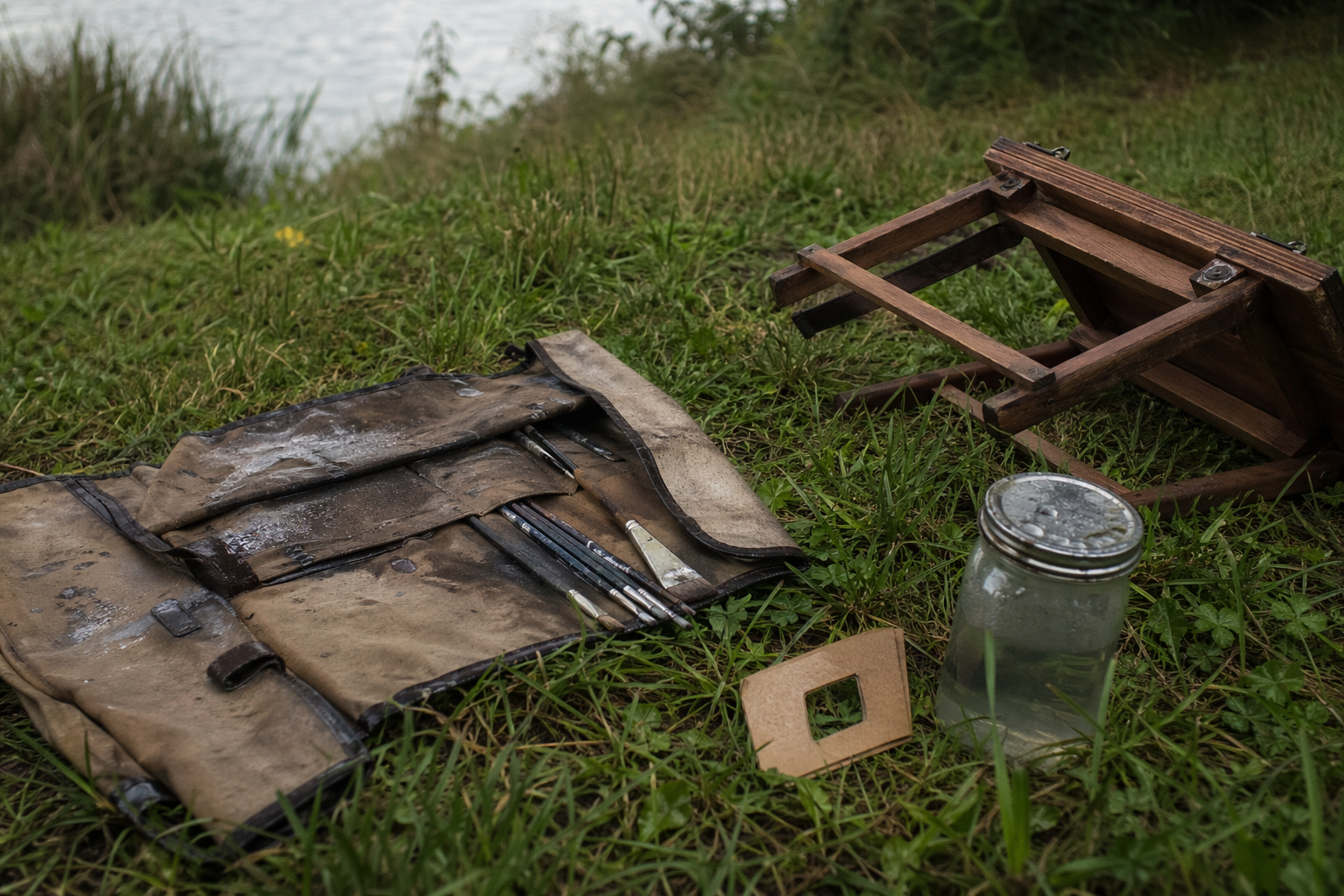
Viewfinder: A small rectangular card with an opening cut to match your panel ratio helps enormously with composition in the field. You can make one yourself in a few minutes or buy one cheaply. It is one of the most underrated bits of kit in a beginner's bag.
Clips and elastic bands: Useful for securing panels in a pochade box and for keeping brush handles together in transit. Cheap and worth having a few of.
Solvent jar or travel bottle: For oil painters, a small sealed container of solvent for brush cleaning is necessary. Use a proper sealed jar rather than an open container, and never pour solvent onto the ground or into waterways. In the UK, responsible disposal means taking used solvent home, allowing it to settle, and decanting the clear portion for reuse. Dried pigment at the bottom should be treated as hazardous waste.
Something to sit on: A lightweight folding stool makes a meaningful difference to a longer session. Your back will thank you. There is a more detailed look at options in a separate guide on the site.
Weather-appropriate clothing and bag: This matters more in the UK than most general plein air advice acknowledges. A waterproof bag for your kit protects panels, paper, and supplies from a sudden shower. A waterproof jacket for yourself is equally practical. Neither needs to be specialist; both should be in your kit before you head out.
A Suggested Starter Kit at Three Budget Levels
It is worth being direct here: spending more does not make you paint better. The best kit is the kit that gets you outside. The minimal setup listed below is entirely legitimate and used by experienced painters who value simplicity.
| Budget level | What to get | Approximate spend |
|---|---|---|
| Minimal (under £50) | Student watercolours, small sketchbook, water brush, foldable cup | Under £50 |
| Solid beginner kit (£100–£200) | Paint tin or basic pochade, artist-grade watercolours or oils, a few brushes, canvas boards or panels, lightweight tripod | £100–£200 |
| Ready to paint regularly (£200–£400) | Proper pochade box, quality oils or watercolours, selection of panels, field easel or tripod, wet canvas carrier | £200–£400 |
The minimal setup works. If you already own any paints and brushes, your starting cost is lower still. The middle tier gives you a setup that will serve you well across many sessions without requiring upgrades. The upper tier reflects what most painters settle on once they know the habit has stuck.
Where to Buy Plein Air Supplies in the UK
Most of what is covered in this article is available from a handful of reliable UK suppliers. Below is a brief overview of where to look for each category.
Jackson's Art (jacksonsart.com) has a wide range of plein air kit including panels, pochade boxes, paints, brushes, and accessories. Their own-brand panels are good value. They run frequent sales and shipping is reliable.
Ken Bromley Art Supplies (kenbromley.co.uk) is particularly strong on oils, specialist plein air kit, and pochade boxes. Worth checking for mid-range options that are not always stocked elsewhere.
Cass Art (cassart.co.uk) has high street stores in several UK cities, which is useful if you want to handle a brush or see a paint range before buying. Their online shop is also well-stocked.
Great Art (greatart.co.uk) is a good source for paper, boards, and watercolour supplies. Strong on Fabriano and Schmincke products.
Rosemary & Co (rosemaryandco.com) for brushes. This is a Yorkshire-based maker producing high-quality brushes available by mail order. If you want to invest in brushes that will last, this is where to look.
A note on Amazon: some plein air supplies are available there, but quality varies considerably, particularly for brushes and panels. For anything where the specification matters, buying from a dedicated art supplier is worth the slight difference in price or delivery time.
FAQ
Frequently Asked Questions
What are the absolute essentials for a first plein air session?
A limited paint set (6 to 8 colours), a support to paint on, a few brushes, something to sit on, and basic weather protection. For oils a palette or pochade and a sealed solvent jar are useful.
Do I need a pochade box or can I start with a paint tin?
You can start with a compact metal paint tin for watercolour or a simple palette for oils. A pochade box is not essential at first but makes oil sessions much more comfortable as you progress.
How many colours should I take outdoors?
Bring six to eight colours. A good oil starter set is warm and cool primaries plus an earth tone and white. For watercolour a 12 or 24 pan set is a lightweight, flexible choice.
What supports work best outdoors?
Rigid gessoed panels are best for oils because they do not warp and fit pochade boxes. For watercolour use 300gsm cold press paper or a watercolour block. Canvas boards are a lighter alternative for oils.
How should I handle solvents and used materials outside?
Use a sealed solvent jar for cleaning brushes and never pour solvent onto the ground. Take used solvent home, allow solids to settle, decant the clear portion for reuse, and treat sediment as hazardous waste.
Author

PleinAirPainting Editorial Team
PleinAirPainting.co.uk helps artists paint outdoors with confidence through UK-focused guides, equipment advice, resources and plein air inspiration.