How to Write an Artist Statement for Landscape and Plein Air Work
Practical, step by step guidance to craft a 150 to 200 word artist statement for landscape painters. Covers structure, drafting exercises, common mistakes, and UK-focused tips.

Key takeaways
- • Use a three-part structure: what you paint, how you work outdoors, and why it matters.
- • Aim for 150–200 words and keep shorter 75 and 150-word versions ready.
- • Draft by free-writing, highlight honest phrases, then shape and cut to clarity.
- • Anchor any abstract claims to specific places, materials, or paintings.
- • Adapt tone and length for galleries, open calls, societies, and online portfolios.
You've been asked for an artist statement. Maybe it's for a gallery submission, an open call, or an application to join a painting society. You know your work inside out, you've been painting seriously for years, and yet the blank page feels harder than any canvas you've faced. This is one of the most common experiences among landscape and plein air painters, and it has nothing to do with how good your work is. Writing an artist statement for landscape painters simply requires a different set of tools than painting does. This article gives you those tools: a clear structure, a practical drafting method, and specific guidance for the UK contexts you'll actually encounter.
What Is an Artist Statement (and What It Is Not)
Before writing a single word, it helps to understand exactly what you're being asked for. The terms "statement", "bio", and "CV" are used interchangeably by some organisers, but they are three distinct documents with different purposes, formats, and audiences.
Statement vs bio vs CV
Here's how they break down:
| Document | Person | Focus | Typical length |
|---|---|---|---|
| Artist statement | First person (I) | Your work and its ideas | 150–250 words |
| Artist bio | Third person (they/she/he) | Your background and career | 100–200 words |
| Artist CV | Third person or neutral | Factual list of exhibitions, training, awards | 1–2 pages |
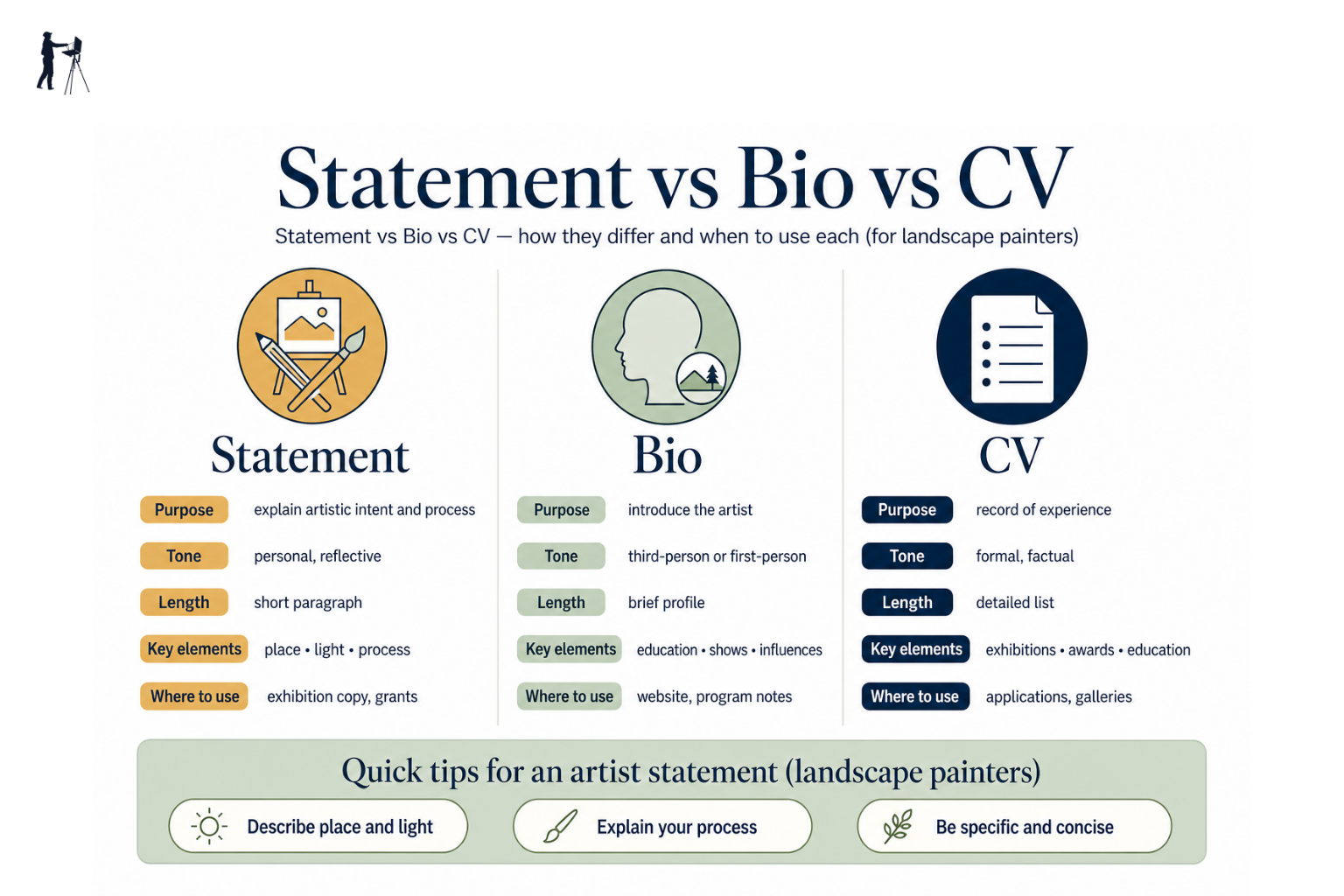
Your artist statement is written in the first person and focuses entirely on your work: what you make, how you make it, and why. It is not a career summary and it is not a list of achievements. It is a window into your practice, written for someone who has never met you but is standing in front of your paintings.
Your artist bio is written in the third person and covers your background as an artist: where you're based, what medium you work in, any significant exhibitions or memberships. It answers "who is this person?" rather than "what do they make and why?"
Your artist CV is a factual document, a structured list of exhibitions, training, awards, and commissions. Most open calls and gallery submissions do not ask for a CV at this stage; if they do, it's a separate document from the statement or bio.
Getting this distinction right matters from the start. Sending a bio when a statement is requested, or a statement when a bio is expected, signals to curators and organisers that you haven't read the brief carefully.
Why it matters for landscape and plein air painters
For painters who work outdoors, the statement serves a particular purpose that goes beyond ticking an administrative box. It tells curators, buyers, and fellow artists why you paint on location and what that choice brings to the work. When someone stands in front of a small, atmospheric oil study of a Northumberland beach or a watercolour of the Somerset Levels painted in fading afternoon light, they may instinctively wonder: why did this person go out there to make this, rather than working from a photograph in a warm studio?
Your statement answers that question. It frames the work and gives the viewer something to carry with them. Without it, your paintings are still paintings, but the practice behind them remains invisible.
The Three-Part Structure Every Artist Statement Needs
The simplest and most effective structure for a plein air artist statement is built around three questions: what, how, and why. Think of these not as a dry formula but as a natural sequence of thought, moving from the concrete to the meaningful.
What: your subject matter and medium
Start with what you actually make. Describe your primary medium, your typical subject matter, and the scale you tend to work at. The goal here is specificity.
Be specific, not sweeping
"I paint landscapes" tells almost no one anything useful. "I paint small-scale oil studies of the Suffolk coast, working directly from the shore" gives a curator, collector, or society member something to picture and remember.
Think about the particular places you return to, the kinds of light or weather that draw you out, the format that feels most natural to your practice. A sentence or two is enough for this section. You're not writing a catalogue entry for every painting you've ever made; you're giving the reader a clear initial picture.
How: your process and working method
This is where your plein air practice earns its place in the statement. Explain that you work on location and, crucially, say something about what that actually means for the work: the directness, the time pressure, the way the light shifts before you've mixed the right colour. One or two sentences about your materials can be useful if they're genuinely distinctive, but this section should illuminate meaning, not turn into a technical inventory.
The difference between "I use a limited palette of oils on board" and "working with a limited palette forces decisions I'd never make in the studio" is the difference between listing tools and explaining why your method matters.
Why: the intention and meaning behind the work
This is where most painters stall, and it's also the most important part of the statement. The "why" is what distinguishes your work from anyone else painting in the same location with the same medium.
Think about what draws you to particular places. Is it a specific quality of light that changes faster than you can mix it? A personal connection to a region? A desire to record landscapes that are shifting or under pressure? What questions or themes run through the work, even if you've never articulated them before? Transience, sense of place, seasonal change, memory, ecology and the way land is used: any of these can be the heart of a landscape statement without tipping into academic abstraction.
The "why" question is the hardest and the most useful
If you find the "why" difficult, try this: imagine someone asks at a private view why you don't just use photographs. Whatever you say in that moment — that's the core of your "why."
A Practical Method for Writing Your First Draft
Knowing the structure is one thing; getting words onto the page is another. Here's a method that works especially well for artists who don't think of themselves as writers.
How to draft your artist statement
Free-write for ten minutes
Without editing yourself, write down what you paint, where you paint it, how you work, and what draws you to those places. Don't worry about sentences — notes and fragments are fine.
Highlight the phrases that feel true
Read back what you wrote and underline or circle the words and phrases that feel most accurate. These are your raw material.
Answer the three questions in order
Write one short paragraph for each: what you paint, how you work outdoors, and why those places or that way of working matters to you.
Cut it down
Aim for 150–200 words in total. Cut anything that doesn't help the reader understand your work. If a sentence would confuse someone who had never seen your paintings, it can usually go.
Read it aloud
If it sounds like something you would never actually say, revise it. It should sound like you — just a considered, calm version of you.
The free-writing step is worth taking seriously. It bypasses the internal critic that produces either hollow abstraction ("I explore the relationship between land and memory") or flat description ("I paint various landscapes in different seasons"). When you write quickly without editing, the phrases that matter tend to surface naturally.
Common Mistakes (and How to Avoid Them)
Even with a clear structure, there are predictable traps. Here are the ones that come up most often in landscape and plein air statements.
Vague, abstract language without grounding. "I explore liminal space and the sublime" is not a statement; it's a placeholder. Every abstract idea in your statement should be anchored to a specific material, place, or practice. If you can't picture a painting in your own body of work that illustrates the claim, cut the claim.
Overloading the process section. Listing every pigment, brush size, and board type turns your statement into a supply inventory. Mention process only where it genuinely explains something about the quality or meaning of the finished work.
Autobiography where practice description should be. The statement is about your current work, not how you got here. The story of taking up painting after a career change, or inheriting your grandmother's watercolours, belongs in an interview or a personal essay, not a 200-word practice statement. Save it for your bio if it's genuinely relevant.
Writing for the wrong audience. A statement written to impress a contemporary art critic will fall flat in a local gallery programme or on an open call application form. Know who is reading it and write for them, not for an imaginary panel.
One statement for every situation. A 250-word general statement is not the right document for a 75-word application field. Pasting it in and hoping for the best rarely works.
Keep a shortlist of versions
Once you have a full statement you're happy with, create a 75-word and a 150-word version. Most application forms have word limits, and having these ready saves a scramble at deadline.
Writing an Artist Bio for Landscape and Plein Air Work
Many UK contexts, including society catalogues, gallery listings, and open studio programmes, ask for a bio rather than a statement. The principles are similar (clear, direct, grounded in specifics) but the format and person change entirely.
A bio is written in the third person and focuses on factual career information: where you are based, what medium and subject matter you work in, any significant exhibitions, memberships in plein air or landscape societies, and training if relevant. It is not the place to talk about inner life or artistic intention; that's the statement's job.
Keep it to 100–150 words. A single well-constructed paragraph is the standard format for most UK society and gallery contexts, and these will often be displayed verbatim, so accuracy matters.
Here's an illustrative template structure (framed as a model, not a real artist):
[Name] is a [county/region]-based painter working in [medium] outdoors. She paints [subject matter], focusing on [particular quality or theme]. Her work has been shown in [type of venue] and she is a member of [society if applicable]. She lives and works in [location].
If you're earlier in your career and have fewer credentials to list, don't pad the bio to compensate. A short, honest bio that says something clear about your practice is considerably stronger than a stretched one built on filler.
How to Adapt Your Statement for Different UK Contexts
This is where the practical reality of a UK landscape practice becomes most relevant. The same core statement can serve multiple contexts, but it almost always needs adapting.
Open calls and painting competitions
UK open calls vary widely in what they ask for. Some want a 50-word description of specific works submitted; others want a full practice statement. Read the brief carefully before you write a word, and match your word count exactly to what is specified. For themed open calls, a brief acknowledgement of how the theme connects to your own practice is usually more effective than a generic statement dropped in unchanged.
Gallery and exhibition submissions
Local galleries, artist-run spaces, and open studios typically want something short and accessible for programme notes or press releases. Here, lean toward the bio format with a sentence or two of statement-style content to describe the current work. Avoid jargon entirely; gallery visitors come from all backgrounds, and plein air is not a term everyone knows. One plain sentence explaining that you paint on location is usually enough.
Plein air and landscape societies
UK groups such as the British Plein Air Painters and The Wapping Group of Artists have active membership and exhibition programmes. When applying to groups like these, check whether they want a statement, a bio, or both. A statement written for a society application should place particular emphasis on your commitment to working on location and your connection to the British landscape. Mentioning existing memberships of relevant groups in your bio signals seriousness and contextualises your practice within a community of fellow painters.
Artist websites and online portfolios
Your website gives you the most freedom and the most room to ramble. Use your full 150–250 word statement on your About page, clearly separated from your bio. Consider keeping a shorter "what I do" paragraph at the very top of the page for visitors who won't read the full statement. And update the statement when your work shifts direction: a statement written about your studio practice four years ago won't represent a committed plein air painter accurately today.
What Makes a Landscape Statement Distinctive Right Now
Landscape painting has always been about more than recording scenery, but in 2025 and beyond, statements that acknowledge what a particular landscape actually means are landing differently than purely technical descriptions. This doesn't mean every landscape painter needs to write a climate manifesto. It does mean that a statement acknowledging why a specific place matters, personally, culturally, or ecologically, tends to be more resonant than one that describes only materials and process.
There's also a tension at the heart of plein air work that is worth naming: you are making a permanent object (a finished painting) in response to something entirely impermanent (the light, the tide, the cloud cover on a specific afternoon). That tension between permanence and transience is often what draws painters outdoors in the first place, and it can be expressed simply and directly without any theoretical scaffolding.
The plein air practice itself carries meaning, too. Choosing to be physically present in a specific place at a specific moment, rather than working from a screen or a photograph, is a meaningful choice. It says something about directness, attention, and the value of being there. You don't need to make grand claims about it; stating it plainly is often enough. "I am drawn to the way the light on the North Yorkshire moors changes faster than you can mix it" is more evocative and more honest than a paragraph about the phenomenology of landscape perception.
A statement doesn't need to be perfect on the first draft. It is a living document, and the most useful thing you can do right now is write something honest. Get it down, read it aloud, cut what doesn't sound like you, and revise it as your work and thinking develop. The painters who have the strongest statements are usually not the ones who wrote something clever; they're the ones who wrote something true.
FAQ
Frequently Asked Questions
What is the difference between an artist statement, an artist bio, and a CV?
An artist statement is first person and explains your work, methods, and intentions (about 150–250 words). A bio is third person and gives background and career details (100–150 words). A CV is a factual list of exhibitions, training, and awards (1–2 pages).
How long should an artist statement for landscape painters be?
Aim for 150 to 200 words for a full statement. Keep ready shorter versions too, for example a 75-word summary and a 150-word version for different application limits.
What should I include in a plein air or landscape artist statement?
Use a three-part structure: what you paint (subject, medium, scale), how you work on location (process and what that choice brings), and why you are drawn to those places or themes (intention and meaning).
How do I start writing if I find it hard to put words down?
Free-write for ten minutes about your subjects, places, methods, and motivations. Highlight true-sounding phrases, then shape three short paragraphs for what, how, and why. Edit to 150–200 words and read aloud to check the voice.
How should I adapt my statement for UK galleries, open calls, or societies?
Read each brief and match its word limit. For galleries use short, accessible lines; for open calls mention theme links briefly; for societies emphasise commitment to working on location and local landscape connections.
Author

PleinAirPainting Editorial Team
PleinAirPainting.co.uk helps artists paint outdoors with confidence through UK-focused guides, equipment advice, resources and plein air inspiration.