Open Studios for Plein Air Artists: How to Take Part
A practical guide for plein air painters on joining regional trails, hosting independent or hybrid open studio events, presenting outdoor work effectively, handling sales, and partnering with local groups.

Key takeaways
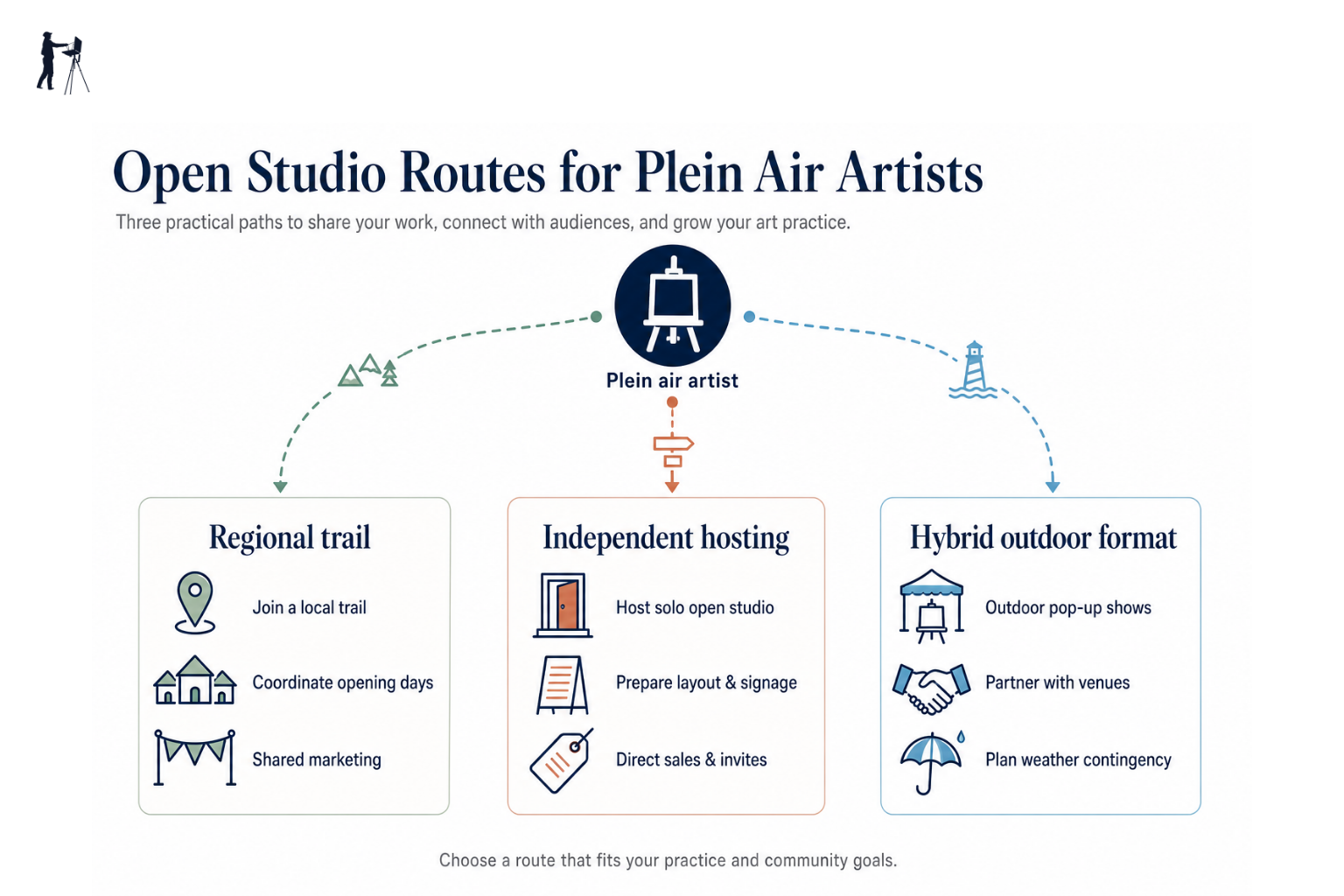
- • Three practical routes: join a regional trail, host your own open studio, or run a hybrid studio plus outdoor painting program.
- • Display pleins air work by location and story, show process materials, label clearly, and schedule demonstrations rather than painting nonstop.
- • Price consistently with multiple tiers; treat small studies as finished works and provide clear event offers rather than negotiating on the spot.
- • Handle logistics early: basic risk assessment, permissions for alcohol and managed land, card reader and receipts, and a second person on site.
- • Use local groups, societies and institutions to promote, schedule group paint-outs, collect visitor contact details, and follow up after the event.
Open studios are one of the most direct ways for a landscape painter to show work, find buyers, and connect with people who already have a relationship with the places you paint. For plein air artists in particular, the fit is natural: your subject matter is local, your process is visible, and the story behind each painting is one that visitors to an open studio art event in the UK tend to find genuinely compelling. If you have been painting outdoors for a few years and wondering how to build a wider audience without committing to the gallery circuit, this is worth taking seriously.
That said, the idea of hosting visitors can feel like a significant step. Most plein air painters spend their time working alone in fields and on clifftops, not welcoming strangers into their space and answering questions about prices. The organisational side of it, the practicalities around display, legals, and logistics, can feel opaque if you have never done it before.
This guide is intended to make it less opaque. It covers how open studios work in the UK today, the different routes available to landscape painters, how to present plein air work in a way that makes sense to visitors, and the practical realities that most general guides skip over.
What Open Studio Art Events in the UK Actually Look Like
Open studios in Britain are well established and growing. The model varies in scale, but the core idea is consistent: artists open their workspace to the public, usually over a weekend or series of weekends, with free entry and the opportunity to buy directly.
Devon Open Studios runs across September and involves nearly 400 artists across the county. It is one of the largest trail-based events in the UK, with a printed guide, coordinated marketing, and strong visitor numbers built up over many years. Demonstrations are actively encouraged, and landscape painters are well represented.
Cambridge Open Studios runs across four weekends in July, with artists opening in rotation. North Yorkshire Open Studios covers a broad rural area and includes a winter weekend alongside the main summer event, which makes it particularly interesting for painters whose work has a seasonal quality.
Spring Fling in Dumfries and Galloway is Scotland's largest open studios event, running over the late May bank holiday weekend and drawing visitors to studios in a genuinely beautiful rural landscape. If you paint in southern Scotland or the Borders, it is the most obvious starting point.
In London, open-house and open studio schemes operate at a more neighbourhood scale, often organised by local arts organisations or studio building managers. These tend to be less structured than county-wide trails but can attract significant footfall in the right areas.
The point is not that you need to know all of these events in detail before you do anything. The point is that the infrastructure exists, it is active, and there is a ready-made audience for it across the country. You are not starting from nothing.
New to open studios?
Visit one or two as a viewer before committing to take part. Most UK trails are free to enter and open on weekends — it's the best way to understand what visitors expect and how artists present their work.
Three Routes In for Plein Air Painters
There is no single right way to take part in open studios. The approach that suits you depends on how much infrastructure you want, how much control you want over the format, and whether your studio space is actually a studio or a corner of your house.
Join a Regional Open Studio Trail
The trail model is the most structured option. You register with the organising body, pay a fee (which varies but is typically in the range of £50 to £150 depending on the event and what is included), and your studio is listed in the printed guide and on the event website. The organisers handle the marketing, produce the trail map, and drive visitors to the region. You provide the space and the work.
What you get in return is real: an audience that has specifically come out to see artists, a framework that gives the event credibility, and the logistical backing of a coordinated programme. For painters who are new to open studios, this is the lowest-risk entry point. You are not responsible for filling the room through your own marketing alone.
The trade-off is that you are working within the event's dates, format, and registration requirements. Most trails have application deadlines months in advance, so it requires planning ahead. Check the relevant trail's website in autumn or winter for the following year's event.
Host Your Own Open Studio
Running an independent event gives you complete flexibility over dates, format, and how you present yourself. This suits painters who have an established local following, who want to combine their open studio with a specific occasion (such as a new series launch), or whose studio location does not fall within an existing trail area.
The practicalities are more squarely on you: signage to get people through the door, listings on community event calendars, local press notices, and your own social media promotion. None of this is especially difficult, but it requires time and some advance planning.
One practical approach that works well is clustering with one or two other artists in your area to create a small informal trail. Visitors are more likely to make a journey for three studios than for one, and the shared promotion means less work for each individual artist. This does not need to be formally organised; it can be as simple as agreeing on a shared weekend, printing a simple joint leaflet, and cross-promoting on social media.
Hybrid: Studio + Outdoor Painting
For plein air painters specifically, the most compelling format is one that combines a studio show with scheduled outdoor sessions. This might mean hosting your studio on a Saturday, then leading or demonstrating a paint-out on Sunday in a nearby landscape. Or it might mean partnering with a local museum or heritage site to run a demonstration on their grounds during the same weekend your studio is open.
This kind of hybrid event is already happening across the UK. Barnstaple Museum has hosted Exmoor-focused painting sessions as part of broader community engagement, and Chartwell in Kent, managed by the National Trust, has run outdoor painting days that connect visitors to Churchill's own painting practice. These are not exceptional arrangements; they are examples of institutions that have found genuine value in outdoor painting as public programming.
As a plein air painter, you are in a strong position to offer something that studio-based artists simply cannot: the live spectacle of working from observation in a real landscape. A scheduled outdoor demonstration during your open studio weekend is a significant draw and positions your practice as something distinct and active, not just a collection of finished canvases on a wall.
How to Display Plein Air Work Well
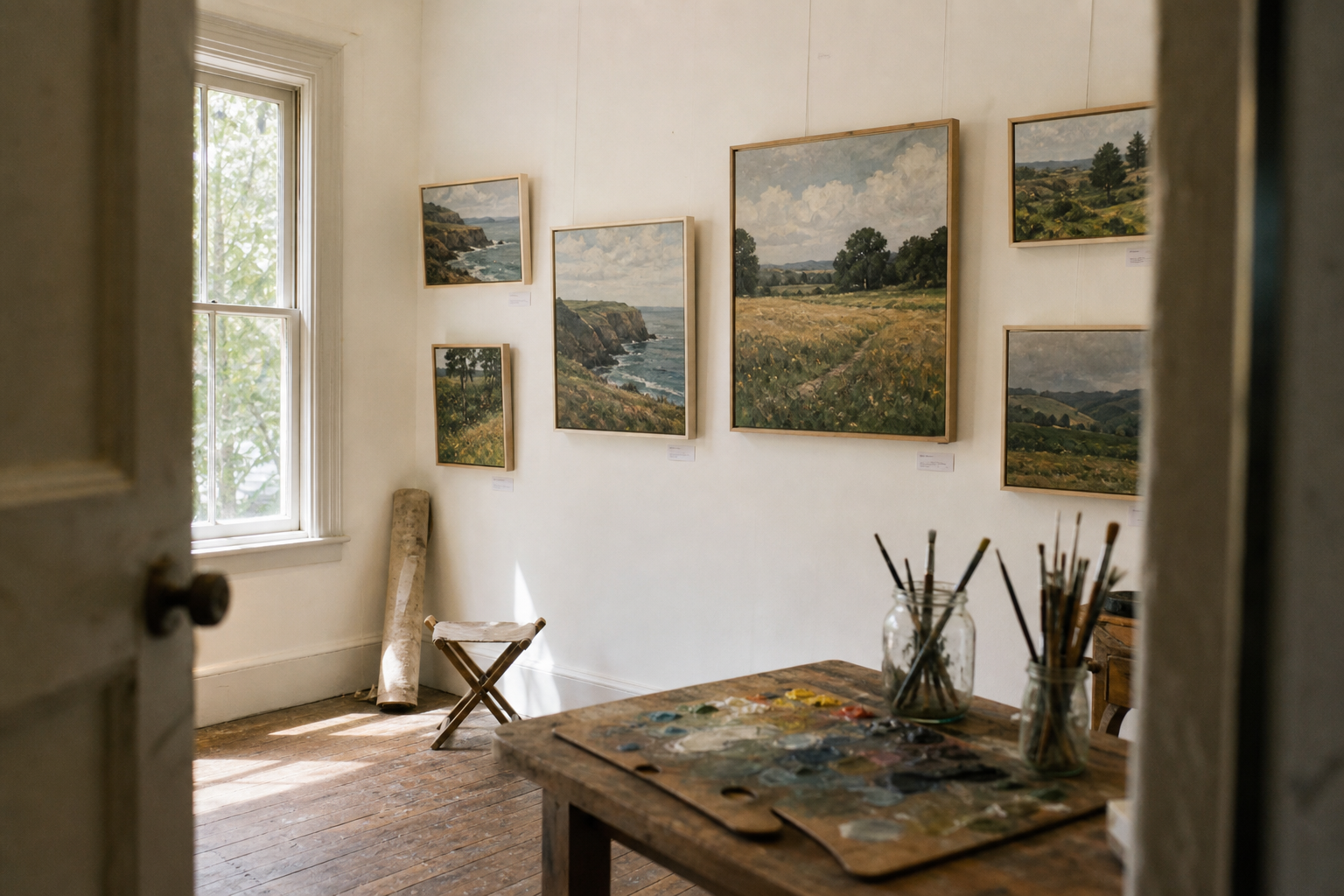
This is where open studios for plein air artists diverge most clearly from the generic guidance. A visitor who walks into a painter's studio and sees fifty small, loosely handled panels on linen boards may not immediately understand what they are looking at. That is not a failure of taste; it is a failure of context. Your job as the host is to provide that context before the visitor even needs to ask.
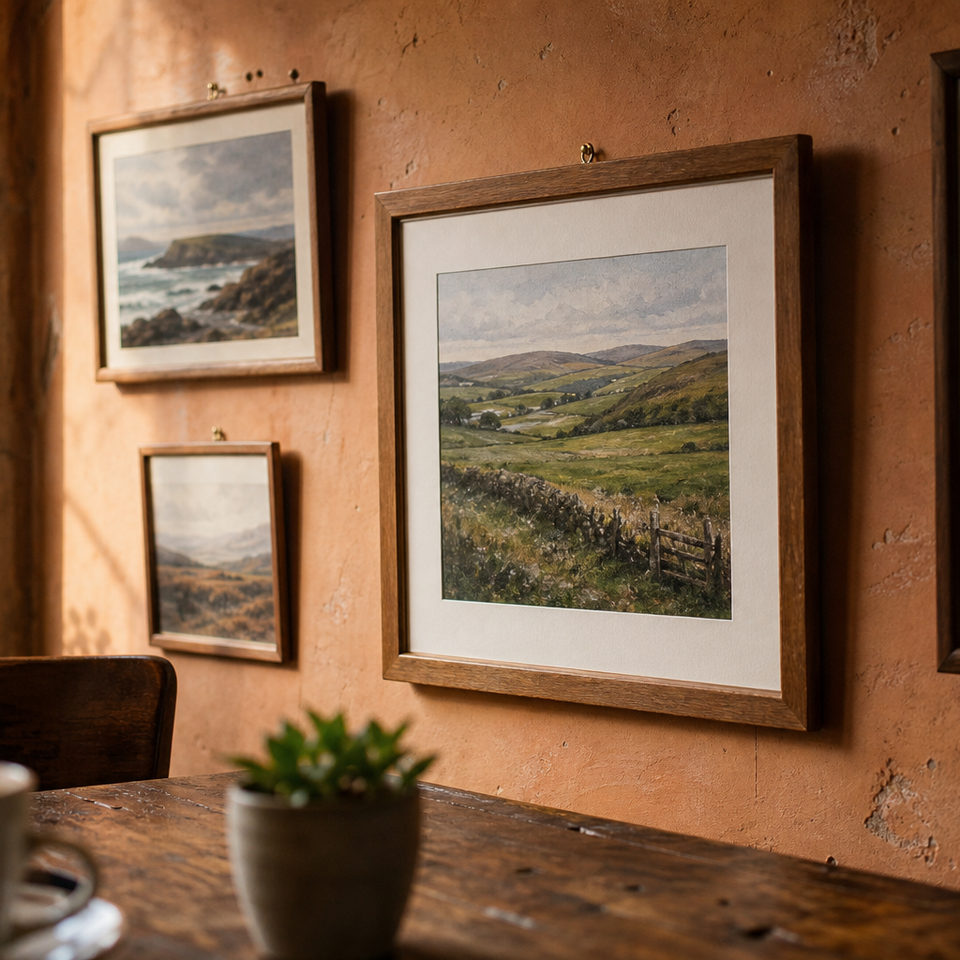
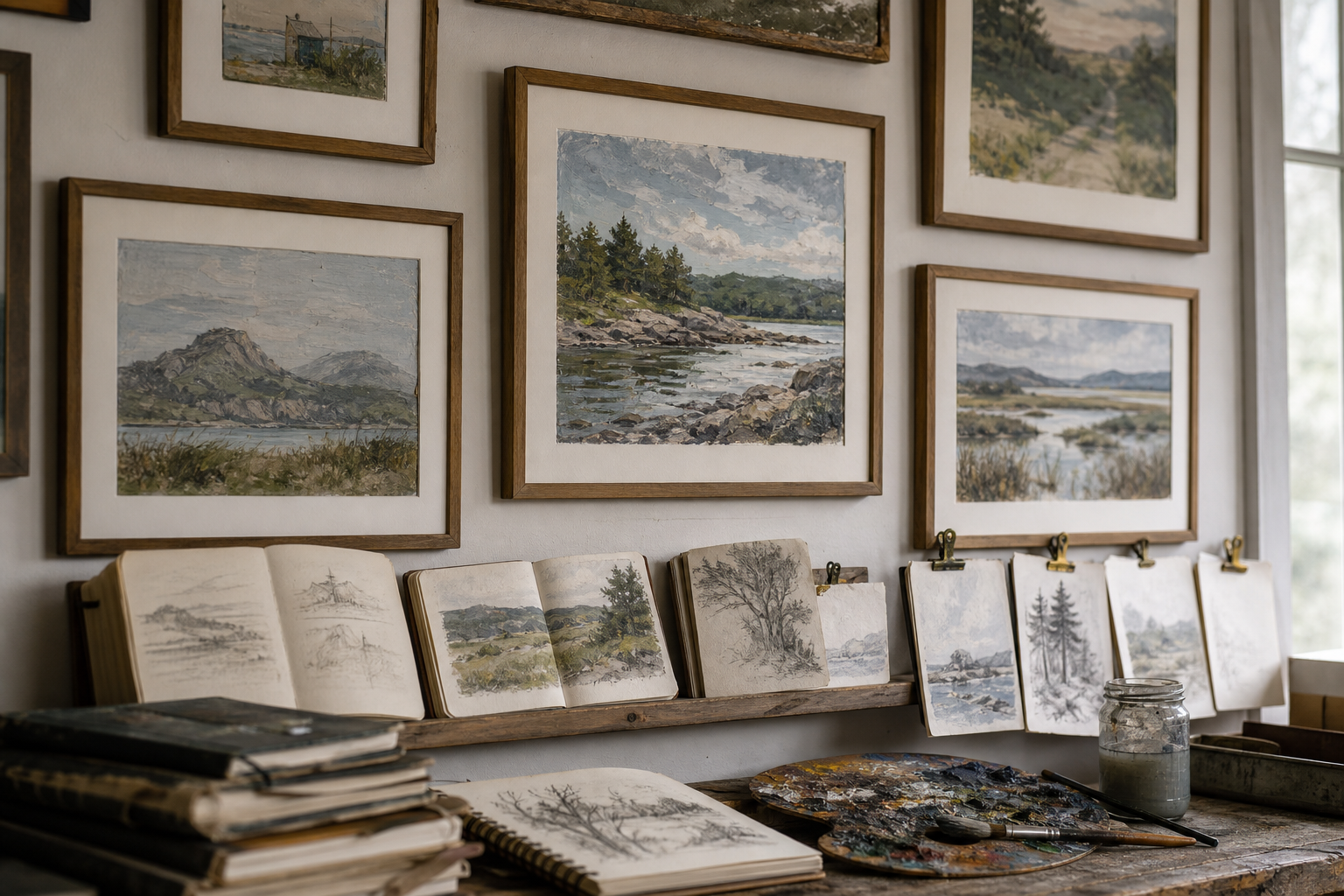
The most effective approach is to group works by location rather than by size or date. A wall of paintings from the Norfolk coast, with a photograph of the location and perhaps a small printed map, tells a story. The visitor who knows Norfolk will feel an immediate connection. The visitor who does not will understand what kind of painter you are. Both outcomes are useful.
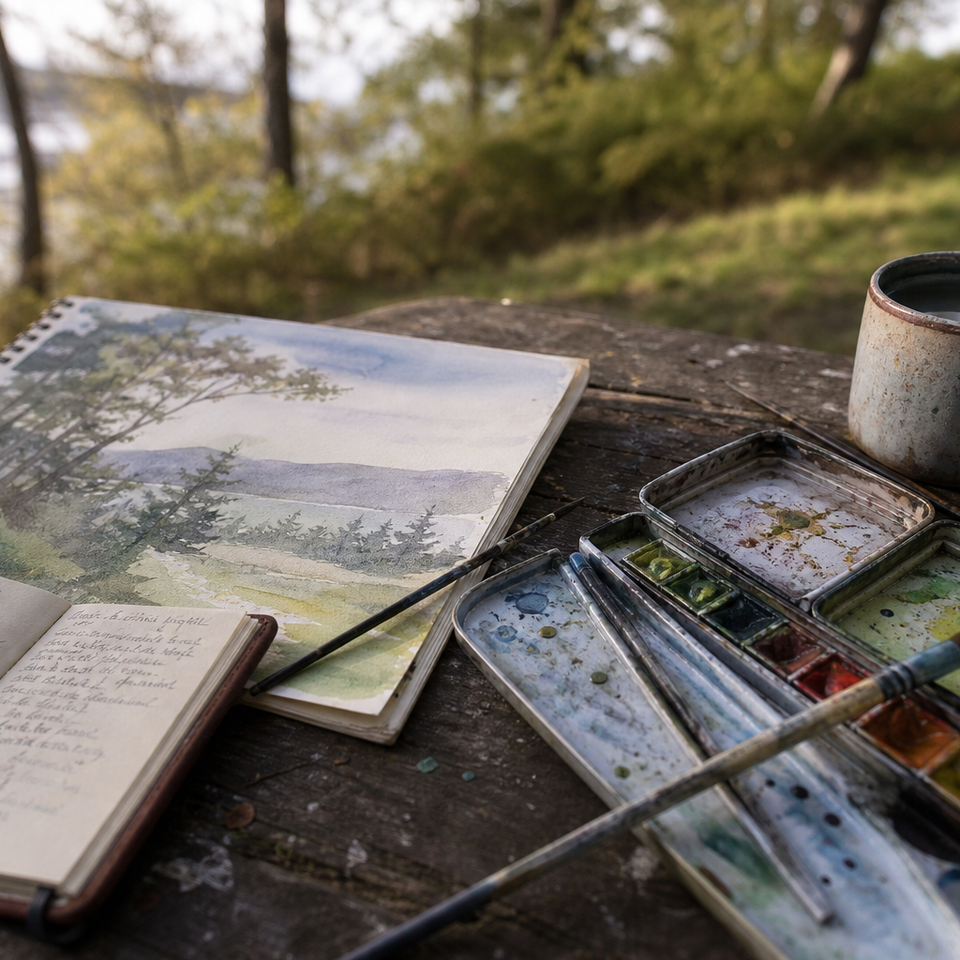
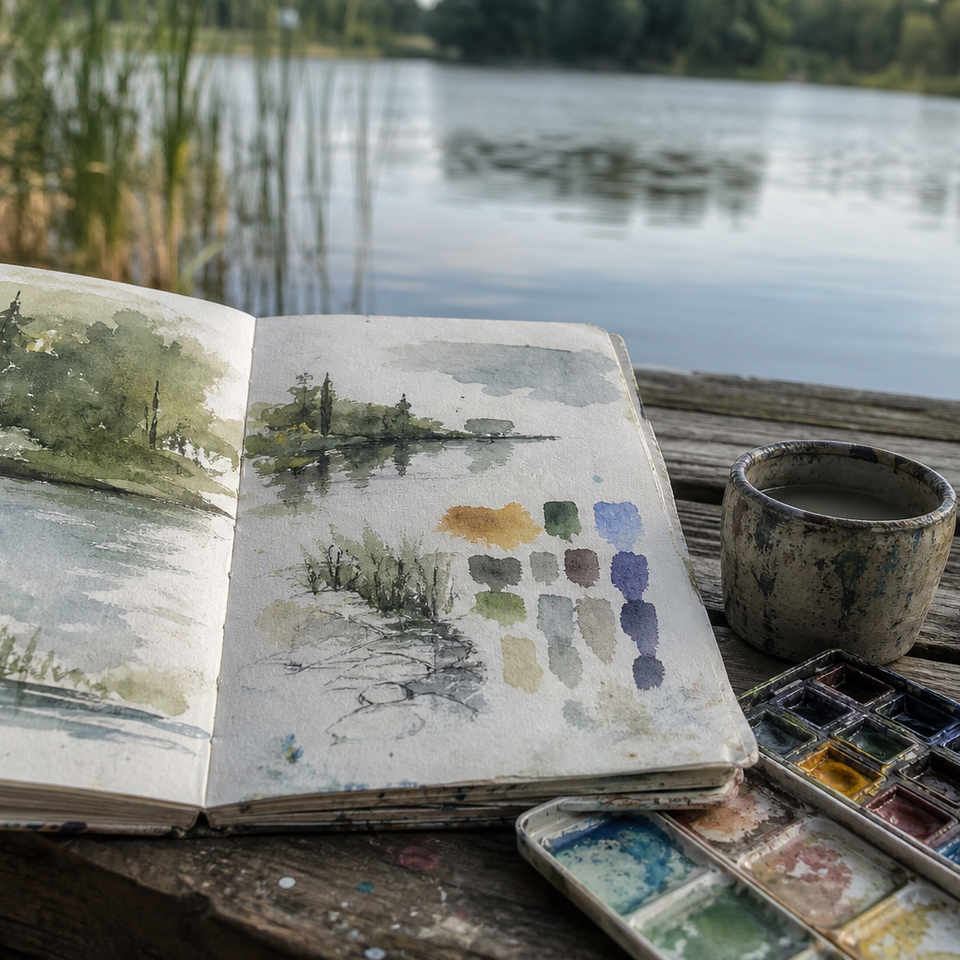
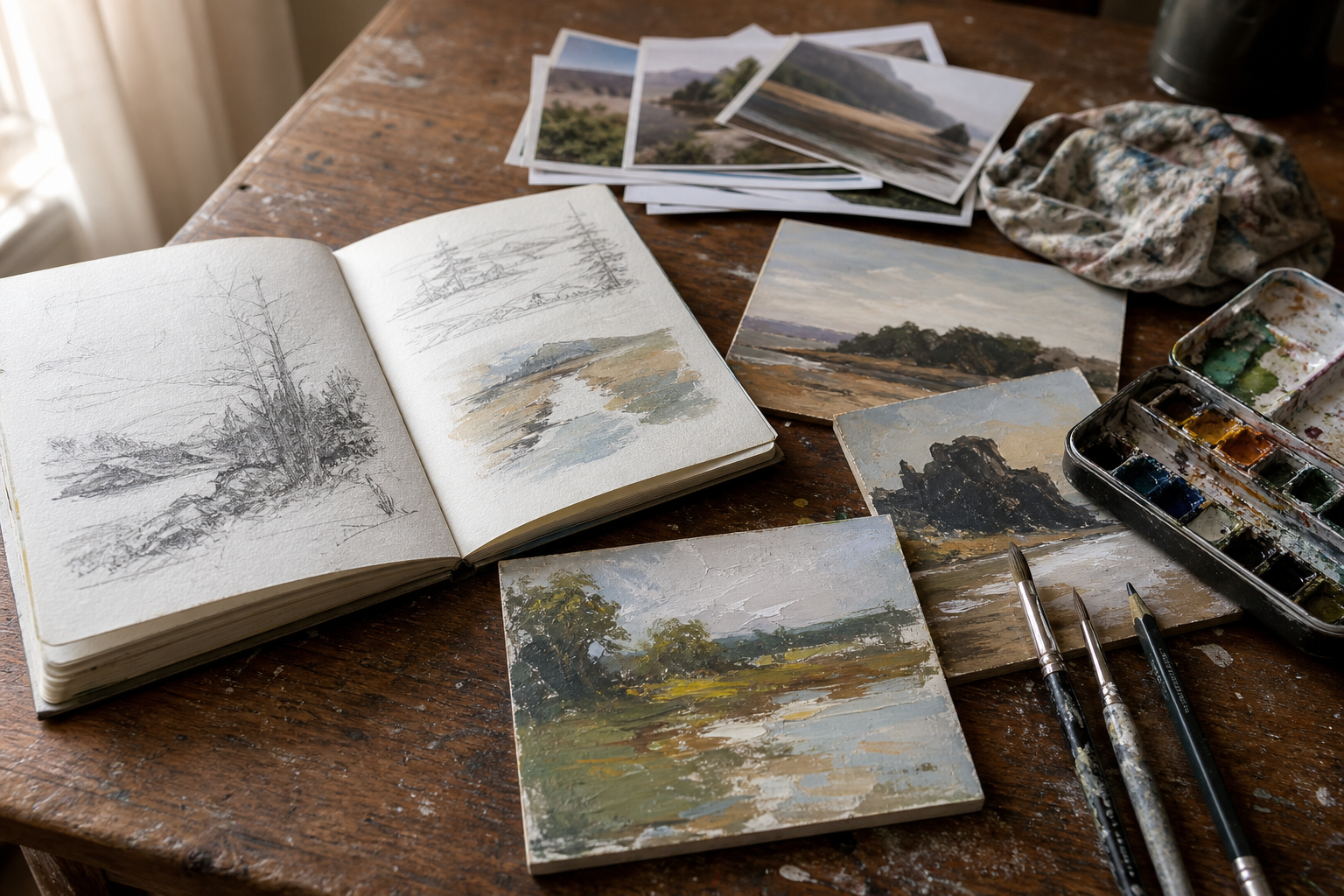
Alongside finished panels, put out the process materials: sketchbooks open to relevant pages, colour studies, perhaps a photograph of you painting on location. This is not cluttering the space; it is providing the narrative that makes the finished work intelligible. A visitor who understands that the small study next to the large panel was painted in two hours on a windy morning on a cliff will value both pieces differently than one who just sees two paintings of the sea.
If you are planning to demonstrate during the event, schedule it and advertise it clearly rather than trying to paint continuously while also hosting. Trying to do both at once rarely works well. A two-hour demonstration at a fixed time, promoted in advance, creates a focal point for the day and gives visitors a reason to arrive at a particular moment.
Labelling matters more than most artists expect. Every work should have a visible label showing the title, location, medium, size, and price. Visitors who have to ask the price of a painting often do not ask; they simply move on. Remove that friction.
| Work type | Display approach | Typical price tier |
|---|---|---|
| Plein air study (6x8 or smaller) | Group by location or trip; label clearly as a study | Lower entry price point |
| Finished plein air panel | Show as primary work; include location context | Mid-range |
| Studio painting from outdoor reference | Contextualise with plein air sketches or photos | Higher price point |
| Sketchbooks and process materials | Display openly as storytelling, not for sale | N/A — adds value to finished work |
Pricing, Sales, and Handling Buyers
Pricing outdoor studies is something many plein air painters find genuinely uncomfortable, and it is worth acknowledging that before offering advice. There is a real tension between knowing how long a piece took (sometimes two hours, sometimes twenty minutes) and knowing what it represents in terms of skill, judgement, and accumulated experience. Visitors occasionally sense that uncertainty and it does not help anyone.
The practical answer is to decide your prices in advance, write them on the labels, and commit to them. On-the-spot discounting is tempting when someone is hovering over a painting, but it undercuts your own pricing structure and can create awkward situations if two visitors compare notes. Price consistently; if you want to offer reductions, do it through a clear "event offer" on a specific category of work, not through negotiation at the point of sale.
Aim for a range of price points. Small studies at an accessible entry level, finished panels in a mid range, and larger studio paintings from outdoor reference at a higher price. Having cards or prints available as a further entry point is a legitimate option, but keep them clearly separate from the original work so there is no confusion.
Have a card reader set up before the event opens. Most visitors arrive without cash, and having to send someone to find a cash machine while their enthusiasm cools is a poor experience for both parties. Square, SumUp, and similar readers are inexpensive and work well in UK studio settings.
Provide a simple sales receipt for each purchase, noting the title, medium, size, and sale price. For oil paintings, a brief care note explaining drying times and how to clean the surface is a professional touch that takes five minutes to prepare and leaves a good impression.
On pricing studies
Small plein air studies have real value — they represent a complete painting session, direct observation, and genuine skill. Price them as finished small works, not as sketches. Visitors who understand your process will understand the price.
The Practical Realities: Safety, Legals, and Logistics
Safety in a Home or Studio Setting
Opening your space to the public requires a basic risk assessment, and this is now standard advice from UK open studio organisations including Devon Open Studios. It does not need to be complicated, but it does need to be done.
Walk through the space before the event and check for trip hazards: trailing cables, low beams, uneven steps, anything stored at ankle height. Block off areas you do not want visitors to enter, whether that is a private room, a storage area, or somewhere with fragile work in progress. Put valuables out of sight.
The single most important step is to have another person present throughout the event. This is not about anticipating anything dramatic; it is simply good practice for anyone hosting the public at home. If a visitor has a fall, if a question arises you need to step away to handle, if you need a break, having a second person there makes everything more manageable. Ask a fellow artist, a friend, or a family member to help.
Licensing: When You Need a Temporary Event Notice
If you are planning to offer alcohol at any part of your open studio, including a private view evening, you may need a Temporary Event Notice (TEN). This applies in England and Wales.
A TEN is a straightforward process: you notify your local authority and the police at least ten working days before the event. The standard fee is around £21. A single TEN covers up to 499 attendees and up to 168 hours. For most open studio events, the application is simple and approval is routine.
If your event is a viewing event with no alcohol and no licensable entertainment, you do not need a TEN. If you are in Scotland, the licensing framework differs and you should check with your local council rather than assuming the England and Wales rules apply.
If you are uncertain whether a specific element of your event requires a notice, contact your local authority in advance. It is a short conversation and removes any ambiguity.
Outdoor Events and Land Access
If your open studio programme includes outdoor demonstrations or paint-outs on National Trust land, in a National Park, or on any other managed land, contact the relevant property or authority before you commit to anything publicly. Trust byelaws may restrict organised public gatherings or trading on their land without prior agreement, even if that land is generally open to walkers.
In practice, many National Trust properties and park authorities are actively interested in outdoor painting as public engagement, and a polite phone call explaining your plans will often result in a supportive response. Get any agreement in writing, even if it is just a follow-up email confirming what was discussed. That protects both parties and avoids any misunderstanding on the day.
Working With Communities, Groups, and Institutions
The most underused resource for plein air painters preparing for an open studio is the community that already surrounds them.
The British Plein Air Painters organisation connects painters across the UK and is an obvious starting point for finding collaborative trail partners or painting companions who might help promote an event. The Wapping Group of Artists, one of the oldest outdoor painting societies in the country, has its own events programme and a wide network that extends well beyond London. Local informal groups, many of which exist on Facebook or Meetup, are equally valid and often more immediately useful if you want to find other painters in your specific area.
Scheduling a group paint-out during your open studio weekend is a natural draw that costs nothing to organise and creates visible activity around your event. Visitors who arrive to find a group of painters working in a nearby field or on a nearby beach are seeing outdoor painting at its most alive.
Local art societies are another practical partner. Many now include regular outdoor sessions, and co-promoting an open studio with a society whose members already paint in your area extends your audience significantly.
For institutional partnerships, the approach is simply to ask. If there is a museum, gallery, or heritage site near your regular painting locations, write or call to explain who you are and what you are proposing. Suggest a demonstration or paint-out on their site during your open studio weekend, framed as public programming that adds value for their visitors as well as yours. Not every approach will succeed, but the ones that do tend to create lasting relationships that grow beyond a single event.
Making the Most of It Beyond the Sales
The value of an open studio is not only what you sell on the day. Some of the most useful outcomes happen in the week after.
Have a guest book at the door and invite visitors to leave their email address if they would like to hear about future work or events. Keep it simple and low pressure: a notebook and pen, not a clipboard with a form. The list you build over one or two events is a genuine asset.
Follow up within a week with a short email thanking people for coming, sharing a photograph or two from the event, and mentioning what you are working on next. This does not need to be polished; it needs to feel like it came from a person.
Unsold work is not failure. Open studios are cumulative: paintings that do not sell at one event often sell at the next, or to someone who first saw them at a previous event and has been thinking about them since. Treat unsold work as inventory, not disappointment.
Document the event carefully with photographs, both of the space and of any outdoor sessions or demonstrations. If you receive press coverage, even in a local paper, keep a record of it. A body of documented open studio activity is useful material for funding applications, gallery approaches, and future event promotion.
The connections made at open studios, with buyers, with other artists, with local press, tend to compound over time. The first event is rarely the most successful in terms of sales, but it is often the most important in terms of what it makes possible afterwards.
FAQ
Frequently Asked Questions
How do I get started with open studios for plein air artists?
Visit a few local open studios as a viewer, then choose a route that suits you: join a regional trail, host your own weekend, or run a hybrid studio plus outdoor paint-out.
What is the best way to display plein air work at an open studio?
Group works by location, include photos or maps, show process materials like sketchbooks and studies, label every piece with title, medium, size and price, and schedule any demonstrations.
How should I price small plein air studies?
Price small studies as finished small works, set prices in advance, offer a clear range of entry, mid and higher price points, and avoid ad hoc haggling on the day.
Do I need permission for outdoor demonstrations or to serve alcohol?
If you plan to serve alcohol in England or Wales you will usually need a Temporary Event Notice. For painting on managed land, contact the landowner or site manager in advance and get any agreement in writing.
What safety and practical steps should I take when opening my studio to the public?
Carry out a basic risk assessment, remove trip hazards, block off private areas, have another person present throughout the event, and ensure you can accept card payments and issue receipts.
Author

PleinAirPainting Editorial Team
PleinAirPainting.co.uk helps artists paint outdoors with confidence through UK-focused guides, equipment advice, resources and plein air inspiration.