How to Pack and Ship Oil Paintings in the UK
Step-by-step UK guide to packing and dispatching oil paintings. Check touch drying, protect surfaces with glassine, use rigid boards and double-walled boxes, and insure or use specialist shippers for high value work.

Key takeaways
- • Confirm the paint is touch dry before packing using a gentle fingertip test.
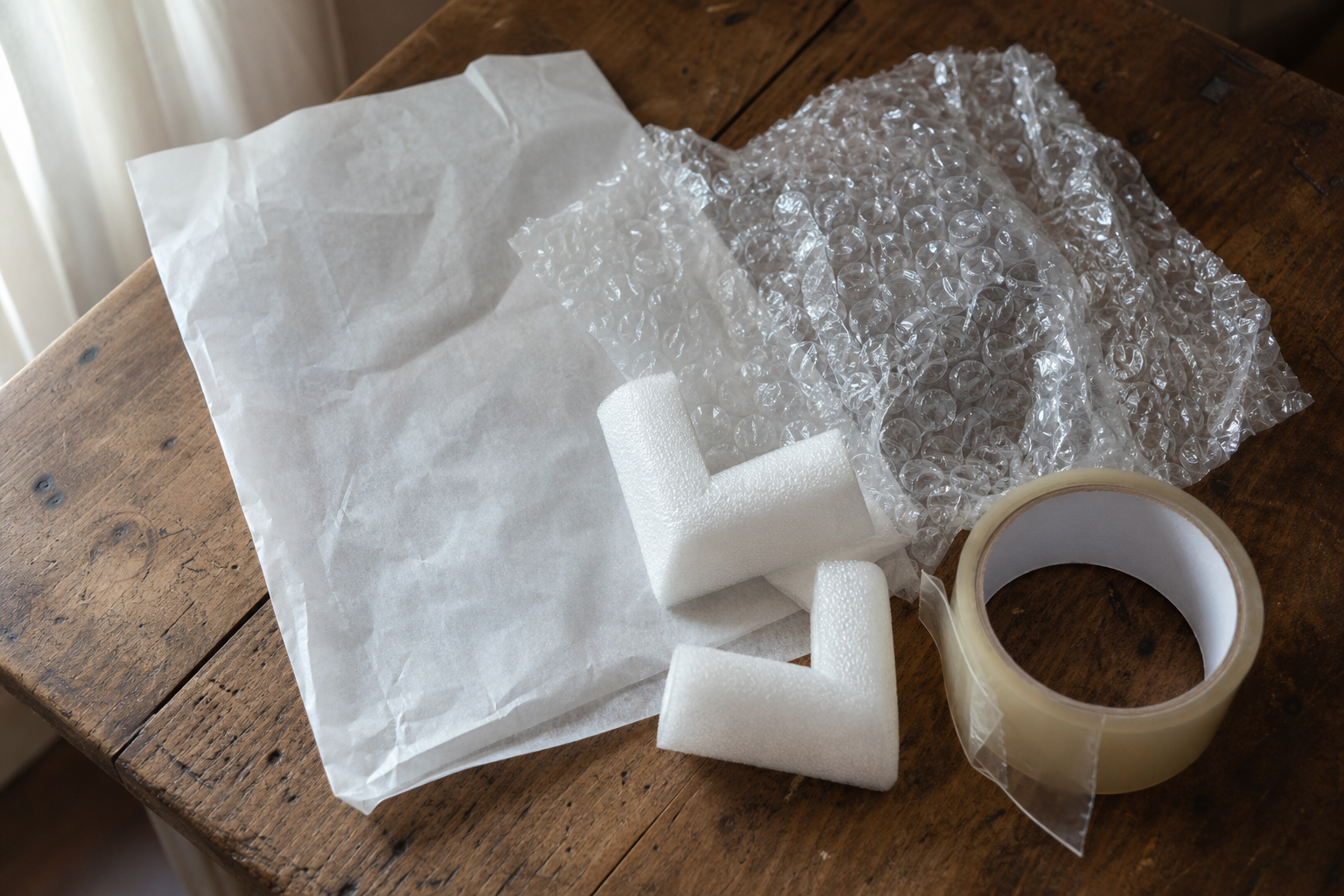
- • Protect the painted surface with glassine, then add small-bubble wrap and foam corner protection.
- • Create a rigid sandwich with foam board or stiff card to prevent flex and use snug double-walled boxes.
- • Choose the carrier to match parcel size and value and check compensation and dimensions before booking.
- • Declare accurate value, insure high value works, and consider specialist art shippers for costly or large framed pieces.
You've made a sale. The hard part is done. Now comes the bit nobody warns you about: getting the painting to your buyer in exactly the same condition it left your studio. Knowing how to ship oil paintings safely in the UK is a skill worth learning properly, because it's where well-intentioned sellers most often come unstuck. This guide covers everything from a single small plein air panel to a framed original under glass.
Before You Pack Anything: Two Things to Check
It's tempting to reach straight for the bubble wrap, but there are two checks worth making before you handle a single sheet of packing material. Skipping either one can cause problems that no amount of careful wrapping will fix.
Is the Paint Touch-Dry?
Oil paint does not dry the way household paint dries. It cures through oxidation, and that process takes time, sometimes a lot of it. How long depends on the pigments you've used, how thickly the paint is applied, what medium (if any) you've added, and the conditions in your studio.
As a general rule, earth colours and ochres dry relatively quickly. Ivory black and alizarin crimson are notoriously slow. A thin study on a warm, dry day may be touch-dry within a week; a heavily worked passage of mixed whites could still be tacky after three weeks.
Before packing, press a clean fingertip very gently to an inconspicuous edge of the painting. If there's any give, any tackiness at all, wait. A painting that feels dry to the touch on top may still be soft beneath the surface. When in doubt, give it another few days. Sealing a not-quite-dry oil painting inside packaging is a reliable way to create a mess that cannot be undone.
What Size and Weight Is Your Parcel?
Weigh and measure your parcel after packing it, or at least estimate the finished dimensions before choosing a carrier. Royal Mail in particular has strict size thresholds that catch many sellers out. Their Large Letter and Small Parcel formats have maximum dimensions that are easy to exceed once you've added a box and cushioning around even a modest panel. Exceeding the size limit for a service means your parcel may be refused, delayed, or returned, so check the current limits on the Royal Mail website before booking.
General couriers often price on dimensional weight rather than actual weight, so an oversized but lightweight box can end up costing significantly more than expected. Getting this right before you commit to a carrier saves both money and frustration.
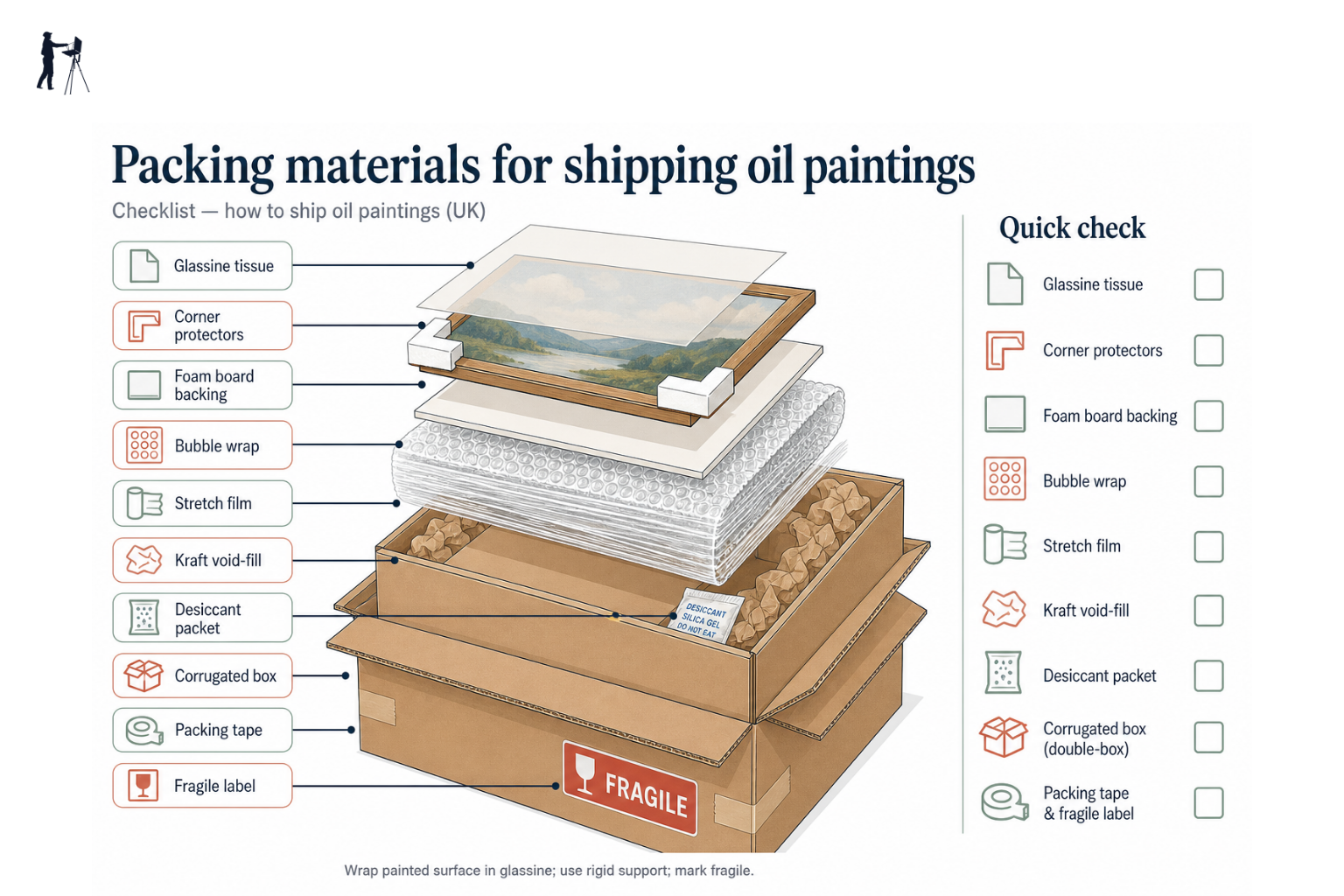
What You'll Need: A Standard Packing Kit
The best time to gather your packing supplies is before you have a sale to dispatch. Running around finding an appropriate box the night before collection is not a situation you want to be in when there's an original painting involved.
Here's what to keep in stock:
- Glassine or archival tissue paper: The non-negotiable first layer. Glassine is a smooth, acid-free paper that won't stick to or mark a painted surface. Archival tissue paper is an acceptable alternative for less delicate work.
- Small-bubble wrap: The standard cushioning workhorse. Use small-bubble, not large-bubble; it conforms better to irregular surfaces and provides more consistent protection.
- Foam corner protectors: These absorb impact at the four points most likely to take a hit. Worth having a range of sizes.
- Foam board or thick corrugated card: For creating a rigid sandwich around panels and frames to prevent flex and bending.
- Double-walled cardboard cartons: Single-walled boxes are fine for light domestic parcels; for anything beyond the smallest study, double-walled gives you meaningful extra crush resistance.
- Strong parcel tape: Brown packing tape rather than sellotape. Run it along every seam, not just the central flap.
- Kraft paper or foam void fill: Crumpled kraft paper is recyclable, easy to source, and effective at immobilising contents inside a box.
In the UK, Jackson's Art, Cass Art, and Ken Bromley all carry glassine and archival materials. For bulk packaging supplies such as double-walled cartons and parcel tape, Rajapack and similar packaging suppliers are often better value than art shops.
Stock up before you need it
Keep a small box of packing supplies ready so you're not improvising the night before a dispatch. Glassine, bubble wrap, corner protectors, double-walled boxes, and parcel tape are the essentials.
How to Pack a Small Unframed Plein Air Panel
Most plein air originals are unframed panels: oils on board or gessoed panel in sizes from 6"×8" up to around 12"×16". This is the format most UK plein air painters are selling, and it's also the most straightforward to ship well once you have the right materials to hand.
Step by Step for a Single Panel
Packing a single plein air panel
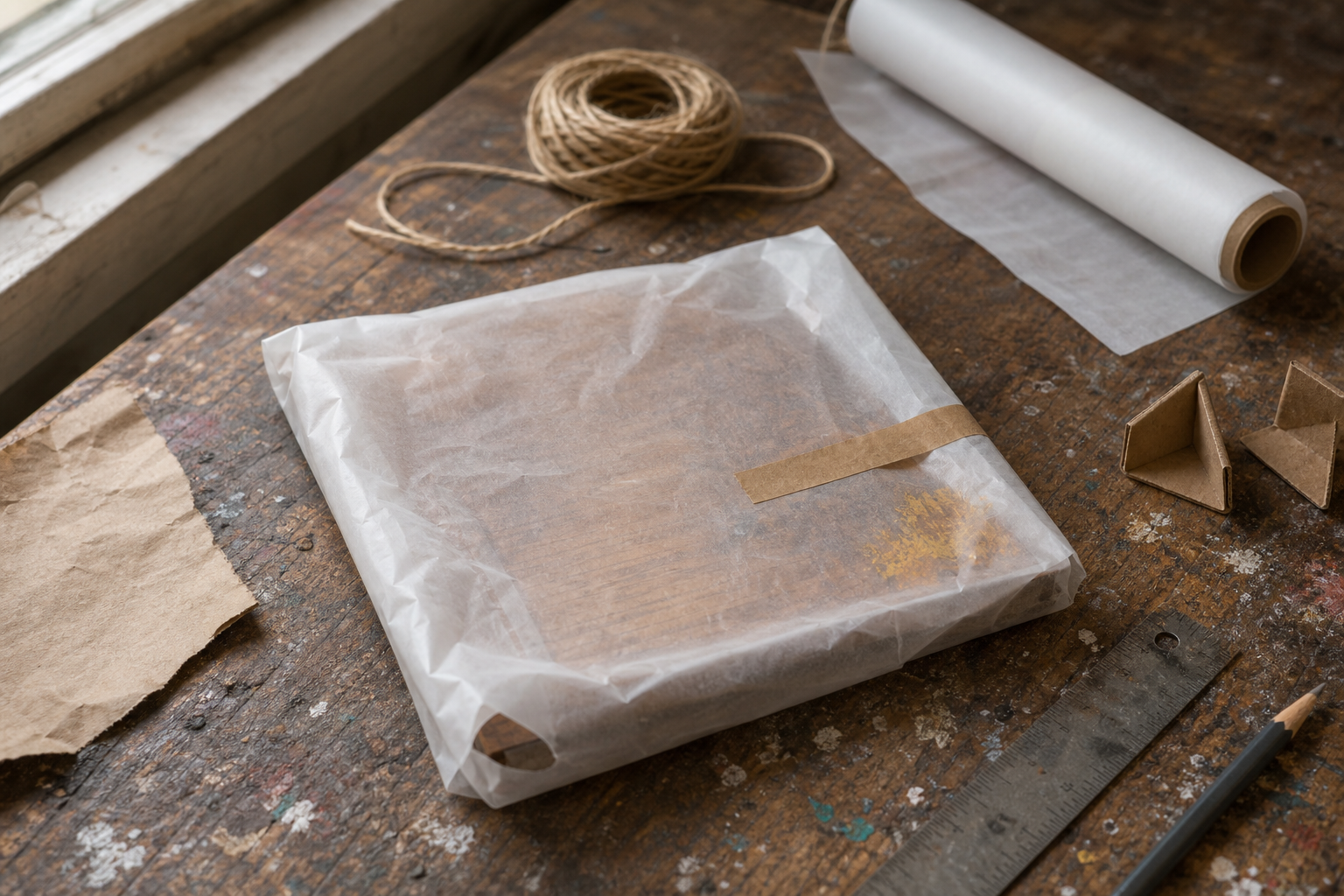
Protect the surface first
Lay a sheet of glassine or archival tissue flat over the painted surface. Never use bare bubble wrap directly against the paint.
Add cushioning
Wrap the panel in two layers of small-bubble wrap, bubbles facing outward. Secure the wrap with tape on the back only, keeping adhesive away from the painted surface.
Create a rigid sandwich
Cut two pieces of foam board or stiff cardboard slightly larger than the panel. Place one on each side to prevent any flex or bending.
Box it up
Slide the sandwiched panel into a snug double-walled box. There should be at least 3–5 cm of space on every side for void fill.
Fill and test
Pack crumpled paper or foam around the panel until nothing moves when you gently shake the box. Silence is what you're after.
Seal and label
Run parcel tape along every seam, not just the central flap. Write "Fragile" and "This Way Up" clearly on at least two sides.
The shake test is worth taking seriously. If you can hear or feel anything shifting inside the box, open it and add more void fill. A painting that can move inside its box will find a way to be damaged.
Shipping Multiple Panels in One Parcel
Shipping several smaller panels together is perfectly workable, but the key is making sure no two painted surfaces can come into contact with each other, and that nothing can slide around.
Stack panels face-to-face and back-to-back: place a piece of foam board or thick card between each pair, so painted faces are always separated by a rigid layer, never touching another painted surface. Wrap each individual panel in glassine first before stacking. Once stacked, wrap the whole bundle in bubble wrap and treat it as a single unit for boxing. The same rules apply: snug fit, no movement, every seam taped.
How to Pack a Framed Oil Painting
Framed work needs more thought, especially anything under glass. The basic principle is the same: protect the surface, create rigidity, cushion thoroughly. But there are a few extra steps that matter here.
Protecting Glass Before You Wrap Anything
If the painting is glazed, deal with the glass before you do anything else.
Tape the glass before anything else
Apply low-tack masking tape or painter's tape in an X or star pattern across the glass before you do anything else. If the glass breaks in transit, the tape holds the shards against the frame rather than letting them fall onto the painting.
This step takes thirty seconds and is worthwhile even for short local journeys. Low-tack tape (painter's tape is ideal) won't leave residue on the glass when removed. Once the glass is taped, lay a sheet of glassine over the artwork behind it before proceeding.
Wrapping and Boxing a Framed Painting
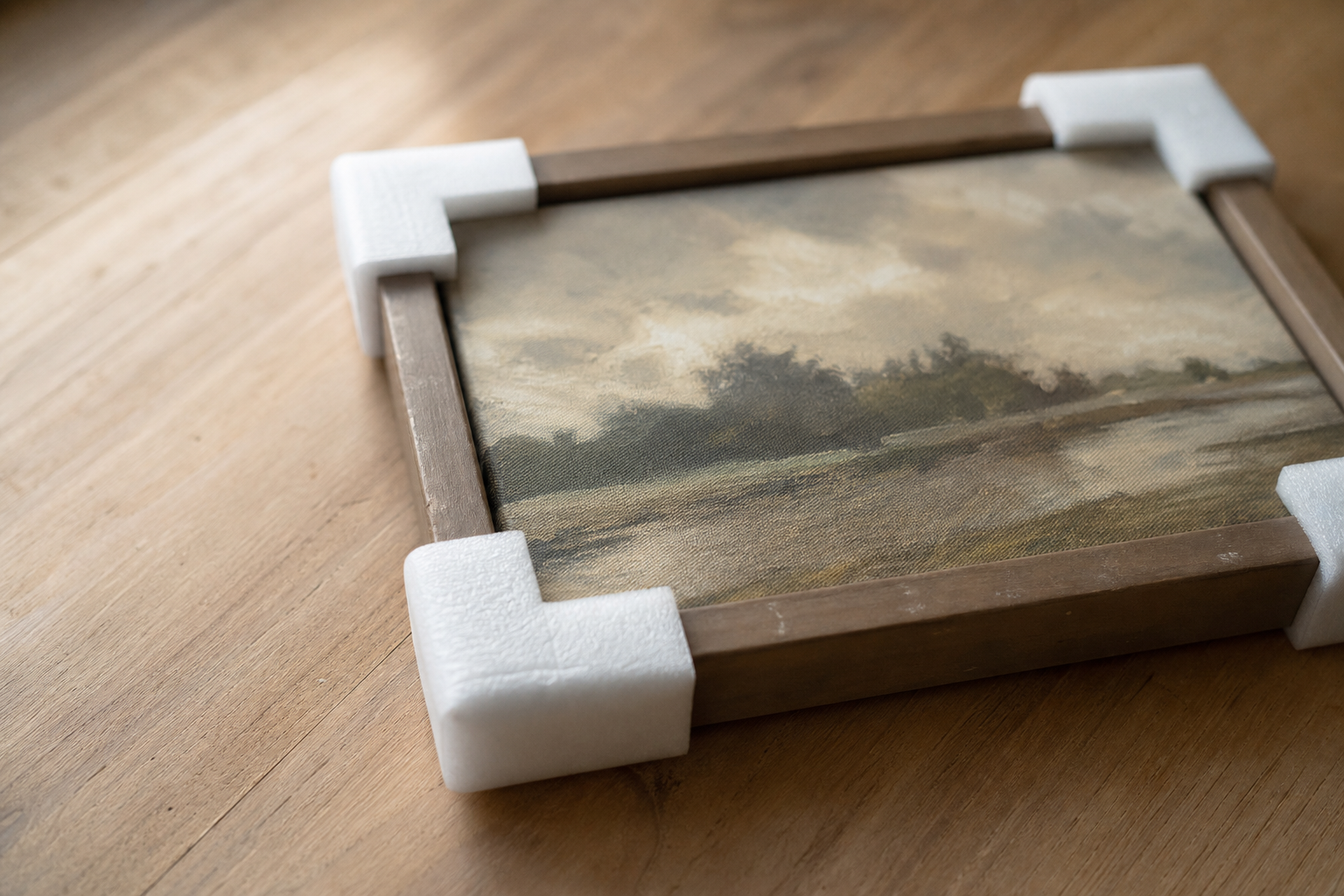
With the glass taped and glassine in place, fit foam corner protectors to all four corners of the frame. These are the points most likely to take a direct impact if the parcel is dropped, and they're the most common cause of damage to framed work in transit.
Wrap the whole framed piece in several layers of bubble wrap, paying particular attention to the corners and edges. Secure the wrap with tape, keeping adhesive away from any exposed frame or surface.
For boxing, you want a snug double-walled box or, for larger glazed works, a telescopic carton that can be sized to fit. There should be foam board or thick card on both the front and back faces of the frame inside the box.
For anything of significant value, double-boxing is worth the extra effort: pack the framed painting snugly in an inner box, then place that box inside a larger outer box with at least 5 cm of cushioning (crumpled kraft paper or foam) between the two. This provides a secondary layer of protection if the outer box is crushed or dropped.
When you send framed paintings in the UK via courier, be aware that carriers handle large numbers of parcels through automated sorting systems. A well-built double-boxed parcel gives the painting a reasonable chance of surviving whatever the sortation warehouse puts it through.
Choosing the Right UK Carrier for Your Paintings
There's no single right answer here. The best carrier for a small unframed study is not the same as the right choice for a large glazed original, and price is only one factor worth considering.
Royal Mail and Parcelforce
For small, well-packed panels up to roughly 2 kg, Royal Mail Tracked or Parcelforce 48 are both practical options. The price is competitive, collection and drop-off are widely available, and tracking is included on most services.
The key limitations to know: Royal Mail has strict size limits on its parcel services, and glass damage is typically excluded from their standard compensation. Check the current compensation terms carefully before shipping anything fragile or of significant value, as the standard limits may be well below the painting's worth. Parcelforce offers higher compensation ceilings on some services, but exclusions still apply; read the small print.
General Couriers (DPD, UPS and Similar)
For mid-size framed works, multiple panels, or anything heavier, general couriers are often the better choice. DPD, UPS, and Evri all offer competitive pricing for larger parcels, and collection from your door is usually available.
Note that "Fragile" labelling, while worth doing, does not guarantee careful handling and does not legally improve your compensation rights with most carriers. Parcels move through automated systems at speed; good packing is your real protection.
Pricing with general couriers is often based on dimensional weight (a calculation of volume rather than actual weight), so an efficient box size matters. Don't over-box if you don't need to, but don't under-box either; find the smallest box that gives you adequate cushioning on every side.
Specialist Art Shippers
For large framed works, high-value commissions, or exhibition loans, specialist fine art shippers such as Momart, Cadogan Tate, or smaller regional fine art courier services offer a meaningfully different level of care: climate-controlled vehicles, bespoke crating, proper insurance as standard, and handlers who understand what they're carrying.
The cost is higher, but it's worth setting against the replacement value of the work. What's changed in recent years is that specialist art shipping services have become more accessible to individual artists, not just galleries and institutions. If you're regularly selling work at prices where a loss would genuinely hurt, it's worth getting a quote.
| Carrier type | Best for | Watch out for |
|---|---|---|
| Royal Mail / Parcelforce | Small panels up to ~2kg, low-value works | Glass damage often excluded from compensation; strict size limits |
| General courier (DPD, UPS etc.) | Mid-size framed works, multiple panels, heavier parcels | Volume-based pricing rewards efficient box sizing |
| Specialist art shipper | Large or high-value framed works, exhibitions, commissions | Higher cost; worth it for anything you could not afford to lose |
Insurance, Compensation, and What to Declare
This is the area most packing guides skip over, and it's the one that bites sellers hardest when something goes wrong.
Standard carrier compensation limits are often well below the value of an original painting. A Royal Mail service might offer £100 of compensation as standard; a DPD or UPS service might offer more, but limits vary by service tier and are subject to exclusions, particularly for fragile items and glass. Always check the current compensation terms for the specific service you're booking, not the headline figure in a brochure.
Declaring an accurate value when booking is important. Under-declaring to save on insurance premiums is a false economy; if a claim is made and the declared value doesn't reflect reality, you may find the payout is based on the lower figure.
It's also worth checking your home or studio insurance policy. Many standard policies do not automatically cover goods in transit at full replacement value. If you're shipping work regularly, it's worth having an explicit conversation with your insurer about this.
For anything of real monetary or sentimental value, consider either a specialist art shipper (who will typically include appropriate transit insurance in their service) or a standalone fine art transit insurance policy. These are available from specialist insurers and can be arranged per-shipment if you don't need an ongoing policy.
The honest reality is that "Fragile" on the outside of a box is a signal, not a guarantee, and it carries no legal weight in a compensation dispute. Your packing is what protects the painting; insurance is what protects you if the packing isn't enough.
Packaging as Part of Your Buyer Experience
There's a practical dimension to packaging that goes beyond protection. How a parcel arrives tells the buyer something about how you work.
A tight, well-labelled parcel with no evidence of improvisation gives buyers confidence that their painting was handled with care. A brief handwritten note inside, or a simple printed care card explaining how to hang the work safely and keep it in good condition (away from direct sunlight, away from damp, away from direct heat), is a small touch that buyers remember. It's also genuinely useful information for someone who may not own many original oil paintings.
You don't need branded tissue paper or custom stickers to look professional. Neat, thorough, and consistent is enough. If a buyer orders from you a second time and the parcel arrives in the same reliable condition, that builds trust quietly and effectively.
Keep a note of how you pack each piece. If you develop a consistent system, it becomes faster with every dispatch.
A Note on Sustainability
Packing an original painting safely does require some single-use materials, and it's reasonable to think about that. There are a few practical choices worth knowing about.
Glassine is made from recycled paper pulp and is biodegradable. As the first protective layer against the painted surface, it's already the more sustainable option compared to placing bubble wrap directly against the painting. Kraft paper void fill is fully recyclable and performs comparably to polystyrene peanuts for immobilising contents.
Bubble wrap remains genuinely useful for cushioning, and there's no perfectly sustainable substitute that offers the same protection. The practical approach is to use the minimum effective amount, and to reuse bubble wrap wherever possible.
Double-walled cartons are robust enough that many buyers will keep and reuse them. Mentioning this in your note to the buyer (letting them know the box is sturdy and worth keeping for their own use) is a small thing, but it's a reasonable way to extend the life of the materials you've used.
The priority is always getting the painting there in one piece. Work within that constraint, and make the most sustainable choices available.
FAQ
Frequently Asked Questions
How long should I wait before packing an oil painting?
Only pack when the paint is touch dry. Gently press a clean fingertip at an inconspicuous edge. If there is any tack or give, wait several more days until fully dry beneath the surface.
What packaging materials are essential?
Use glassine or archival tissue against the paint, small-bubble wrap, foam corner protectors, foam board or stiff card for rigidity, double-walled boxes, strong parcel tape and kraft paper for void fill.
How do I pack a framed painting with glass?
Tape the glass in an X with low-tack tape, place glassine behind the glass, fit foam corner protectors, wrap in bubble wrap, use foam board front and back, and double-box for higher value works.
Which UK carrier should I choose for paintings?
For small panels, Royal Mail or Parcelforce can work. For larger framed pieces use general couriers like DPD or UPS. For high value or very large works use specialist art shippers with bespoke crating and transit insurance.
Do I need to declare value and insure shipments?
Yes. Declare the correct value when booking and check carrier compensation limits. For valuable work check studio or transit insurance or buy fine art transit cover; underdeclaring risks reduced payouts.
Author

PleinAirPainting Editorial Team
PleinAirPainting.co.uk helps artists paint outdoors with confidence through UK-focused guides, equipment advice, resources and plein air inspiration.