Online Platforms for Selling Original Plein Air Work
A practical 2025 guide for UK plein air painters on where to sell art online UK, how to choose platforms, manage shipping and taxes, and build a hub-and-spoke sales plan.

Key takeaways
- • Treat your website as the hub and use one or two marketplaces as spokes.
- • Choose platforms by product and price: Etsy/Printful for prints, Artfinder/Saatchi for higher‑priced originals.
- • Start focused: one well-maintained shop outperforms many half-finished ones.
- • Factor shipping, packaging and insurance into your pricing and test POD quality before listing.
- • Keep clear records for HMRC, understand the 14-day consumer rights and seek advice when needed.
You've built a body of work. You paint regularly, people respond well to your paintings at exhibitions or on Instagram, and occasionally someone buys a piece. But turning that into a consistent online sales presence feels like a different skill altogether — one that involves algorithms, shipping logistics, platform fees, and a learning curve you're not sure you have time for.
That gap is genuinely common among experienced painters, and it's worth naming. The ability to read a landscape and capture light on wet canvas doesn't automatically translate into knowing where to sell art online in the UK, what the realistic trade-offs between platforms are, or how to build something sustainable without becoming a full-time e-commerce manager.
This article is the practical guide to that question. It covers the main channels available to UK-based painters in 2025, what each one actually involves, and how to build an approach that fits around a working painting practice rather than taking it over. It won't tell you how to photograph your work, price it, or market it on Instagram — those topics are covered elsewhere on this site. What it will give you is a clear map of where to sell, and enough honest detail to make a genuinely informed decision.
Start With the Right Question
Before comparing platforms, it's worth spending a moment on what you're actually selling and what kind of relationship you want with buyers. Skipping this step leads to joining every platform at once and doing none of them well.
Originals, Prints, or Both?
The platform decision depends heavily on what you're putting in front of buyers. A painter selling one-off originals at £200 to £800 has different needs to one who wants to offer open-edition prints at £30. Originals are higher price, lower volume, and relationship-driven: buyers need to trust the work and the artist before spending several hundred pounds. That means platforms that attract genuine collectors or serious art buyers matter more than raw traffic numbers.
Prints are a different proposition entirely. Lower price points mean higher volume potential, and print-on-demand services mean you don't need to manage stock or pack anything yourself. Etsy works well for prints in a way it doesn't always work for expensive originals.
Most painters benefit from offering both eventually. But starting focused is usually wiser than trying to do everything at once. If you're primarily an original painter, start there and add prints later if there's demand.
How Much Time Can You Realistically Give This?
Running a marketplace shop takes more ongoing attention than many painters expect. Listings need writing, photographs need uploading, messages need answering, and orders need packaging and posting. None of this is complicated, but it adds up.
Your own website gives more control and no per-sale commission, but it requires some setup time and occasional maintenance. Be honest with yourself about how much admin sits comfortably alongside your painting practice. That answer shapes which combination of channels makes sense far more than any platform's theoretical audience size.
The Main Options for Selling Paintings Online in the UK
Here's an honest look at the platforms most relevant to UK painters in 2025. None of them is perfect. Each involves trade-offs, and the right combination depends on your work, your prices, and your available time.
Your Own Website
There is a strong consensus among artists who sell regularly: once you're selling in any serious way, having your own website is non-negotiable. It's the one place you control completely. No algorithm changes, no platform shutting down or altering its fee structure, no commission on every sale, and no rules about what you can and can't list.
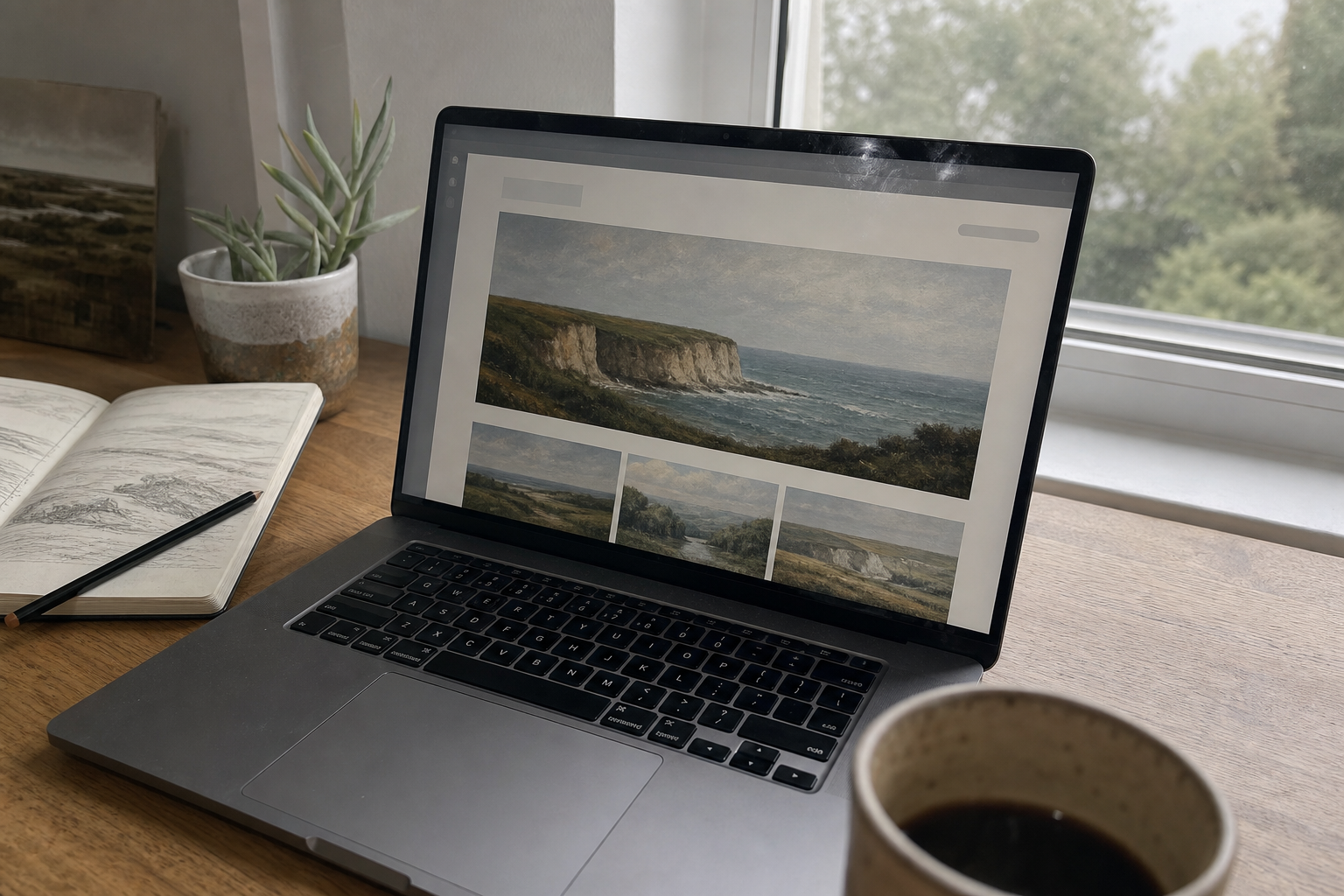
What a painter's website needs is fairly simple: a clean design that reflects the work, high-quality images with accurate colours, clear prices and sizes visible without having to enquire, a straightforward checkout, and an email sign-up. It doesn't need to be elaborate. Squarespace, Format, and WordPress with WooCommerce are all realistic options for non-technical people, and the learning curve is much shallower than it was five years ago.
One practical point worth making: basic SEO is genuinely worth learning. A page titled "Yorkshire Landscape Oil Paintings For Sale" will reach buyers who are specifically looking for exactly that. That's traffic you won't get from an Etsy shop where your work is competing with thousands of others.
Think of your website as the hub of everything else. All the other channels feed into it.
Etsy
Etsy has an enormous existing audience and genuinely does put original art in front of buyers who wouldn't otherwise find you. For prints, smaller studies, and plein air sketches at accessible price points, it's a reasonable starting point. The platform's search traffic is real and the buyer intent is there.
The honest trade-offs: competition is intense and includes a significant number of mass-produced print-on-demand shops, which can make it harder for original work to stand out. The fee structure is layered — listing fees, transaction fees, payment processing, and optional but increasingly pressured advertising costs all add up. You also have limited ability to build a direct relationship with buyers within the platform; Etsy owns that customer data, not you.
Etsy's algorithm rewards consistent activity. It's not a set-and-forget shop. If you list twelve paintings and then ignore it for six months, don't expect much. If you keep it active and maintain quality listings with good photographs and clear descriptions, it can produce results. Worth testing properly for a few months before deciding it does or doesn't work for your specific work.
Folksy
Folksy is the UK-specific alternative to Etsy: a handmade art and craft marketplace whose buyers are specifically looking for work made in Britain. The audience is smaller than Etsy's, but it's more UK-focused and generally more sympathetic to original art and craft than the broader Etsy pool.
GBP pricing throughout makes the accounting simpler. There's a community feel that many sellers find more supportive than the more commercially driven Etsy environment. The honest trade-off is that the smaller audience means you'll need to drive more of your own traffic — Folksy won't send buyers your way in the same volume as Etsy might.
Worth considering as a UK-first alternative or as a complement to Etsy, particularly if your buyers are primarily UK-based. If keeping things local matters to you or to the people who buy your work, Folksy is a natural fit.
Artfinder
Artfinder is a curated online art marketplace aimed at buyers who are specifically looking for original art, not gifts or homeware. It's a better fit for original paintings at higher price points than either Etsy or Folksy, and being on a curated platform has its own trust signal for buyers who might hesitate to spend £400 on a painting from an unknown shop.
There is an application process, so not every painter gets in immediately. Commission is charged on sales, so factor this into your pricing before you list anything. The audience is smaller than Etsy's but more genuinely oriented towards buying original work. If your paintings are clearly finished, original, and priced in line with what a serious collector market expects, it's worth applying.
Saatchi Art
Saatchi Art is one of the largest international online galleries and has a substantial buyer base that includes interior designers and corporate collectors as well as private individuals. It offers real reach, particularly for larger, more finished pieces at mid-to-high price points.
The significant trade-off is commission, which at the time of writing sits at around 35% (verify this before listing, as it may change). That's a meaningful chunk of each sale, and it's worth doing the maths on what that means for your income per painting before committing. For smaller studies or lower-priced work, the numbers may not stack up. For larger pieces you might not sell otherwise, the reach can justify it.
Saatchi Art is less about building a relationship with UK buyers specifically and more about accessing a global collector audience. If that's your goal, it's worth considering seriously.
ArtGallery.co.uk
ArtGallery.co.uk is a UK-based online gallery targeting UK art buyers specifically. It operates on a commission model similar to other gallery platforms, with GBP pricing and a UK shipping context as the default rather than an afterthought.
It's less well-known than Saatchi Art but worth exploring for painters who want gallery-style positioning without the overheads of a physical gallery relationship. The UK focus means it's more naturally aligned with the kind of buyer who wants to buy British work and isn't browsing an international marketplace.
Print-on-Demand as a Supporting Revenue Stream
Print-on-demand (POD) allows painters to offer prints, cards, or other products featuring their work without holding any stock. The provider prints and ships on your behalf when an order comes in.
Printful is one of the most widely used POD services and can connect to Etsy, Shopify, or your own website. Fine Art America offers a hybrid model: an art marketplace with built-in POD, so you can list both originals and prints from the same profile and reach buyers at different price points.
The key framing here is that POD is a supporting revenue stream, not a replacement for original sales. It lets fans at lower price points buy something from you without you having to reduce the price of your paintings. The margin on individual POD sales is modest, but the work is done once and the products keep selling. One practical caution: quality varies between providers. Order test prints before listing them publicly.
How to Choose Without Spreading Yourself Too Thin
The Hub-and-Spoke Model
The most useful mental model for thinking about online selling as a painter is the hub-and-spoke approach. Your own website is the hub: the place where collectors can always find you, browse your work, buy directly, and join your mailing list. The spokes are the platforms and social channels that bring people to that hub.
This framing prevents the common trap of trying to be equally active on six platforms simultaneously and burning out after three months. Practically, it means: build your website first (or alongside your first marketplace listing), add one or two platforms that feel like a natural fit for your work and price point, and use Instagram or a newsletter to drive traffic to both.
When someone finds you on Etsy or Artfinder and likes your work, the goal is to get them to your website and onto your mailing list. That's where the long-term relationship happens, and it's entirely yours — no platform can take it away.
Which Platforms Suit Which Painters
Rather than abstract advice, here's some practical guidance for common situations:
- If your paintings are primarily small studies and sketches at accessible prices (under £150), Etsy and your own website are a sensible starting point. The Etsy audience for affordable originals and prints is real.
- If you're producing larger, more finished landscapes at £400 and above, Artfinder or Saatchi Art are worth considering alongside your own site. Their buyer base is more oriented towards spending seriously on original art.
- If your buyers are primarily UK-based and you value keeping things local, Folksy is worth a look, particularly as a complement to your own website rather than a replacement for it.
- If you want to offer prints without the hassle of printing and posting them yourself, Printful connected to Etsy or your own site is a practical option that doesn't require significant upfront investment.
- If you want gallery-level positioning aimed specifically at UK collectors, ArtGallery.co.uk is a lesser-known but worth-exploring route.
The instinct to join everything at once is understandable but counterproductive. A half-maintained shop with poor photographs and sparse descriptions undermines rather than helps your credibility with buyers.
One shop done well beats five shops done badly
A single, well-maintained Etsy shop with consistent photographs, clear descriptions and prompt replies will outperform five half-finished listings across multiple platforms. Start with one or two channels, do them properly, and expand only when those are working.
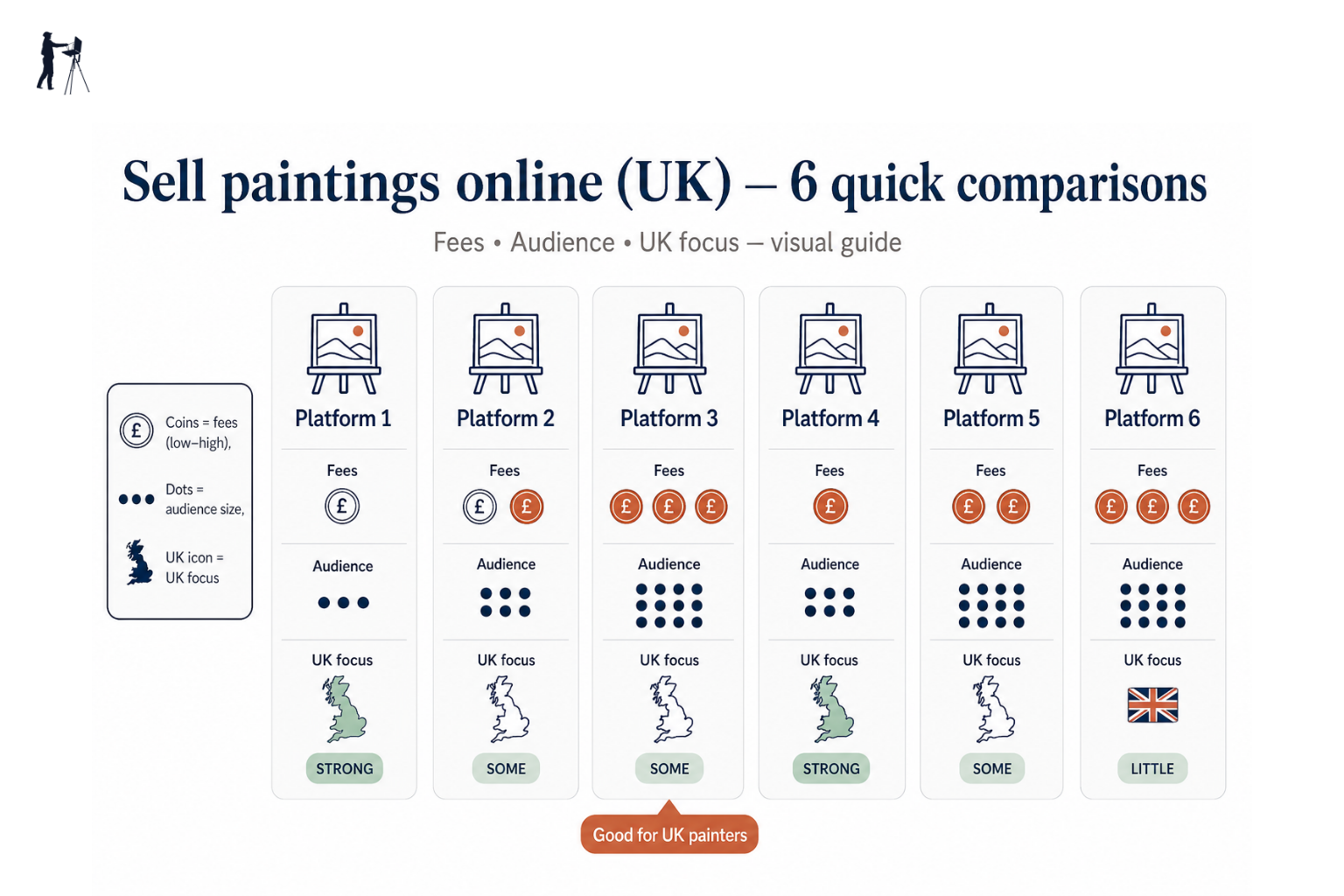
Below is a summary comparison to help orient your thinking. Commission figures and platform terms change, so treat these as a starting point and verify current rates before listing.
| Platform | Best for | Audience | Fees | UK focus |
|---|---|---|---|---|
| Your own website | All work, long-term | Your own audience | Payment processing only | Fully yours |
| Etsy | Prints, studies, lower-priced originals | Global, large | Listing + transaction + payment fees | Global (UK sellers common) |
| Folksy | Original work and handmade | UK buyers | Listing + commission | UK-only |
| Artfinder | Original paintings, mid-to-high prices | Collectors | Commission on sales | Global, curated |
| Saatchi Art | Larger originals, higher prices | Global collectors | ~35% commission | Global |
| ArtGallery.co.uk | Original paintings | UK art buyers | Commission on sales | UK-focused |
| Fine Art America | Originals + prints | Global | Commission + POD margin | Global |
A Few UK-Specific Practicalities Worth Knowing
HMRC and Self-Assessment
This section gets skipped in most general guides, which is a shame because it catches painters off guard. Once you're selling regularly, HMRC treats this as trading income. You'll need to register for Self Assessment and declare your earnings even if art is a part-time activity alongside employment.
There is a Trading Allowance of £1,000 per tax year (correct at time of writing, worth verifying) which means you won't owe tax on the first £1,000 of trading income in a given year, but once you're regularly above that you should register and keep records. You don't need to register for VAT until your turnover exceeds the VAT threshold, which stood at £90,000 at the time of writing. That's a long way off for most painters, but it's worth knowing it exists.
Keeping records doesn't need to be complicated. A simple spreadsheet tracking what sold, for how much, and what your costs were (materials, platform fees, postage, framing) is genuinely sufficient to start with. If your income from art becomes significant, an hour with an accountant who works with creatives is money well spent.
Don't let the tax question be the thing that stops you from starting. At the early stages it's genuinely straightforward, and HMRC's own guidance for self-employed artists is clearer than its reputation suggests.
Shipping and Packaging Original Paintings
Shipping originals is a practical consideration that catches many painters out when they first start selling online. Plein air studies on panel or canvas need real protection: acid-free tissue or glassine paper directly against the surface, corner protectors, a rigid outer box (not just a padded envelope), and ideally at least five centimetres of padding on all sides.
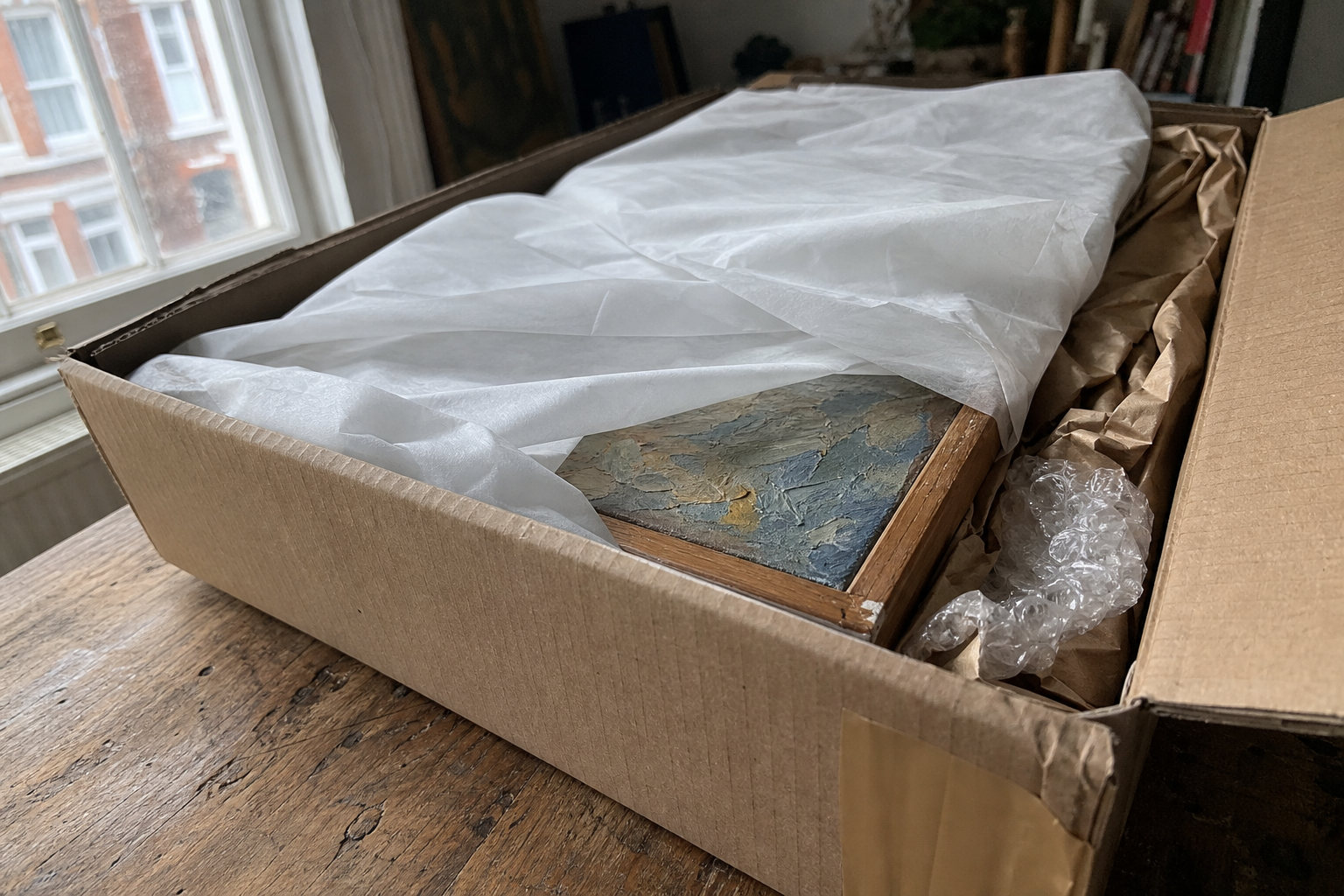
Royal Mail, Parcelforce, DHL, and DPD are all used by UK artists for sending work. For heavier or larger pieces, couriers typically offer better value than Royal Mail. For anything over £100, insure the parcel for its full value: many standard shipping options don't include meaningful cover by default, and a damaged painting that can't be replaced is a real loss.
Packaging costs are a genuine part of your cost of goods. Factor boxes, tissue, corner protectors, and labels into your pricing rather than treating them as an afterthought. For international sales, factor in customs declarations and the potential for delays or additional charges for EU buyers post-Brexit, which has added friction to what was previously straightforward European shipping.
Consumer Rights and Returns
When selling online in the UK, buyers have rights under the Consumer Contracts Regulations 2013 — specifically, the right to cancel and return most goods within 14 days of receiving them, with a full refund. This applies to distance selling, which includes everything sold through your website or a marketplace.
There is an important exception relevant to painters: goods that are "made to specification or clearly personalised" are exempt from this right. Commission work made to a buyer's brief is likely to fall into this category. Standard stock paintings probably don't, though the position isn't entirely clear-cut.
It's worth being transparent about your returns policy in your shop terms and in any commission agreement: not to alarm buyers, but to avoid confusion later. This is a complex area and the specifics matter, so treat what's written here as practical orientation rather than legal advice. If you have questions about your specific situation, it's worth taking your own advice from someone qualified.
Making Online Sales Work Long-Term
Building an online sales presence as a painter takes time, but the painters who do it well aren't the ones who found a magic platform or cracked some algorithm. They're the ones who showed up consistently with good work and made it straightforward for buyers to trust them and complete a purchase.
Three things matter more than anything else over the long term. Presentation quality shapes whether buyers trust what they're buying: a painting needs to be photographed accurately, with true colours and enough detail that a buyer can imagine it on their wall. Your email list is the most reliable way to stay in touch with people who already like your work; social media reach is borrowed, but a list of buyers and collectors who've asked to hear from you is genuinely yours. And online visibility builds steadily rather than happening overnight; the artists who feel like they "suddenly" started selling were usually the ones who had been quietly consistent for a year or two before it tipped.
Start with one channel done well. Build your website so you own the relationship. Add platforms as it makes sense for your work and your time. And keep painting: the work itself is still the thing that makes all of it worth doing.
FAQ
Frequently Asked Questions
Which platforms are best for selling originals versus prints?
Originals: use curated or gallery-style marketplaces like Artfinder, Saatchi Art or UK-focused ArtGallery.co.uk and Folksy. Prints: Etsy, Fine Art America or Printful (POD) suit lower-priced, higher-volume sales.
Do I need my own website to sell art online in the UK?
Yes. A website is the hub you control: no platform commissions, full customer data, and better SEO. Use it alongside one or two marketplaces rather than replacing it.
How much time does running an online shop take?
It takes ongoing attention: good listings, photos, messages, orders and packaging. Expect to maintain activity regularly; one well-run shop beats several neglected ones.
What are the essentials for shipping originals safely?
Protect the surface with acid-free paper, use corner protectors, a rigid outer box and ample padding. Insure parcels over £100 and consider couriers for large or heavy pieces.
What tax and returns rules should I know in the UK?
Register for Self Assessment once trading regularly. There is a £1,000 trading allowance and a VAT threshold well above most painters. Buyers have a 14-day cancellation right for distance sales, with some exceptions for bespoke work; get professional advice for specifics.
Author

PleinAirPainting Editorial Team
PleinAirPainting.co.uk helps artists paint outdoors with confidence through UK-focused guides, equipment advice, resources and plein air inspiration.