Constable vs Turner: Two Visions of the British Landscape
A clear comparison of Constable vs Turner, showing Constable's careful observation and Turner's luminous feeling, their rivalry, influence, and where to see their works.

Key takeaways
- • Constable vs Turner contrasts two approaches: observation and scientific looking versus light driven, emotional expression.
- • Constable focused on specific places, cloud studies, and en plein air sketches to capture exact conditions.
- • Turner treated light and atmosphere as the subject, often dissolving form into colour to convey sensation.
- • Their rivalry at the Royal Academy highlighted competing philosophies but both reshaped landscape art and influenced later movements.
- • Today painters benefit from combining Constable's attentive seeing with Turner's expressive handling of light.
At roughly the same moment in history, two men were standing in the British landscape with paint and canvas, looking at the same skies, the same light, the same rivers and fields and coastlines. John Constable and J.M.W. Turner were contemporaries, rivals, and two of the greatest painters Britain has ever produced. The Constable vs Turner comparison has fascinated art lovers for two centuries, and for good reason: rarely have two artists shared so much common ground while arriving at such utterly different conclusions about what painting should do.
One believed that truth was in the looking. The other believed that truth was in the feeling. Both were right.
Two artists, one landscape, completely different eyes
Constable and Turner were born just a year apart: Constable in 1776, Turner in 1775. Both came of age during the Romantic era, both were elected to the Royal Academy, and both spent their careers painting the British landscape at a moment when landscape painting was still fighting for the prestige reserved for history and portrait painting. By the end of their lives, they had transformed the genre entirely.
And yet the contrast between them is about as stark as British art gets. Constable was rooted, patient, scientific. He returned to the same Suffolk fields for decades, looking harder and harder at the same patch of earth. Turner was restless, ambitious, increasingly visionary. He travelled across Europe, pushed his palette to extremes, and in his later years produced paintings that his own contemporaries struggled to understand.
The Hay Wain, Constable's most celebrated painting, consistently ranks among the most popular works of British art. Turner's The Fighting Temeraire has topped polls for the nation's favourite painting more than once. Between them, these two pictures define something about how Britain sees itself and its landscape. What is remarkable is how little they have in common.
This is not an article that will declare a winner. The more interesting argument is that the tension between Constable and Turner is one of the most productive in the history of art, and that understanding what separated them tells you something essential about what painting can be.
Constable: painting what he saw, exactly as he saw it
The Suffolk fields as laboratory
John Constable did not need to travel to find his subject. He had grown up in East Bergholt, on the Suffolk and Essex border, and the landscape of the Stour Valley was, for him, the whole world. Flatford Mill, Dedham Vale, the slow-moving river and its willows and meadows: he returned to these places again and again throughout his career, and each time he looked with the intensity of someone who believed that looking itself was a moral act.
This fidelity to a specific place was not provincialism. It was a philosophical position. Constable believed that the honest painter had to earn their subject through sustained, patient attention. "The sound of water escaping from mill-dams, willows, old rotten planks, slimy posts, and brickwork," he wrote, "I love such things." The local, the particular, the specific: these were not limitations. They were the whole point.
He was also one of the first British artists to work extensively in oil directly from nature, en plein air, meaning outdoors and in front of the actual subject. His outdoor sketches have a freshness and urgency that his large finished paintings, produced in the studio for Royal Academy exhibition, sometimes lack. There is a looseness and confidence in the sketches that speaks directly to any painter who has ever tried to capture a passing cloud or a shifting light before it disappears.
Clouds, light, and the science of looking
Between 1820 and 1822, Constable undertook one of the most extraordinary projects in the history of British art. Working on Hampstead Heath, where he had moved with his family, he produced dozens of oil sketches of clouds, annotating many of them on the back with the date, time of day, wind direction, and weather conditions. This was not the behaviour of a romantic daydreamer. This was a scientist.
He had studied meteorology. He read Luke Howard's Essay on the Modifications of Clouds, published in 1803, which provided the first systematic classification of cloud types. Constable took this science and applied it to paint. He wanted the sky in his pictures to be right: not a generic blue backdrop, but a specific sky on a specific day, behaving in a specific way. He called the sky "the chief organ of sentiment" in a painting, and he worked harder at it than almost any other element.
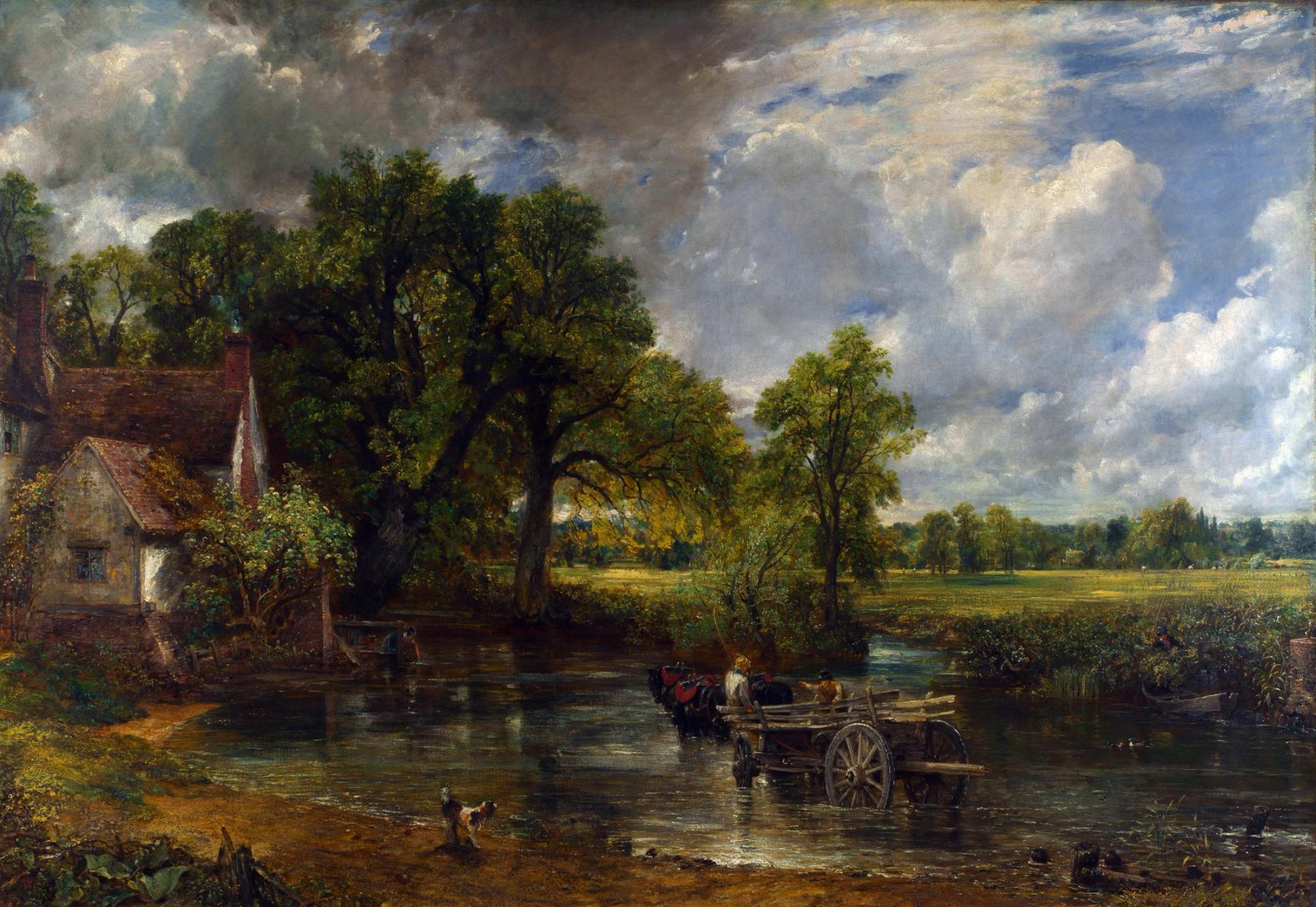
The Hay Wain, an 1821 oil painting by John Constable. by John Constable; National Gallery, London via gallerix.ru; Public domain.
In his 1836 lectures at the Royal Institution, Constable proposed that painting was both "scientific and poetic." He did not mean that science and poetry were in conflict. He meant that the discipline of looking, really looking, was what made the poetry possible. Imagination alone, he argued, could never match what reality offered to the attentive eye.
Seascape Study with Rain Cloud (c. 1824) is a useful painting to hold in mind when thinking about Constable. Its slashing, energetic brushwork could almost be mistaken for Turner. The two men were not as different in their methods as their reputations suggest. But where Turner used painterly freedom to reach beyond the visible, Constable used it to get closer to it.
Turner: painting how it felt, not how it looked
Breaking free from the Academy
Joseph Mallord William Turner was a prodigy. He entered the Royal Academy Schools at fourteen, exhibited his first watercolour at fifteen, and was a full Royal Academician by twenty-six. He understood the institution's conventions from the inside, and he spent roughly thirty years systematically dismantling them.
His output was staggering. More than 500 oil paintings, over 2,000 watercolours, and approximately 30,000 works on paper. He worked obsessively and, for much of his life, very privately. He left the bulk of his estate to the nation, which is why Tate Britain now holds the largest collection of Turner's work in the world.
Where Constable was rooted to Suffolk and Hampshire and Hampstead, Turner was in constant motion. He travelled across Britain and Europe: Venice, the Alps, the Rhine valley, the coast at Margate. He had spent formative time in Margate as a child, lodging there, and he returned throughout his life, drawn by the quality of the light over the Thames estuary. Turner Contemporary, the gallery that now stands near the site of those childhood lodgings, is a fitting monument to the connection.
Turner was also the only one of the two to engage directly with industrial Britain. Rain, Steam and Speed: The Great Western Railway (1844) depicts a locomotive crossing Maidenhead Bridge in conditions that dissolve the machine into atmosphere. Constable never painted a railway. He found industry threatening and largely looked the other way. Turner found it thrilling and made it sublime.
Light as the subject
The defining characteristic of Turner's mature work is the treatment of light as the primary subject of the painting, not as something that illuminates the subject. His later canvases, especially from the 1830s and 1840s, push this to an extreme. Forms dissolve into gold and white. Horizons disappear. Ships emerge from and dissolve back into fog. Some of his contemporaries thought he had simply lost control.
Camille Pissarro, the French Impressionist, wrote that Turner could "make colours blaze out with their natural brilliance." His palette of yellows, reds, and luminous whites was unlike anything the Academy expected from landscape painting. He appeared to be painting the air itself, not the things in it.
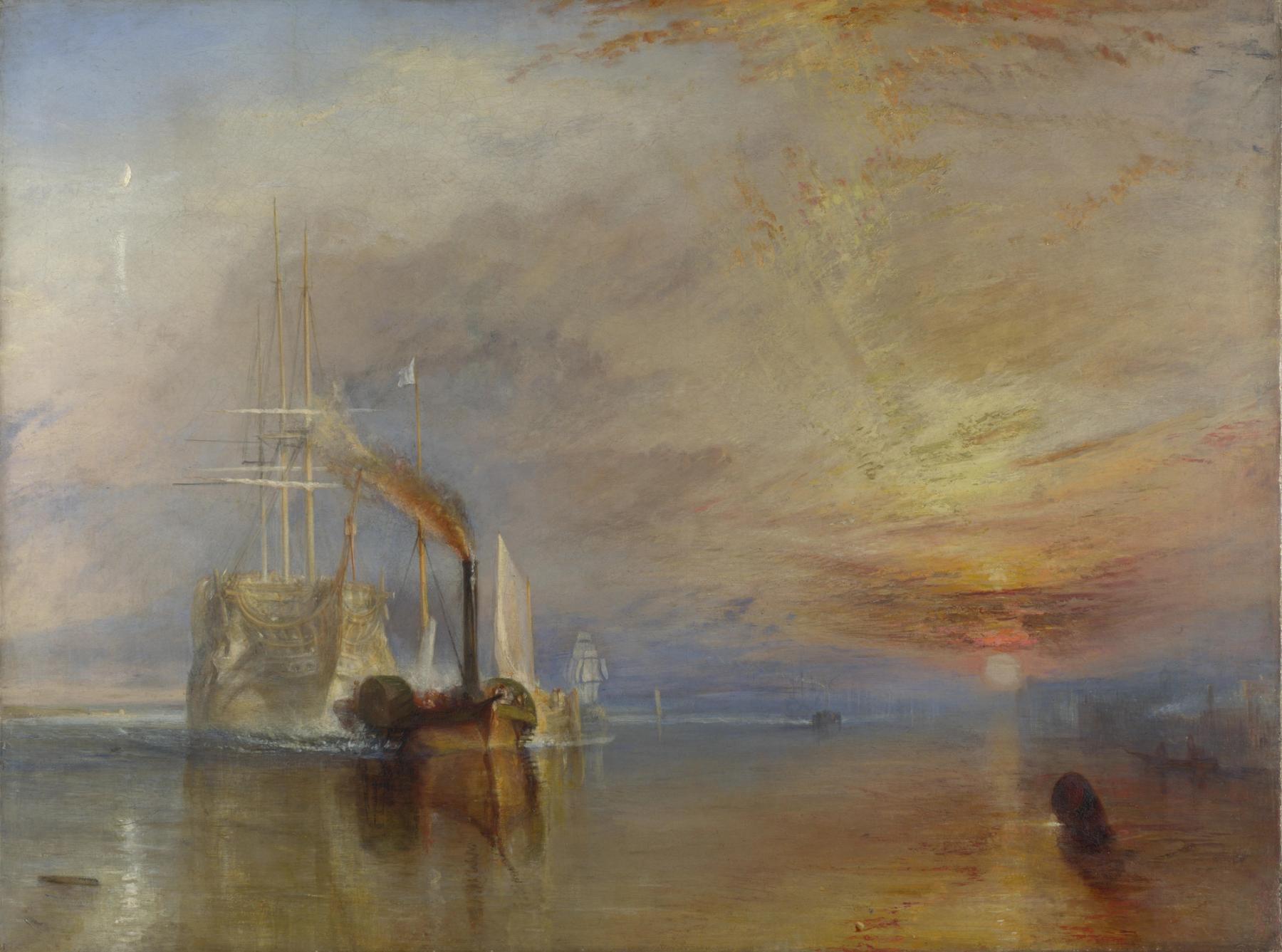
The Fighting Temeraire, 1839, by J. M. W. Turner. by J. M. W. Turner; National Gallery of Art; Public domain
The Fighting Temeraire (1839) is the painting where this approach reaches something close to perfection. The old warship, ghostly white, is being towed to the breakers' yard by a squat, fire-breathing steam tug. The setting sun turns the Thames into something that barely looks like water. It is a painting about loss, about time, about the passing of one age into another, and it achieves all of this through light and colour rather than narrative. Turner now appears on the UK £20 note, a sign of just how thoroughly his reputation has endured.
The rivalry that came to a head at the Royal Academy
By the 1820s and 1830s, both men were in their fifties and firmly established as major figures. They knew each other. They exhibited at the same institution. And they watched each other carefully.
The Royal Academy's annual exhibition included so-called "varnishing days," when artists were permitted to make adjustments to their work after it had been hung. Turner was notorious for using these days aggressively. He would sometimes arrive with a canvas that appeared barely started, then spend the varnishing days transforming it into a finished painting, partly as a demonstration of skill, partly as a kind of competitive theatre aimed at the works hanging nearby.
The 1831 incident in brief
At the 1831 Royal Academy exhibition, Constable placed his Salisbury Cathedral from the Meadows directly beside one of Turner's large canvases. Accounts suggest Turner's work appeared "sparkling and magnificent" next to Constable's, which was described at the time as "busy and overdone." At a dinner shortly afterwards, Turner responded sharply to Constable, who reportedly "wriggled like a detected criminal."
It is one of art history's most vivid moments of professional rivalry, and it illuminates just how personally both men took the question of what landscape painting should be.
The 1831 incident matters not because it tells us who was the better painter, but because it reveals the anxiety beneath both men's confident exteriors. Both were insecure about their legacy. Both needed their work to prevail. Constable, on the hanging committee that year, had the power to position his painting advantageously, and he did. The result did not go as he had hoped. Turner, whose instinct for competitive drama was keener, made his advantage count.
It is, as the best art world stories usually are, a deeply human episode: two middle-aged men, both brilliant, both frightened of being overlooked, measuring themselves against each other in a crowded London gallery.
What the two approaches meant for the painters who came after
Constable and the road to Impressionism
In 1824, Constable exhibited The Hay Wain and two other paintings at the Paris Salon. The response was remarkable. Théodore Géricault and Eugène Delacroix, two of the leading French painters of the moment, were struck by Constable's handling of paint and his fidelity to observed nature. Delacroix is said to have repainted sections of his own Massacre at Chios after seeing what Constable's flickering, textured paint surface could do.
It is widely argued by art historians that the influence of Constable's naturalism flowed through the Barbizon School, the group of French painters including Corot, Théodore Rousseau, and Charles-François Daubigny who worked outdoors in the Forest of Fontainebleau from the 1830s onwards, and from the Barbizon School directly into French Impressionism. The idea that paint applied loosely and freshly, with visible brushwork, could capture light more honestly than a smooth academic finish: this owes something significant to Constable. He helped make outdoor painting a serious artistic practice before the Impressionists were born.
Turner and the road to abstraction
Turner's downstream influence ran in a different direction. Claude Monet visited London twice, in 1870 and 1899, and was deeply affected by what he saw. Turner's treatment of fog and light on the Thames, his willingness to let atmosphere overwhelm form, provided a direct precedent for Monet's own series paintings of Waterloo Bridge and the Houses of Parliament. Many art historians point to Turner's late work as the bridge between Romantic landscape and the atmospheric dissolution of early Impressionism and beyond.
The further argument, that Turner's later paintings anticipate twentieth-century abstraction, is harder to make definitively but difficult to dismiss. Mark Rothko, who visited the Tate's Turner collection in 1958, was evidently affected by what he saw. Whether that constitutes influence in any strict sense is debatable, but the visual kinship between a late Turner canvas and a field painting by Rothko is not nothing.
Two artists working in Britain in the early nineteenth century, from opposite philosophical positions, changed the course of Western painting. The paradox is genuinely striking.
| Constable | Turner |
|---|---|
| Core aim | Faithful observation of a specific place |
| Palette | Greens, cool blues, natural tones |
| Subject matter | Suffolk and Essex countryside |
| Approach | Scientific, studied, observational |
| Influence on later art | Barbizon School, French Impressionists |
| Legacy in Britain | The Hay Wain; Constable Country |
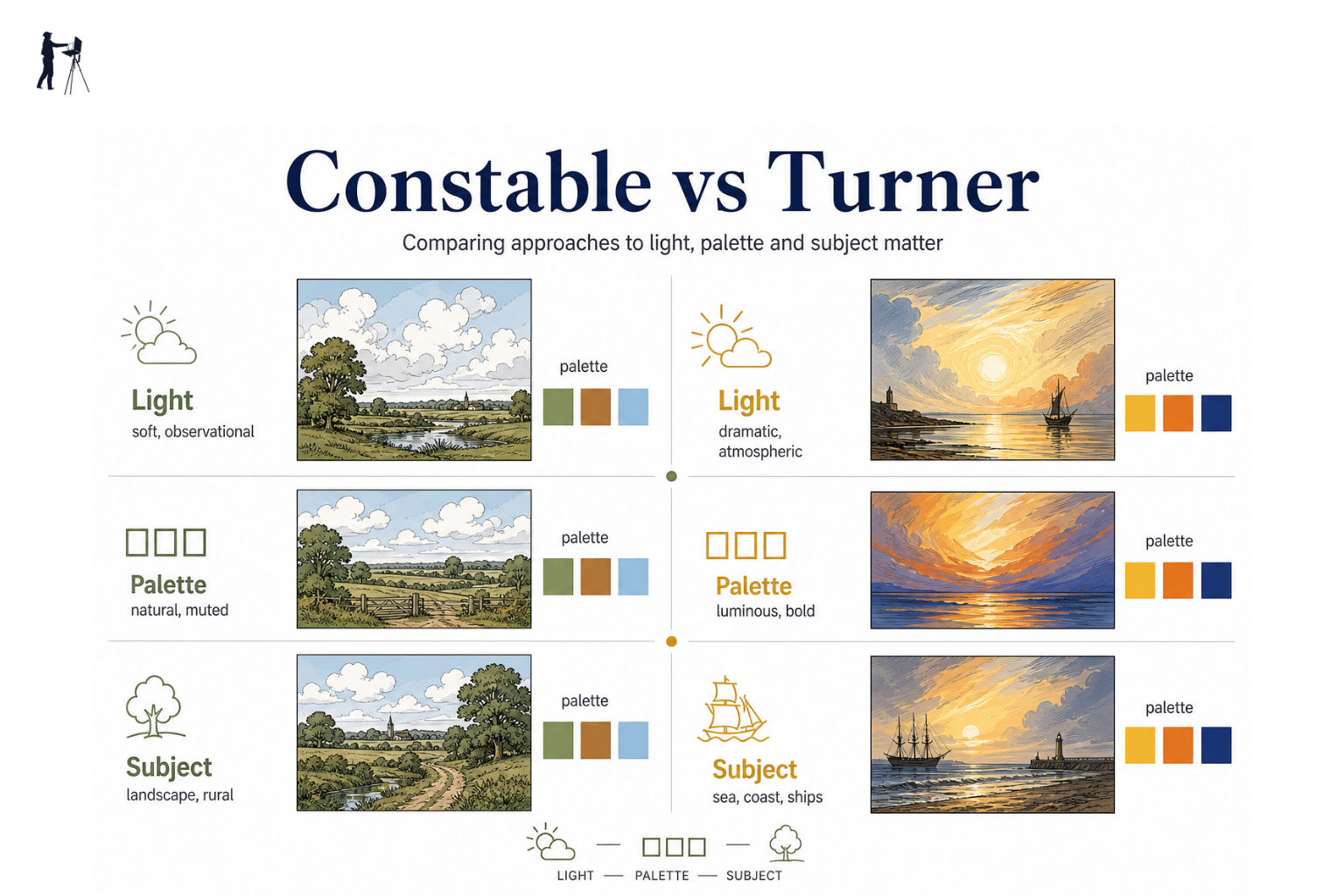
A Constable-look versus Turner-feel outdoor exercise, not a winner
Do not pick a champion. Run two sittings on the same motif. One names the light. One lets weather charge the colour. Then a short note on using both. Artist biographies stay on Constable plein air and Turner as landscape painter.
Session one, Constable-look: stand still long enough to name the cloud type, the wind on the grass, and the exact colour of the wet earth. Paint those facts. No mood words until the values are true.
Session two, Turner-feel: same motif, different hour. Let the weather's charge shape colour and edge. The light does not have to be locally true if the temperature of the hour is. Oil handling stays on plein air oil techniques; this is not that tutorial.
Then hang the two studies together. If they look like two painters, you over-split. If they look like one painter in two weathers, you can use both without a winner.
Neither man asked to be a method. The exercise is for you, outdoors, this week.
Where to look in the UK after the exercise
Go to named works, not a vague greatest hits list. Confirm what is on view before you travel.
Seeing Constable and Turner in Britain
- Tate Britain, London
- Largest collection of Turner's work in the world
- National Gallery, London
- The Hay Wain and other Constable masterworks
- Victoria and Albert Museum, London
- Constable's full-scale sketches and studies
- Flatford Mill, Suffolk
- The landscape Constable painted throughout his life
- Turner Contemporary, Margate
- Gallery on the site of Turner's childhood lodgings
Free entry to permanent collection
Free entry to permanent collection
Free entry to permanent collection
National Trust site; entry charges apply
Free entry to many exhibitions
Start with Tate Britain for Turner's range. Check current rooms rather than assuming the Clore hang never changes.
At the National Gallery see The Hay Wain and The Fighting Temeraire. Stand between them after your two sittings. That is the comparison this page is for.
For Constable oil sketches use the V&A Constable collection. Full-scale sketches show the outdoor decision more clearly than a finished salon picture.
Then walk the Stour. Constable Country in Suffolk is the location page. Do the look sitting there if you can.
Turner's estuary light is a different hour. If you take a Margate day, run the feel sitting, not a copy of The Fighting Temeraire.
Two sittings and four named rooms are enough. Do not turn this page into a travel itinerary.
FAQ
Frequently Asked Questions
What is the main difference between Constable and Turner?
Constable prioritized faithful, patient observation of specific places and meteorological detail. Turner prioritized atmosphere, light, and emotional effect, often dissolving form into colour.
Did Constable and Turner influence later art movements?
Yes. Constable's naturalism helped pave the way for the Barbizon painters and French Impressionists. Turner influenced Monet and helped anticipate atmospheric approaches that fed into modern abstraction.
Were they rivals and did they know each other?
Yes. They were contemporaries, colleagues at the Royal Academy, and engaged in a noted rivalry, including the famous 1831 exhibition incident over hanging positions.
Where can I see their work in Britain?
Key venues include Tate Britain for Turner, the National Gallery for both The Hay Wain and The Fighting Temeraire, the Victoria and Albert Museum for Constable sketches, Flatford Mill, and Turner Contemporary in Margate.
Which approach should a landscape painter use today?
Neither is strictly right. Use Constable's discipline of sustained looking to ground your work, and Turner's permission to let feeling and light shape the final painting.
Author

PleinAirPainting Editorial Team
PleinAirPainting.co.uk helps artists paint outdoors with confidence through UK-focused guides, equipment advice, resources and plein air inspiration.