JMW Turner: Chasing Light Across Britain
Turner turned restless field observation into lessons on sketching, colour notes, and painting atmosphere. Practical guidance for outdoor painters following his lead.

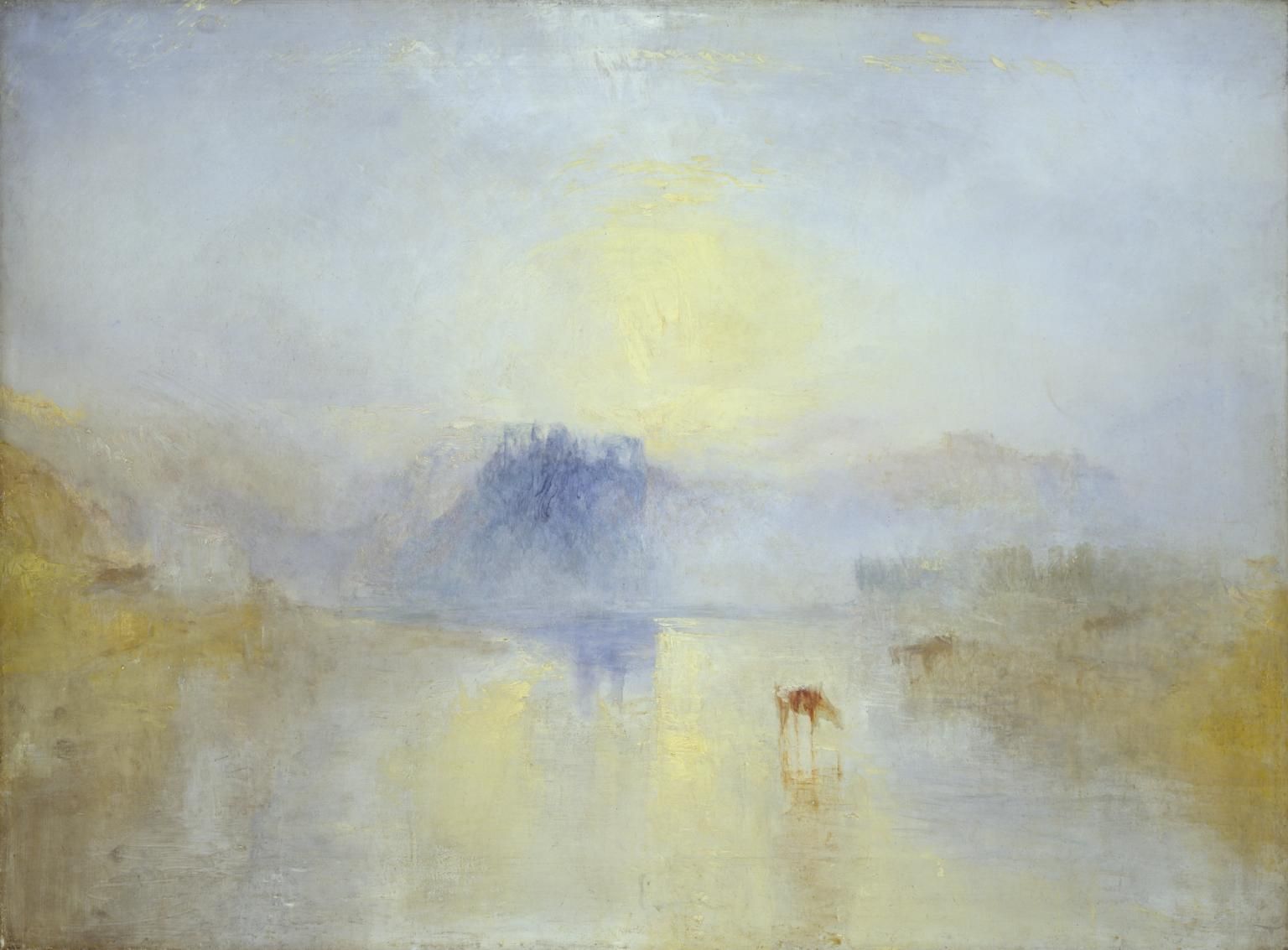
Norham Castle, Sunrise (c. 1845) by J. M. W. Turner.
Credit: J. M. W. Turner; Wikimedia Commons; Public domain
Key takeaways
- • Turner prioritized relentless field observation over studio invention alone.
- • He used sketchbooks for fast structural studies and written colour notes to capture fleeting light.
- • Atmosphere was central to his work; he painted the air and light that define objects.
- • Turner adapted to all weather and treated mist, rain, and smoke as material to depict.
- • Paint in Margate, the Lake District, Cornwall, or Wales to study the light Turner pursued.
There is a particular kind of restlessness that any landscape painter will recognise: the urge to get out, to find the light, to see what the sky is doing today. JMW Turner had it in an almost compulsive form. Turner landscape painting, as it is now understood and admired, was not born in a comfortable studio. It was forged on hillsides, riverbanks, clifftops, and estuary shores across Britain and Europe, through decades of relentless looking. If you have ever packed a bag before dawn to catch the morning light, you are, in some small way, in his company.
This is not a full biography of Turner. It is something more useful for anyone who paints outdoors: a close look at how he actually worked in the field, what drove him to keep moving, and what his methods can still offer a painter setting up a easel in the British landscape today.
The painter who never stopped moving
Joseph Mallord William Turner was born in London in 1775 and died there in 1851, but the years in between were marked by almost constant movement. From his early twenties he was making extended sketching tours, sometimes on foot, sometimes by coach, covering remarkable distances across Britain and later the Continent. These were not casual holidays. They were working expeditions, undertaken with clear purpose: to observe, to record, and to gather the raw material that would eventually feed his studio practice.
By the time he was in his thirties, annual touring had become a fixed rhythm of his life. He would head north to the Lake District, west to Wales and Cornwall, or down to the Kent coast, filling sketchbooks as he went. Later tours took him to the Rhine, the Alps, and Venice. But Britain remained central throughout. The particular quality of British light, filtered through maritime air and forever shifting with the weather, was not a limitation he worked around. It was the thing he was after.
He was not, to be precise about it, a plein air painter in the way we use that term today. He was not typically setting up a canvas outdoors and completing a finished painting on the spot. The connection between Turner and JMW Turner plein air practice is real but needs stating carefully: he was an extraordinary outdoor observer and a tireless field sketcher, and his studio paintings were deeply rooted in what he had seen and felt outside. The distinction matters, and it is part of what makes his practice so interesting.
What Turner's sketchbooks reveal about his process
Hundreds of books, thousands of studies
Tate holds over 300 of Turner's sketchbooks, bequeathed to the nation on his death along with a vast body of finished and unfinished work. The sketchbooks range from tiny pocket-sized books he could slip into a coat while walking, to larger volumes used for more extended studies. Together they represent one of the most extraordinary records of sustained visual observation in British art history.
The studies inside them are equally varied. Some are rapid pencil notations, little more than a few lines capturing the silhouette of a hillside or the curve of a harbour wall. Others are more developed watercolour sketches, with colour washes laid in quickly to record an overall mood. Many fall somewhere in between: tonal drawings with just enough information to jog memory later. What they share is a quality of purposeful speed. These were not laboured works. They were tools.
Turner's Turner light studies, as they are sometimes called, were raw material rather than finished art. They fed a studio practice that was synthetic by nature, drawing on dozens of visual sources to build a single painting. A cloud formation from one sketchbook might find its way into a canvas alongside a headland from another tour taken years earlier. The studio was where the alchemy happened. The field was where the facts were gathered.
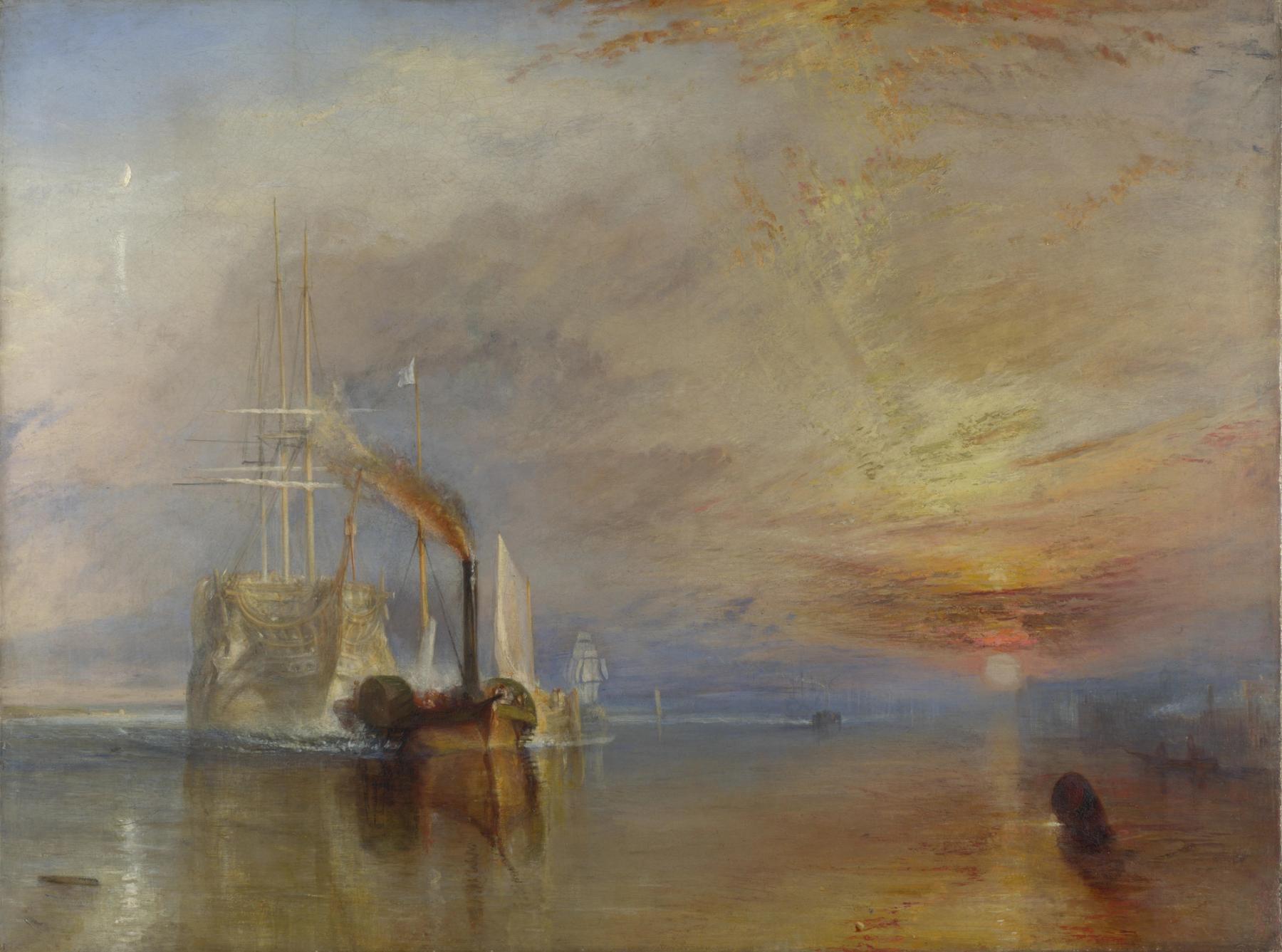
The Fighting Temeraire (1839), one of Turner’s most celebrated studies of light, atmosphere and change.
Credit: J. M. W. Turner; National Gallery, London; Public domain
Drawing first, colour later
One of the most practically interesting aspects of Turner's field method was his habit of separating drawing and colour observation. Rather than attempting to capture both simultaneously in the field, he would often complete a structural drawing and then annotate it with written colour notes. A sketch might carry words like "warm orange above, cool grey beneath" or a note about the particular quality of reflected light on water. The colour existed in language alongside the drawn form, to be translated into paint later in the studio.
This was a practical response to the speed at which light moves. Trying to match paint to sky in the field is a battle most outdoor painters know well. Turner found a way to record the essential information without being slowed down by the technical demands of mixing colour on the spot. His eye and his memory were the real instruments. The sketchbook was the notebook he used to preserve what they had found.
What we can take from this
Turner often made written colour notes on his sketches rather than finishing them in the field. If the light is moving fast, a few words alongside a tonal sketch can be just as useful as trying to capture everything in paint.
Turner's sketching tours across Britain
The Lake District and the drama of scale
Turner first visited the Lake District in the 1790s, when he was still in his early twenties. The north of England gave him something qualitatively different from anything he could find closer to London: genuine scale. Mountains, open water, and vast skies working together to produce the kind of drama that had no equivalent in the gentle landscapes of the Home Counties.
He responded to this with something close to awe, and the sketches from these early tours show him working to understand how light behaves across large open landscape. How a cloud shadow can alter the character of an entire hillside in seconds. How morning mist softens the edges of fells that will later stand sharp and clear. He returned more than once. The north continued to offer him things he needed.
Wales and the industrial sublime
His tours of Wales added another dimension. Snowdonia provided wild upland landscape that rivalled anything he had found in the Lake District. But Wales in Turner's time was also a place of early industrialisation: mines, quarries, and ironworks sat alongside ancient hills and fast rivers.
Turner was drawn to both, and in this combination he found something central to his idea of the sublime. The sublime, briefly put, is the feeling nature produces when it exceeds human control: vast, dramatic, slightly threatening. Turner extended this instinct to include the forces of industry and technological change. A blast furnace at night could be as sublime as a mountain storm. Wales gave him both at once.
Margate and the light on the Thames Estuary
Turner's connection to Margate was lifelong and personal. He first visited as a child and returned throughout his adult life, in his later years staying for extended periods at a boarding house on the seafront. Whatever else was complicated in his life, Margate seems to have been a place where he felt settled and, more importantly, where he could look at the sky for hours.
The quality of light on the Thames Estuary is genuinely distinctive. The sky is enormous, the horizon is wide, and the moisture in the air gives everything a particular luminosity that painters either love immediately or find hard to understand. Turner loved it immediately. He is widely reported to have described Margate's skies as the loveliest in all Europe, though the exact wording of the remark should be treated with caution since it survives in paraphrase rather than direct quotation. What is not in doubt is that the light there influenced his colour palette throughout his career.
Margate now has its own dedicated gallery, Turner Contemporary, opened in 2011, which sits on the seafront not far from where he used to stay. It is a working destination for artists and worth the visit.
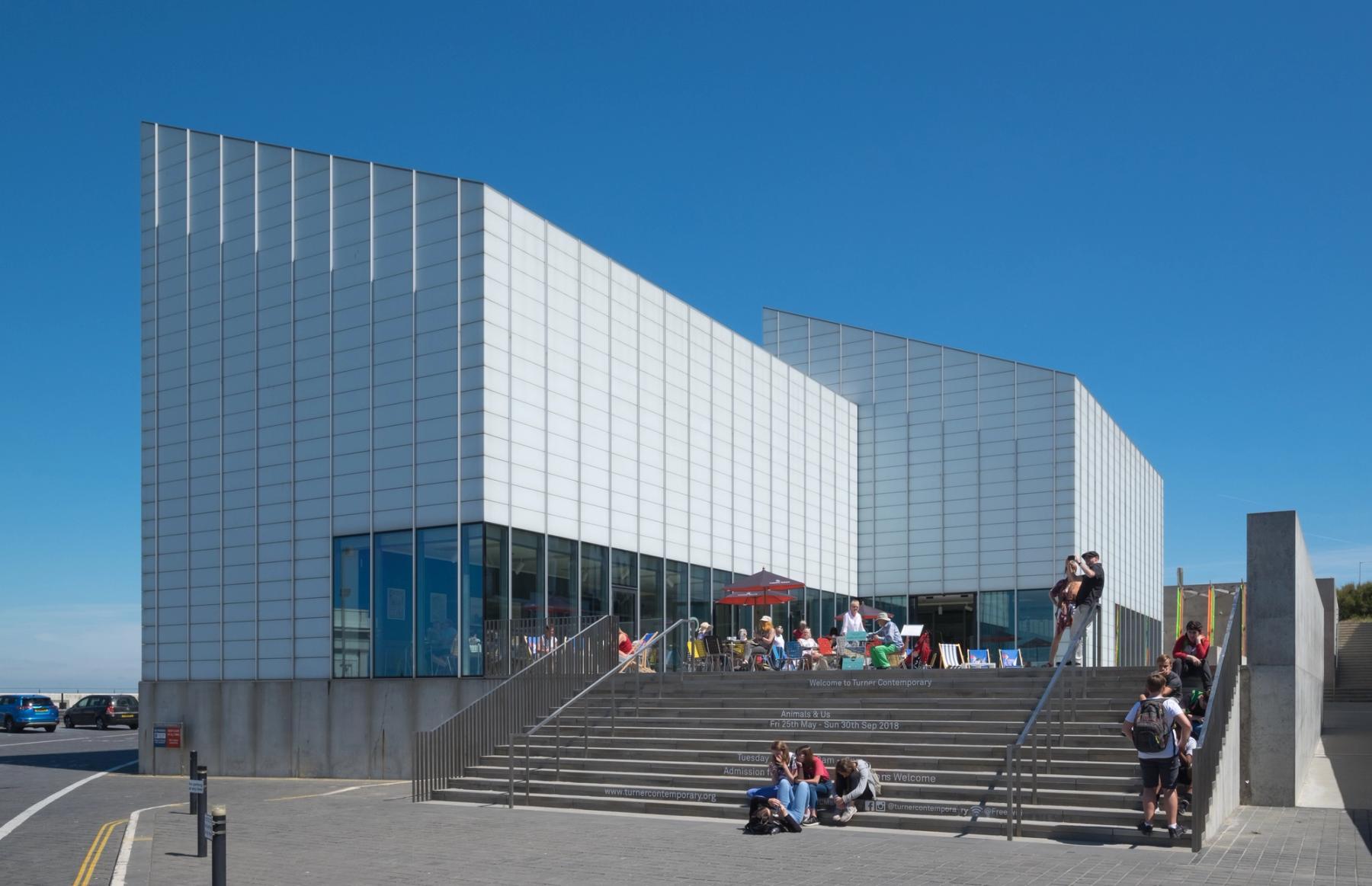
Turner Contemporary in Margate, named after J. M. W. Turner.
Credit: DeFacto / Wikimedia Commons; CC BY-SA 4.0
Cornwall and the western coastline
Turner's travels took him further west than most of his contemporaries ventured for painting purposes. The Turner Cornwall connection is less celebrated than his association with Margate or the Alps, but the Atlantic coastline offered him conditions found nowhere else in Britain. Stronger light, more dramatic cliffs, open ocean rather than sheltered estuary or inland lake.
The sea off the Cornish coast behaves differently from the Channel or the North Sea. The swells are longer, the light more oblique, the sense of exposure greater. Turner was drawn to precisely this kind of extremity. His work from the western coastline shares a quality of raw energy that connects it to his most ambitious seascapes and storm paintings.
What Turner meant by atmosphere
Turner atmospheric painting is sometimes discussed as though atmosphere were an aesthetic preference, a vague softness he applied like a filter. It was not. Atmosphere, for Turner, was a physical and technical problem. He understood that light does not travel in a vacuum. It passes through air, and air has properties: moisture, dust, smoke, haze. Those properties change how light behaves, how colours appear, how edges look, how far the eye can travel before things dissolve.
What he was painting, in his most characteristic work, was not the cliff or the ship or the bridge. He was painting the quality of the light as it arrived at those objects and as it reflected back toward the viewer. The atmosphere was not a backdrop. It was the medium through which everything was seen, and that made it the primary subject.
In his later career this approach became more radical. Objects begin to lose their solidity in some of his final oils. Figures dissolve into light and colour. Ships become suggestions. This was controversial in his own time. Critics who wanted clear, legible subjects found his late work frustrating, unfinished, or wilfully obscure. Ruskin defended him passionately; others were less charitable. It is worth knowing that even Turner's reputation was not without its complications. That honesty makes him more interesting, not less.
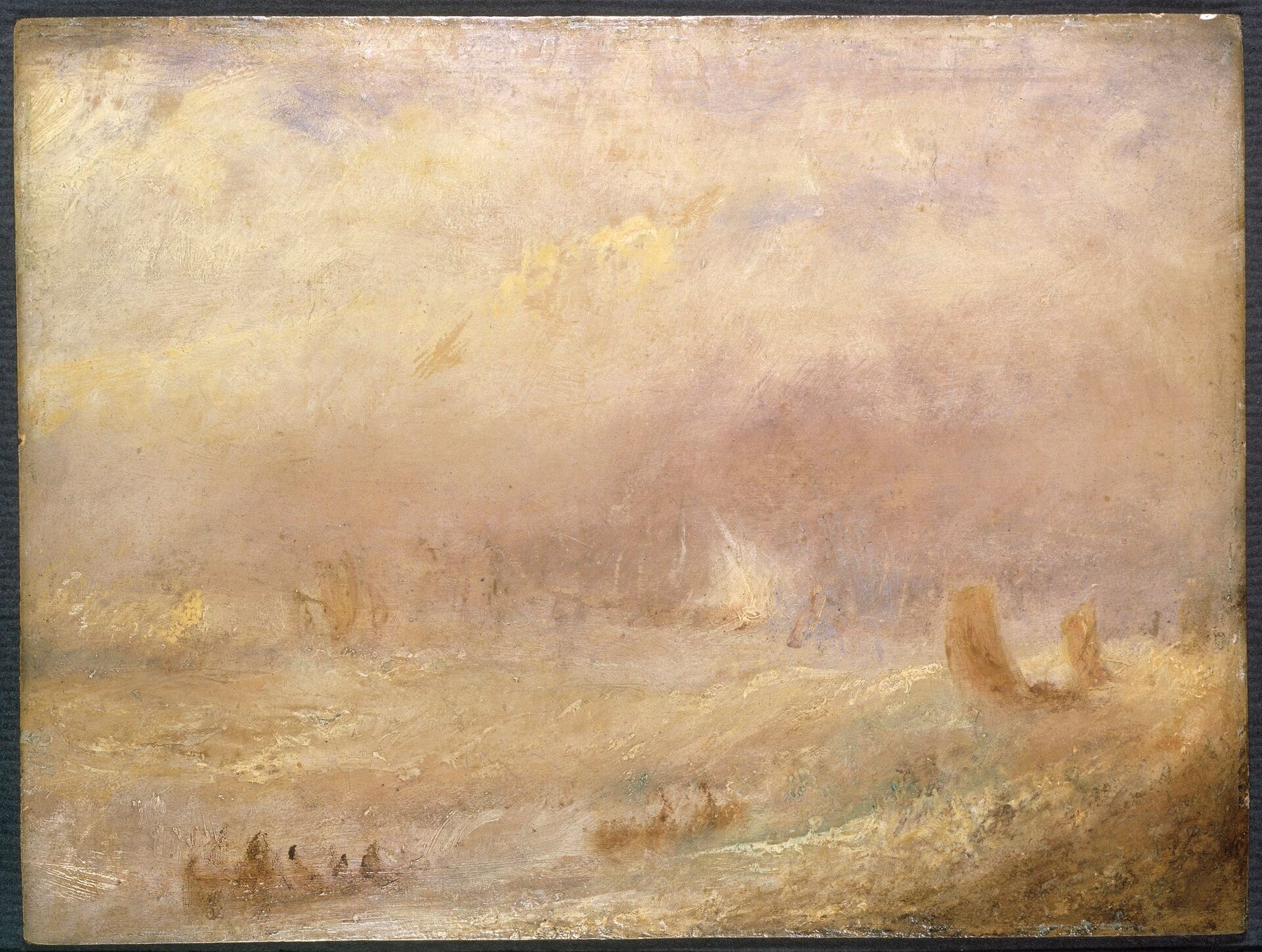
A View of Deal, an atmospheric coastal scene by J. M. W. Turner.
Credit: J. M. W. Turner; Nationalmuseum; Public domain
Painting the air, not just the objects
Turner was less interested in the cliff or the ship than in the light falling across them. When you set up outdoors, try asking yourself: what is the air doing today? Hazy, sharp, golden, grey? That quality is your real subject.
Turner landscape painting and the British weather
There is a version of Turner's story in which his genius consisted partly of turning a problem into an advantage. Britain is not a country of reliable light. The sky changes without warning. Rain comes in sideways. Estuary mist reduces the far bank to a smudge. Coastal haze softens the line between sea and sky until you are not quite sure where one ends and the other begins.
Turner could have treated all of this as inconvenient. Instead he treated it as material.
Rain, fog, and mist appear throughout his work not as unfortunate conditions that had to be endured but as subjects in themselves. His watercolour technique was particularly well adapted to this: wet-on-wet working, soft edges blended while the paper was still damp, colour run into colour to produce exactly the kind of indistinct, moisture-laden atmosphere he was trying to describe. He was, in a technical sense, using the properties of watercolour to simulate the properties of air.
This does not mean Turner only worked in grey, difficult conditions. He painted in strong sun, in clear Mediterranean light, in the golden warmth of late afternoon. The point is his adaptability: his willingness to engage with conditions as they presented themselves, rather than waiting for something more convenient. On any given day outdoors, the weather is the weather. Turner's practice suggests that this is always enough to work with.
For anyone painting outdoors in Britain, this attitude is practically useful. The overcast day is not the consolation prize. It is a different kind of subject, and it comes with its own beauty.
Turner's output in numbers
- Sketchbooks held by Tate
- Over 300
- Oil paintings completed
- Around 550
- Watercolours and works on paper
- Around 2,000
- Sketching tours of Britain
- Dozens
Bequeathed to the nation on his death
Spanning more than five decades
Many never intended for exhibition
Beginning in the 1790s and continuing throughout his life
Why Turner still matters to painters working outdoors today
Turner elevated landscape painting within the British art establishment. At the Royal Academy, landscape had traditionally occupied a lower rung than history painting, portraiture, or grand allegory. Turner spent much of his career arguing, through the work itself, that landscape could carry as much weight and ambition as any other genre. By the end of his life, few disputed it.
His influence spread further than Britain. Monet visited London on multiple occasions and was aware of Turner's paintings of the Thames. Whether the debt is direct or parallel is a matter of ongoing art-historical discussion, but the connection between Turner's atmospheric dissolution of form and the Impressionist interest in light and perception is clear enough. Turner was, in some sense, working toward problems that an entire movement would later make central.
For a painter heading out with a sketchbook or a pochade box today, none of that institutional history is the most relevant part. What matters is his attitude. He treated direct observation as essential, non-negotiable work. He used the sketchbook as a thinking tool rather than a record of finished thoughts. He let the light be the subject, not just the illumination for whatever else was in the scene. And he showed, over more than five decades of work, that the British landscape, in all its changeable, cloud-laden, rain-drenched variety, is worth taking completely seriously.
That is not a historical footnote. It is an argument that every outdoor painter in this country can still make use of.
Where to paint in Turner's footsteps
The locations Turner returned to again and again are, for the most part, still accessible. The light on the Thames Estuary from Margate is still there. The Turner Contemporary gallery makes the town a natural destination for any painter interested in his work, and the seafront itself is as paintable as it ever was.
Cornwall's Atlantic coastline still offers that combination of strong western light, dramatic cliff geometry, and open sea that drew Turner westward. The quality of the air on a clear day in late afternoon, with the sun dropping toward the ocean, has not changed since he was there.
In the Lake District, the scale and drama that gave Turner his early understanding of open landscape remain intact. Windermere, Coniston, and the surrounding fells on a morning when low cloud is breaking up offer conditions that are not so far from what he was sketching in the 1790s.
None of these places require a special expedition. They are reachable, they are varied, and they each carry a particular quality of light that painters have been responding to for a very long time. Going to look at them with Turner's questions in mind, asking what the air is doing, what the light envelope feels like, where the atmosphere is thickest, is as good a way as any to start a day's work outdoors.
FAQ
Frequently Asked Questions
How did Turner work outdoors without finishing paintings on site?
Turner used rapid tonal drawings and watercolour studies to record structure and mood. He often annotated sketches with written colour notes to translate later in the studio rather than completing finished canvases outdoors.
What do Turner's sketchbooks tell us about his process?
They show intense, purposeful observation: pocket sketches for shape and composition, larger washes for mood, and written colour cues. The books were working tools to gather visual facts, not finished artworks.
What does 'atmosphere' mean in Turner's work?
For Turner, atmosphere was the medium of light. It referred to moisture, haze, smoke, and dust that change colour, edge quality, and distance. He painted the air as the primary subject rather than only the objects within it.
How can outdoor painters use Turner's methods today?
Treat sketchbooks as thinking tools, separate structural drawing from colour notes, observe how air and light alter forms, and use weather as subject matter rather than an obstacle.
Where in Britain can I paint in Turner's footsteps?
Key places include Margate and the Thames Estuary, the Lake District, Cornwall's Atlantic coast, and parts of Wales such as Snowdonia. Each offers the distinct light and atmospheric conditions Turner sought.
Author

PleinAirPainting Editorial Team
PleinAirPainting.co.uk helps artists paint outdoors with confidence through UK-focused guides, equipment advice, resources and plein air inspiration.