Plein Air Portfolio Tips: How to Build a Body of Work Worth Showing
Practical plein air portfolio tips to edit ruthlessly, form a clear series, photograph work accurately, and present a focused selection to galleries and online audiences.

Key takeaways
- • Edit ruthlessly: 15 to 25 strong works for a working portfolio, 8 to 10 for gallery submission.
- • Show a clear identity or series by location, season, subject or technique.
- • Photograph accurately with diffuse light, correct white balance and straight-on shots.
- • Use specific titles and short location notes to add authenticity and search value.
- • Start locally: open studios, regional galleries and markets are effective entry points.
If you've been painting outdoors for a year or two, you've probably accumulated a decent stack of work. Studies from the coast, sketches from the moors, a few pieces you're genuinely proud of and plenty you're not. These plein air portfolio tips are designed to help you look at that body of work with fresh eyes and start shaping it into something you can actually show, something that reflects the best of what you do and opens doors you might not have thought were available to you yet.
This isn't about selling your soul to commerce or turning a joyful practice into a business exercise. It's about recognising that the work you're already making has real value, and that a little strategic thinking can take you from "I've got loads of paintings stacked in the corner" to "here is my practice, presented with confidence."
Why Most Plein Air Painters Struggle with Their Portfolio
The field sketch mindset is, in many ways, exactly the right one. You go out, you respond to what's in front of you, you work fast and unselfconsciously. That immediacy is the whole point. But it can also make painters oddly dismissive of their own output. "It's just a study" is something you'll hear at almost every plein air group session in the country, often said about genuinely strong work.
The problem isn't the work itself. It's the habit of seeing each piece in isolation, as a one-off response to a single afternoon, rather than as part of a growing body of practice. Most intermediate painters have never actually looked at their accumulated output as a collection. When they do, they're often surprised by what they find.
There's also a quiet anxiety that plein air work isn't "serious" enough for a professional portfolio. That finished studio paintings are what galleries want, and outdoor studies are just for learning. This is largely untrue, and it's worth saying so plainly: the best outdoor work, with its captured light and decisive brushwork, is often more compelling to buyers and gallerists than a laboured studio piece. The freshness and directness of painting on location is a strength, not an excuse.
The transition from "someone who paints outdoors" to "a painter with a coherent portfolio" doesn't require you to change how you paint. It requires a shift in how you think about what you've made.
A portfolio isn't fixed, either. It's a working document that evolves as your practice does. Start where you are, with what you have.
Start with an Honest Edit
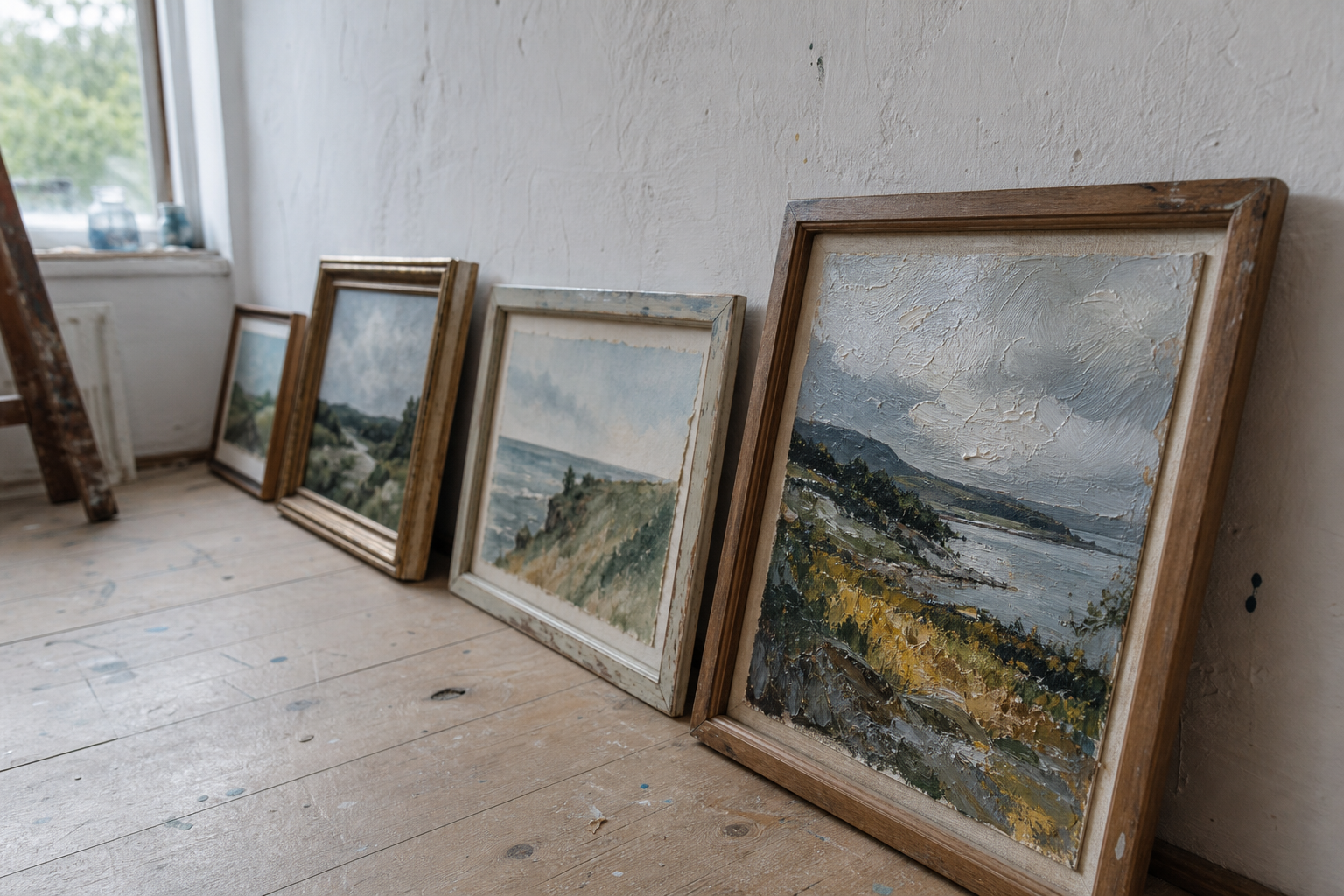
How many works actually belong in a portfolio?
Quality is the only rule that matters here, and it cuts in one direction: fewer, stronger pieces will always serve you better than a large undifferentiated collection.
For an intermediate painter putting together a working portfolio, aim for 15 to 25 pieces. That's enough to show range, consistency, and depth without overwhelming anyone looking at it. For a specific gallery submission, you'll usually be asked for 8 to 10 images. For an open studio display, you might put out 20 to 40 pieces including studies and finished work.
The temptation is to include everything you like, plus a few things you're on the fence about, plus a couple of early pieces to show your development. Resist this. Every weak piece in a portfolio pulls the overall impression downwards. A gallerist or collector looking at 25 paintings will form a mental average, and that average is what they remember.
What to look for when you edit your own work
When you pull out everything you've made in the last couple of years and lay it out, look for these qualities:
A convincing light effect. Plein air painting lives and dies by its captured light. Does this piece have a specific, believable quality of light, the low winter sun across a field, the flat grey of an overcast Cornish morning? If the light feels generic or unconvincing, the painting probably doesn't belong.
Confident, decisive marks. Outdoor painting tends to look best when the brushwork is direct and committed. If a piece shows signs of overworking, of going back in repeatedly to fix things that never quite got fixed, that will read to a viewer even if they can't name it.
Freshness and immediacy. This is the hallmark of good plein air work. If a painting looks tired or fussed-over, it contradicts the very thing that makes outdoor painting compelling.
Not everything needs to be "finished." Some of your strongest studies will outperform your most laboured finished pieces. Don't automatically exclude something because it's small or feels incomplete. Ask whether it works as an image, not whether it ticks a conventional "finished painting" checklist.
When you've made your first selection, don't treat it as final. Live with it for a week. Pin the shortlisted pieces up somewhere you'll pass them regularly. You'll start to see which ones hold up and which ones you were defending out of sentiment rather than quality. Getting a second opinion from a trusted fellow painter or a teacher is genuinely useful here. We are all poor judges of our own recent work.
The one-year test
If you wouldn't hang this painting on your own wall, it probably doesn't belong in your portfolio. Distance helps. Live with your edited selection for at least a week before treating it as final.
Large varied portfolio vs. tight curated selection
Pros
- + Shows the range of your practice
- + Useful for internal reference and tracking your own progress
- + More choice for buyers browsing in person
Cons
- - Dilutes the strongest work
- - Makes your portfolio identity harder to read
- - Gallerists and online visitors rarely scroll past the first dozen images
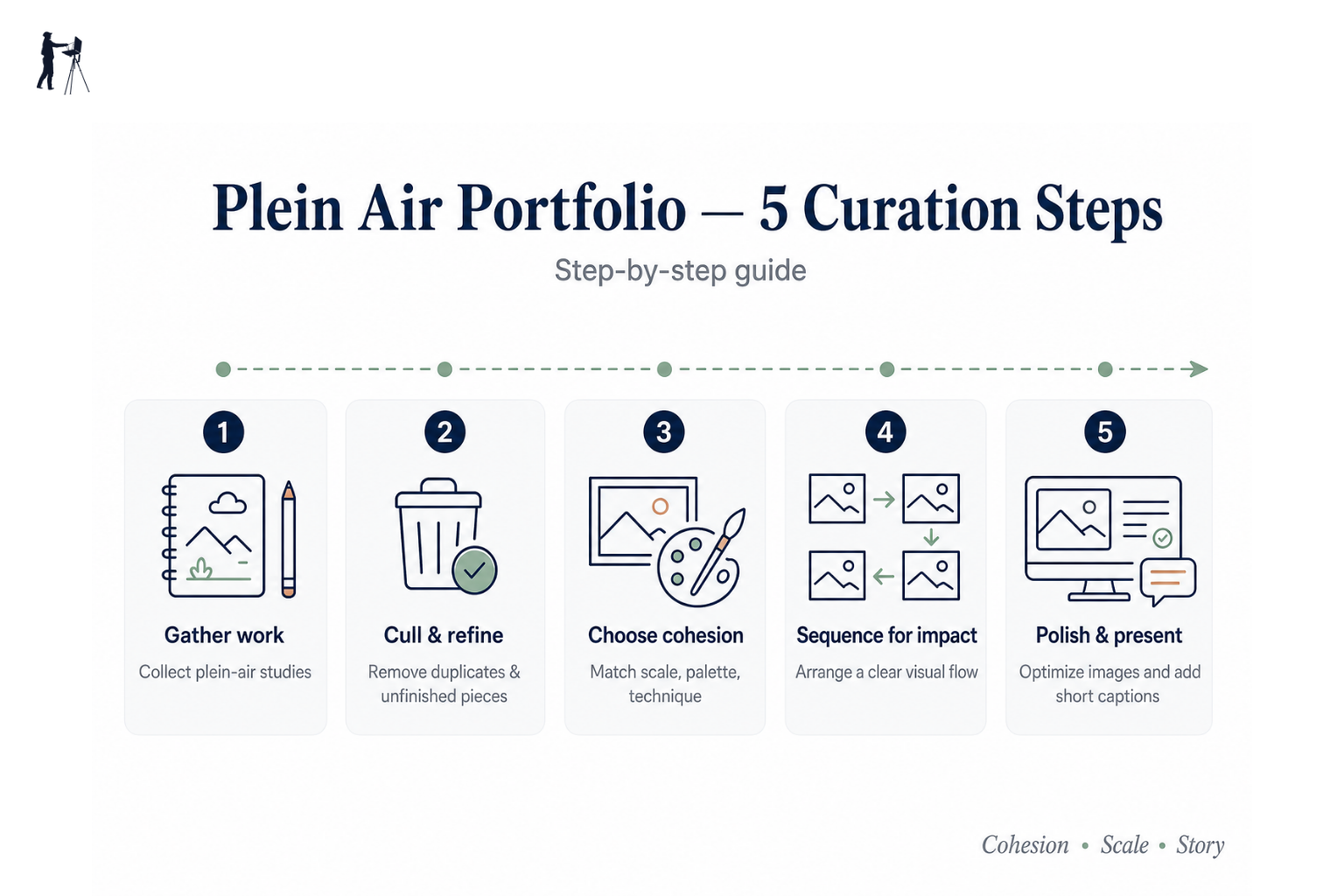
Building a Portfolio with a Clear Identity
Should you specialise by location, subject, or season?
A portfolio with a clear through-line reads as intentional. A portfolio that shows twenty unrelated landscapes from twenty different places and painted in twenty different styles reads as someone who hasn't thought about it yet, even if the individual pieces are strong.
That through-line doesn't have to be rigid. You don't need to paint only one thing in one place forever. But when someone looks at your portfolio, they should be able to feel a consistent sensibility and, ideally, see a consistent focus. Here are the main ways that focus can work:
| Approach | Example | Strength |
|---|---|---|
| Geographic | Dartmoor landscapes; North Norfolk coast | Strong regional market appeal; gallery fit |
| Seasonal | A winter light series; golden hour studies | Thematic coherence; series potential |
| Subject-led | Working harbours; ancient woodland | Clear narrative; collector recognition |
| Technical | Limited palette work; plein air watercolour | Demonstrates discipline; workshop credibility |
You don't have to choose just one. But at least one consistent thread should be visible across the majority of your selected work. Galleries respond to recognisable bodies of work. Buyers do too. Versatility is admirable in a painter; it's a liability in a portfolio.
It's also worth saying that specialising your portfolio isn't the same as limiting your practice. You can paint anything you like when you go out. The portfolio is a curated selection, not a cage.
Find your accidental series
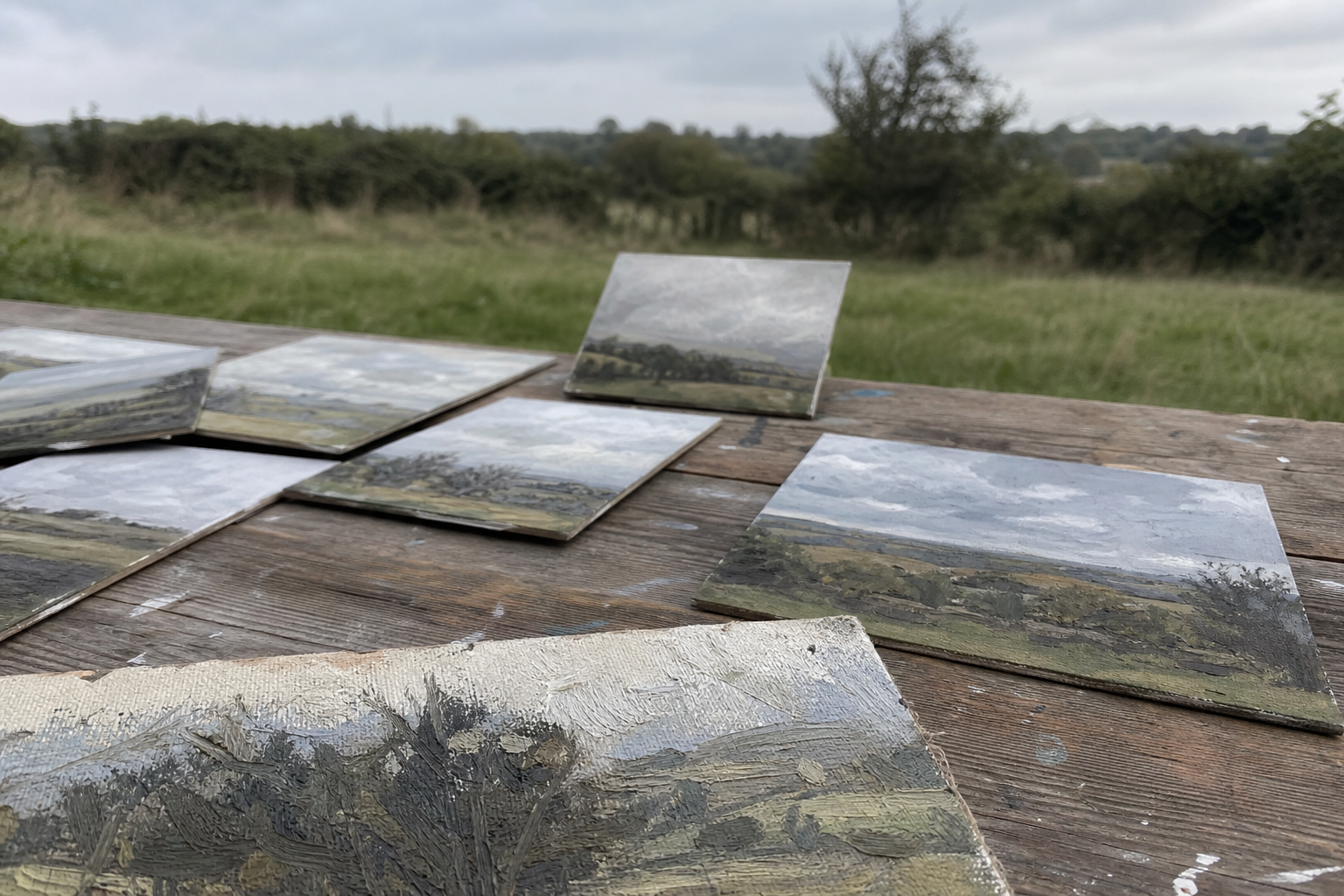
Go back through your paintings from the last two years and group any six or more works by location, subject, or light condition. You may already have a series without having planned one.
Series work and why galleries respond to it
A series, five or more works connected by subject, location, or approach, signals something important to a gallerist: sustained engagement. It shows that you didn't just paint something once and move on, but that you returned to a subject, thought about it, and developed a body of responses. That's what distinguishes a serious practice from a collection of one-offs.
Series work also performs well online. A viewer who lands on one painting from a coastal series and sees five more in the same spirit has a reason to keep looking. It creates a sense of depth and intention that a random selection doesn't.
Go back through your existing work before you start planning new series. Group anything you have six or more of: a stretch of coastline, a particular wood, studies at a particular time of day. Many painters discover they've already made a series without having named it as such. That's worth recognising and making visible in how you present your work.
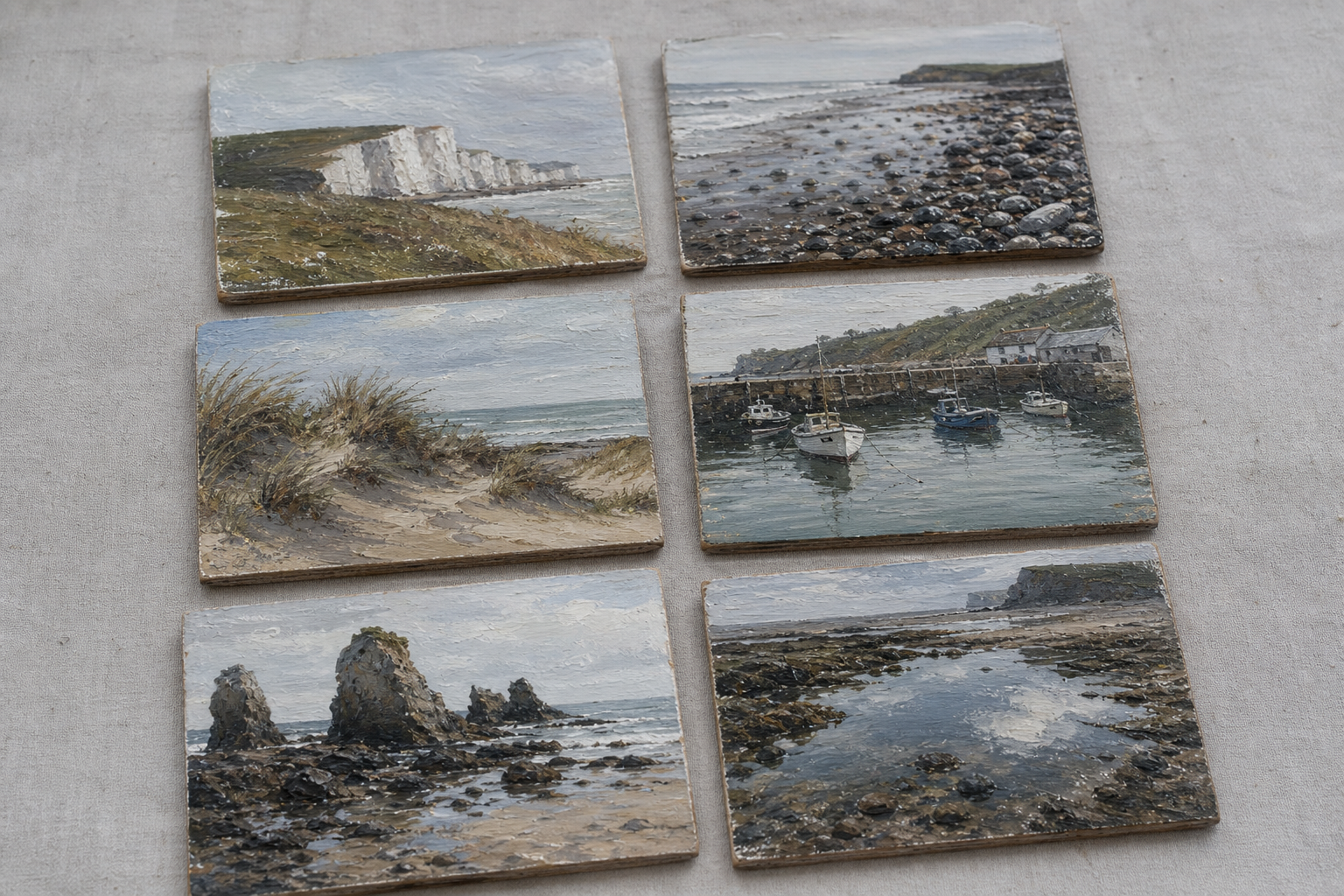
Photograph, then write, then shortlist, then approach
Photograph in diffuse light, square-on, for colour accuracy
Side light exaggerates brush ridges. Use north light or an overcast window. Do not stage drama. Accuracy first. Capture technique lives on the photograph-artwork page; this sequence only needs a usable record.
Shoot square-on. A tilt makes the panel a trapezoid. Colour should match the painting in the hand, not a warmer Instagram version.
If screen and object disagree, the photo is wrong. Recheck white balance before you write the statement.
Export a clean JPEG. Enhancement is not documentation.
Editing your photos without overcooking them
Edit for exposure and crop only. Saturation boosts lie to the next venue.
Crop to the painting edge. Leave the frame out unless the frame is the point; framing itself is how to frame plein air.
Keep files modest. A 1200 to 2000 pixel longest edge is enough for a leave-behind and a website.
Assemble the UK presentation pack
Statement, shortlist, leave-behind, then the first approach
Write 150 to 250 words that name place and working method. Not a biography. Not a sales pitch. Then assemble 15 to 25 pieces with one visible through-line. Then a four-to-six image leave-behind. Only then choose the first approach: open studio, regional gallery or fair, after matching price point and current programme. Price detail is how to price; site construction is the artist website guide. No official open-studios calendar was verified, so none is invented.
The leave-behind is four to six images, your name, and one sentence of place. It is not a catalogue.
Worked example for a Norfolk or East Anglian painter: shortlist local studies of the same weather and tide, not one of everything. Statement names the Broads or north Norfolk working method. First approach is a regional open studio or a town gallery whose current hang is landscape, not a London open call you have not priced for.
Regional first approaches fail less often than cold emails to names you cannot visit. Workshops and events can wait until the pack exists; see workshops and events only after the shortlist is honest.
Digital portfolios and what to include online
Online, the same 15 to 25 images. Do not dump every study. Location one-liners help; essays do not.
Painted at Brancaster, late flood is enough context. Keep the website legal and shop questions on the website page.
Portfolio reference numbers
- Working portfolio size
- 15–25 works
- Gallery submission selection
- 8–10 images
- Open studio display
- 20–40 works
- Web image size
- 1200–2000px long edge
- Artist statement length
- 150–250 words
Strong curated selection for an intermediate painter
Typical for an initial approach
Mix of studies and finished pieces
Under 500KB for fast loading
Specific and honest; avoid vague generalities
Place is the through-line, not a slogan
A Norfolk painter showing local studies is clearer than a mixed UK tour. Buyers recognise weather they know.
Name the place in the title. Low Tide, Brancaster tells the next person more than Seascape No. 4.
Match the first approach to that place. Do not send a Broads pack to a gallery currently hanging only ceramics.
You can still paint elsewhere. The shortlist on the table should still look like one painter.
If the pack is not ready, do not approach. Photograph, statement, shortlist, leave-behind, then the email.
Stop when the through-line is visible. Adding weaker studies to look prolific is not a presentation sequence.
From Portfolio to Opportunity: Next Steps in the UK
Local exhibitions and open studios
Open studios are one of the most accessible entry points for plein air painters in the UK, and they're often underestimated. Counties across the country run open studio trails, Suffolk Open Studios, Derbyshire Open Arts, and the Cornwall Open Studios among the best established, and these bring buyers directly to the work in a low-pressure setting. A well-curated display of plein air paintings, hung or arranged thoughtfully in a studio or home space, can be genuinely effective. Buyers at open studios are often making emotional purchases, and outdoor work travels well in that context.
Art fairs and markets
Plein air work often sells well at outdoor and artisan markets, partly because the work itself connects to the landscape context buyers are already in. A small coastal oil study, properly framed and priced accessibly, appeals to buyers who might not visit a commercial gallery. Art fairs can also be useful for understanding which subjects and formats attract the most attention, information that can inform how you develop your portfolio going forward.
Approaching galleries
Research thoroughly before you approach any gallery. Look at what they currently show, who their buyers are, and what price points they work at. Submitting landscape paintings to a gallery whose programme is primarily abstract or figurative wastes your time and theirs, and makes a poor first impression. Regional galleries with a track record of showing local landscape work are the natural starting point, and many of them are far more approachable than their websites suggest. A brief, honest initial email with a link to your website and three or four images attached is usually the right first move.
Pricing your work is its own conversation, and getting it wrong in either direction causes real problems. Getting a sense of what comparable work sells for in your target galleries before you approach them will help you position yourself appropriately.
Building a plein air portfolio is, in the end, an act of attention: looking honestly at what you've made, finding the work that genuinely holds up, and presenting it in a way that gives other people the chance to see what you see. The paintings are already there. The curation is what turns them into a portfolio. Start with what you have, be ruthless in your editing, and let the work speak with the confidence it deserves.
FAQ
Frequently Asked Questions
How many paintings should I include in a working plein air portfolio?
Aim for 15 to 25 strong pieces for a working portfolio. For a gallery submission include 8 to 10 images. Fewer, better works are preferable to a large undifferentiated collection.
What are the key things to look for when editing my work?
Choose paintings with a convincing light effect, confident brushwork, and freshness. Avoid overworked pieces and include studies that succeed as images even if not fully finished.
How should I photograph plein air paintings for online use?
Use diffuse, even light and shoot straight on. Include a grey card for colour reference, correct white balance, crop to the edges and export JPEGs sized 1200 to 2000px on the longest edge under 500KB.
Should I specialise my portfolio by place or subject?
Yes. A clear through line by location, season, subject or technique helps galleries and buyers recognise your practice. You do not need to limit your painting, only your presented selection.
What should I bring to a gallery meeting?
Bring 8 to 10 clean, undamaged original works and a one or two page leave-behind with 4 to 6 images, contact details and a 150 to 250 word artist statement that is specific and honest.
Author

PleinAirPainting Editorial Team
PleinAirPainting.co.uk helps artists paint outdoors with confidence through UK-focused guides, equipment advice, resources and plein air inspiration.