The Best Palette Knives for Plein Air Painting (UK, 2025)
Practical UK guide to the best palette knives for plein air painting. Recommendations on stainless blades, grippy handles, and the three essential shapes every landscape painter needs.

Key takeaways
- • Choose stainless blades and medium flex for reliable outdoor performance.
- • Start with three shapes: medium diamond, small pointed, and a wide blade for mixing and scraping.
- • Jackson's extra offset crank knives bought as singles give the best value and specificity.
- • RGM Pro-Grip is the top choice for regular wet weather use thanks to rubberised handles.
- • Economy sets are fine for trying knife painting but invest in quality once you commit.
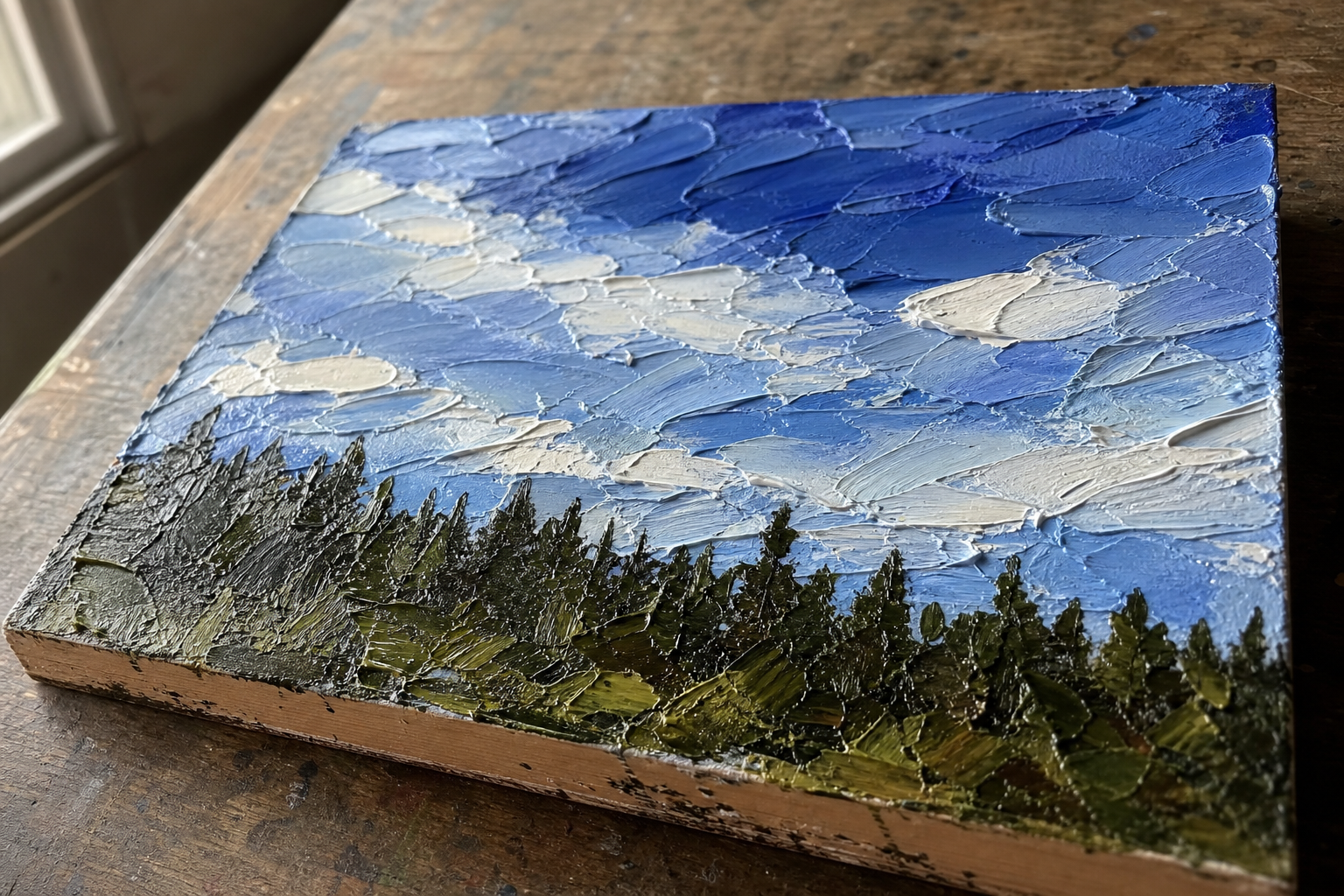
A good palette knife changes what's possible outdoors. Bold sky passages laid in one clean stroke, textured foreground grass built up in seconds, wet paint scraped back to reveal a pale highlight: these are the marks that give plein air work its energy, and brushes simply can't replicate them. Finding the best palette knives for plein air work, though, comes down to a few specific outdoor concerns that most product roundups never get into.
Working outside in Britain adds a layer of practical demands that studio painters don't face. Carbon steel can rust if a knife is packed away wet after a session in the rain. Handles that feel fine in a warm studio become slippery when your hands are cold and oily. The same oversized knife that's a pleasure to use in front of a large canvas becomes awkward on a small pochade panel propped on a hillside in Derbyshire. These things matter, and they're worth getting right before you spend money.
This article covers the best palette knives for plein air painting currently available from UK suppliers, with honest assessments of each and a practical guide to which shapes you actually need for landscape work. If you're still getting to grips with the technique itself, our palette knife plein air guide covers the basics — this article is focused on which knives to actually buy.
What to Look for in a Plein Air Painting Knife
Before getting into specific products, a few features are worth understanding, because they directly affect how a knife performs in outdoor conditions.
- Cranked (offset) neck vs flat: An offset or cranked neck lifts your hand above the painting surface. On a small pochade panel, where your knuckles would otherwise drag through wet paint, this matters enormously. Offset knives are also far easier to use over thick impasto, where a flat-shanked knife catches and smears.
- Stainless vs carbon steel: Carbon steel can stain and, left wet after a session in British weather, will rust. Stainless steel requires no special care after use and is the sensible default for outdoor work.
- Flexibility: Medium-flex blades load well with paint and respond to pressure expressively. Very stiff blades are harder to work with for applying paint; very floppy blades lack control. Medium flex suits most landscape work.
- Handle material: Rubberised or plastic handles grip more reliably in cold, damp, or oily conditions. Traditional wooden handles are well-balanced and comfortable but can feel slippery when wet.
- Size and portability: Short-handled knives pack more easily into pochade boxes and rucksacks. A medium diamond and a small pointed knife will cover most of what a landscape painter needs.
The Best Palette Knives for Plein Air — Our Picks
A mix of individual knives and sets, covering a range of budgets, all available from UK suppliers. Whether you want to build a bespoke kit from scratch or buy a ready-made set and get straight outside, there's a good option here.
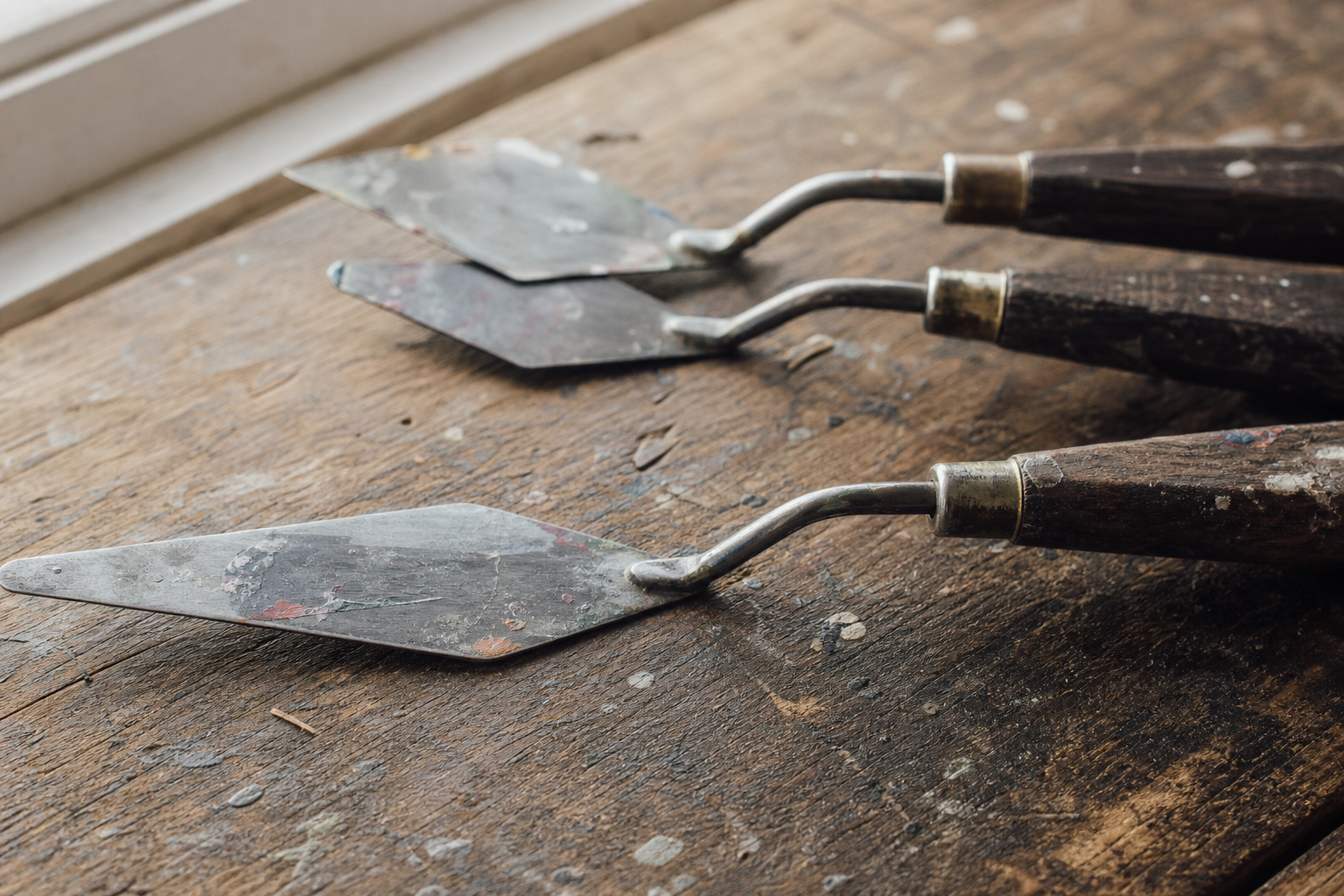
Jackson's Extra Offset Crank Painting Knives — best for building a bespoke plein air kit
These individual stainless-steel knives from Jackson's are, for many outdoor painters, the most logical starting point. Buying singles means you choose exactly the shapes you need rather than working around the contents of someone else's set. The offset crank design keeps knuckles clear of the panel surface and makes loading thick paint straightforward, even on smaller format boards.
Three shapes make a sensible starting trio for landscape work: No.12 (a small pointed blade, good for tree lines, grasses, and fine marks along rooftops and horizon edges), No.14 (a medium diamond, versatile enough for skies, mid-ground passages, and most everyday landscape marks), and No.20 (broader and well-suited to palette mixing and covering larger colour masses). All three come in at approximately £4.90 each, making this an affordable way to build a compact, thoughtfully chosen field kit.
Pros: Stainless steel; proper offset crank; buy only what you need; good flex for landscape work Cons: No case or roll included; you'll need to source your own storage for the field
Jackson's Extra Offset Crank Painting Knives

Jackson's : Extra Offset Crank Painting Knife : No.12

Jackson's : Extra Offset Crank Painting Knife : No.14

Jackson's : Extra Offset Crank Painting Knife : No.20
Best for: Painters who want to build a tailored kit and prefer to own three excellent knives rather than a set of six average ones.
Jackson's XXL Painting Knife — best for bold skies and large colour masses
This is the oversized sibling of the offset crank range, and it's a genuinely satisfying tool when you want to lay in a big sky quickly or work with wide, gestural strokes across a larger panel. At approximately £7.50, it's not expensive, but it's also not a standalone purchase for most plein air painters. A blade this broad has limited usefulness for the finer marks that landscape work demands, and it won't help you paint a treeline or pick out the edge of a building.
The XXL comes into its own as an addition to a small kit of more versatile knives: reach for it at the start of a session to block in sky and ground tones rapidly, then switch to smaller shapes for the detail work.
Pros: Covers large areas quickly; excellent for initial lay-in; stainless steel; offset neck Cons: Too broad for most detailed landscape marks; better as a supplement than a core knife
Jackson's
Jackson's : XXL Painting Knife
Jackson's XXL Painting Knives Are Great For Covering Large Surfaces With Paint, Or For Creating Bolder, Larger Impressions Or Marks. Each Palette Knife Has A High Quality Steel Blade And A Convenient Hanging Hole In The Handle For Safe Storage.

Best for: Painters working on larger formats who want to rough in big shapes fast before switching to detail knives.
Panart Painting Knife Sets — best mid-price set for oils
Available at Jackson's at approximately £19, these Italian-made sets offer a coherent range of shapes in one purchase. Panart has a solid reputation in the trade for consistent blade quality and reliable flex, and a well-made Italian painting knife set for oils is a noticeably different thing from a budget multi-pack. The set includes a useful mix of trowel and pointed shapes covering the key landscape marks, so you're not having to hunt separately for complementary blades.
It's worth checking the exact shapes included at the time you buy, as the composition of mixed sets can vary, but as a mid-price entry into quality knife painting this is a strong option for painters who prefer the simplicity of a ready-made kit.
Pros: Italian-made quality at a mid-range price; coherent shape selection; good for oils and acrylics Cons: Less flexibility to customise than buying singles; shapes may vary between batches
Jackson's
Panart : Painting Knife Sets
Panart Painting Knives Are High Quality Tools That Feature A Single-piece Construction Of The Blade That Gives Sturdiness And Flexibility. They Are Made From High-grade Steel And Help To Produce A Large Variety Of Textures And Strokes On A Range Of Surfaces. Available In Densifie

Best for: Painters who want a quality set without the hassle of selecting individual knives.
RGM x6 Pro-Grip Palette Knife Set — best for regular outdoor painters who want longevity
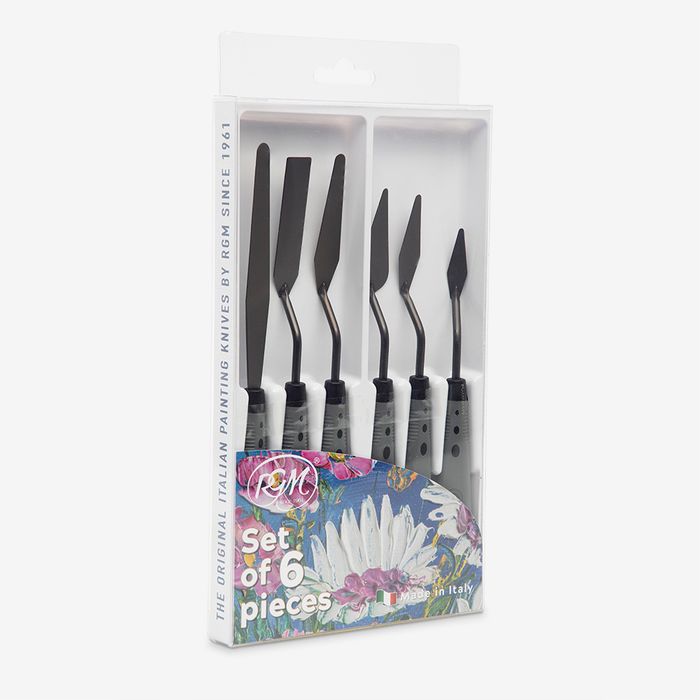
If you paint outside regularly and want a set built to handle it, the RGM Pro-Grip is the one to buy. Six Italian-made stainless-steel blades come with solvent-proof rubberised handles, and those handles are the key differentiator here. When your hands are cold, rain-damp, or oily from a long session, a rubberised grip is noticeably more secure than wood or plain plastic. This is not an abstract feature for UK outdoor painters: it's the kind of thing you notice on a blustery October morning in the Peak District.
The blades themselves are excellent: well-tempered stainless steel with good flex and a range of shapes covering both palette mixing and paint application. At approximately £38, this is the highest-priced set in this roundup, but it's the kind of investment that pays off over years of regular outdoor use rather than months.
Pros: Solvent-proof rubberised handles; excellent wet-weather grip; six stainless blades; Italian quality; built to last Cons: Higher upfront cost; handles suit some painters' preferences better than others
Jackson's
RGM : x6 Pro-Grip Palette knife Plastic Handle
The Set Contains RGM Pro-Grip Artists' Palette Knives Which Have Tempered Steel Blades With A Non-stick Coating And A Moulded Rubber Handle.
Best for: Serious plein air painters who go out regularly and want a set that performs reliably in poor conditions without requiring careful maintenance.
RGM x6 Traditional Palette Knife Set — best for experienced painters who prefer classic wooden handles
A well-regarded Italian-made set at approximately £29, the RGM Traditional offers the same quality blade construction as the Pro-Grip but with classic wooden handles. For painters who prefer the feel and balance of wood in hand, this is a genuine alternative rather than a compromise, and the price point sits comfortably between the budget options and the Pro-Grip set.
The honest trade-off is exactly what it sounds like: wooden handles become slippery when wet, and for a painter who regularly works in rain or cold, that's worth acknowledging before buying. If your outdoor sessions are mostly fair-weather or you find rubberised handles uncomfortable over long periods, the Traditional is a very solid choice. If you're regularly out in changeable British weather, the Pro-Grip handles the conditions better.
Pros: Italian quality blades; good flex and blade range; well-balanced wooden handles; lower price than Pro-Grip Cons: Wooden handles less grippy in wet or cold conditions; requires drying before storage
Jackson's
RGM : x6 Traditional Palette knife Set
RGM Artist Palette Knives Are Crafted In Italy. The Steel Blade Is Tempered And Ground By Hand To Ensure Consistent Flexibility And The Best Possible Quality. RGM Palette Knives Have Rounded Bubinga Wood Handles And Carbon Steel Nickel Plated Blades With Brass Ferrules. They Are

Best for: Experienced painters who prefer the feel of traditional wooden handles and mostly paint in manageable conditions.
RGM Solid Stainless Steel Palette Knife Sets — best for painters prioritising rust resistance above all
These all-stainless sets, where both blade and handle are stainless steel, are the maintenance-free option. There's no wood to swell or warp, no rust risk from packing away damp, and no solvent degradation to worry about. For painters who work in particularly wet or coastal environments, or who simply want to clean up and pack away without thinking about their knives, the all-stainless construction is genuinely appealing.
The trade-off is weight and feel. All-metal handles are heavier than wood or rubber alternatives, and some painters find them tiring over a long session or uncomfortably cold to hold in winter. Priced at approximately £37, the cost is similar to the Pro-Grip set, so the choice between them comes down to handle preference and conditions.
Pros: Completely rust-proof; no maintenance required; ideal for coastal or very wet conditions; durable Cons: Heavier than wooden-handled alternatives; metal handles can feel cold in winter; less comfortable over long sessions for some painters
Jackson's
RGM : Solid Stainless Steel Palette Knife Sets
Carefully Crafted In Italy, These Sets Feature RGM Stainless Steel Palette Knives, Which Are Made Of Fully Non-welded Stainless Steel, Resulting In A Very Sturdy Knife That Can Be Used With Chemical-based Products. The Mirror Polish On The Blades Gives Them A Slick Feel That Guar

Best for: Painters working regularly in wet, coastal, or high-humidity conditions who want knives they can treat without care.
Studio Essentials Economy Set of 5 — best for beginners or as a backup field set
At approximately £12.90, this is the budget entry point, and it's worth being straight about what that means. The build quality won't match RGM or Jackson's: blade edges tend to be slightly thicker, flex can be less consistent across the set, and the handles won't grip as well in cold or wet conditions. These are not knives you'll still be using in five years.
What they are is a low-risk way to find out whether knife painting suits your outdoor practice. If you've never worked with metal painting knives for landscape work and you're not certain you'll take to it, spending £12.90 rather than £38 to experiment makes reasonable sense. They'd also serve adequately as a backup kit to keep in a bag when you don't want to risk your better knives.
Pros: Very affordable; accessible entry point; covers the basic shapes; fine for experimenting Cons: Lower blade quality and consistency; less durable; handles less secure in poor conditions
Jackson's
Studio Essentials : Economy Set of 5 Palette Knives
Palette Knives Look Simple But Are Surprisingly Versatile. Longer Narrower Blades Will Flex Against The Painting Surface, Allowing The Artist To Smear Paint Thinly Over Large Areas. Thinner, More Pointed Blades Are Great For Adding Detail, Or For Sketching In The Outlines Of Dist

Best for: Complete beginners trying knife painting for the first time, or as a low-worry backup set.
Which Shapes Do You Actually Need Outdoors?
This is the question most roundups sidestep, and it's the one that makes the most practical difference. A set of twelve knives sounds comprehensive until you're standing in a field and realise you only ever reach for the same three. For landscape work specifically, the following shapes cover almost everything.
| Shape | Best used for | Essential? |
|---|---|---|
| Medium diamond/trowel | Skies, broad colour masses, mid-ground | Yes |
| Small pointed | Tree lines, grasses, edges, fine marks | Yes |
| Wide/broad blade | Palette mixing, large areas, scraping back | Yes |
| Very small detail knife | Tight accents, fine highlights | Optional |
| XXL / oversized | Gestural marks on larger panels | Optional |
The medium diamond or trowel is the workhorse of landscape knife painting. It loads well, lays smooth passages for skies and distant hills, and is versatile enough to handle most of what a typical session demands. If you only buy one knife, this is it.
A small pointed knife handles the marks that give landscape paintings their specificity: the sharp line of a treeline against sky, a flick of grass texture in the foreground, the edge of a rooftop. Load the back edge of the blade and pull it lightly across the surface for fine textural marks.
A wider or broader blade is genuinely useful less for applying paint and more for mixing on the palette and scraping back. Painting over a colour passage you want to correct, or lightening a sky tone by dragging across the surface, is much easier with a broader blade.
The detail knife and the XXL are both optional extras. Add them once you know which of the core three you reach for most often, and where you find yourself wanting something different.
Start with three
Most plein air landscape painters can get through a full session with just three knives. A medium diamond, a small pointed knife, and a wider blade for mixing covers most landscape marks. Resist the urge to carry more until you know which shapes you actually reach for.
Handling Knives Outdoors — A Few Practical Notes
Good knives are easy to look after outdoors if you build a couple of habits early.
Wipe between colours. This is non-negotiable with knife painting: colours muddy faster with a blade than with a brush because the whole tool contacts the paint. A folded rag or a few sheets of kitchen roll tucked into your kit solves this. Wipe the blade clean before picking up a new colour and your mixes stay clean.
Dry before packing. If you're using carbon steel knives (less common but worth checking), dry them before packing away, especially after a damp session. Stainless knives are more forgiving but benefit from a quick wipe anyway. All-stainless sets are the most forgiving option for painters who tend to pack up quickly.
Grip in cold weather. If your hands are cold and handles feel slippery, a small piece of dry rag in your hand gives extra friction. Lightweight nitrile gloves are another option if you work in genuinely cold conditions, though some painters find they reduce tactile sensitivity.
Packing. Short-handled knives fit tidily into most pochade boxes alongside paints and panels. Longer-handled knives benefit from a roll-up canvas tool wrap, which protects the blades and keeps the kit organised in a rucksack.
For more on how to actually use knives outdoors, loading the blade, varying pressure, and scraping back for highlights, the palette knife plein air guide covers the technique in detail. If you're interested in building thick, layered impasto work outdoors, the impasto plein air guide is worth reading alongside this one.
Our Verdict
For most UK plein air painters, the Jackson's Extra Offset Crank knives bought as a trio (No.12, No.14, and No.20) offer the best combination of quality, specificity, and value at around £14.70 for all three. They're stainless, properly offset, and you're buying exactly the shapes you need rather than a set padded with blades you'll never pick up. The Panart set via Jackson's is a strong alternative for painters who prefer the simplicity of a single purchase at a sensible mid-range price.
For painters who go out regularly regardless of conditions and want a set that handles British weather without any compromise, the RGM x6 Pro-Grip is worth every penny of its £38. The rubberised handles make a genuine difference on a cold, damp morning, and the blade quality means this is a set you're likely to still be using in a decade.
Beginners are best served by the Studio Essentials Economy Set as a starting point: spend the smaller amount, find out whether knife painting suits how you work outdoors, then invest properly once you know what you're looking for.
Now get outside and start scraping some paint around. That's where the real learning happens.
FAQ
Frequently Asked Questions
Which palette knife shapes do I actually need for plein air landscape work?
Start with three: a medium diamond or trowel for skies and broad masses, a small pointed knife for treelines and grasses, and a wider blade for mixing and scraping.
Stainless or carbon steel which is better outdoors?
Stainless is the sensible default for UK plein air work. It resists rust and needs less drying after a damp session. Carbon steel can offer fine edges but must be dried and oiled to avoid staining and rust.
What handle type works best in British weather?
Rubberised or solvent proof handles give the most reliable grip in cold, wet, or oily conditions. Wooden handles feel nicer in hand but can be slippery and need drying before storage.
What set should a beginner buy?
Try an economy set to test the technique, but for an affordable tailored kit buy three Jackson's offset knives (No.12, No.14, No.20). They are stainless, offset, and cover most landscape marks.
How should I care for knives after an outdoor session?
Wipe between colours while painting, dry blades before packing if damp, and store in a roll or pouch. All stainless sets are the most low maintenance for quick pack ups.
Author

PleinAirPainting Editorial Team
PleinAirPainting.co.uk helps artists paint outdoors with confidence through UK-focused guides, equipment advice, resources and plein air inspiration.